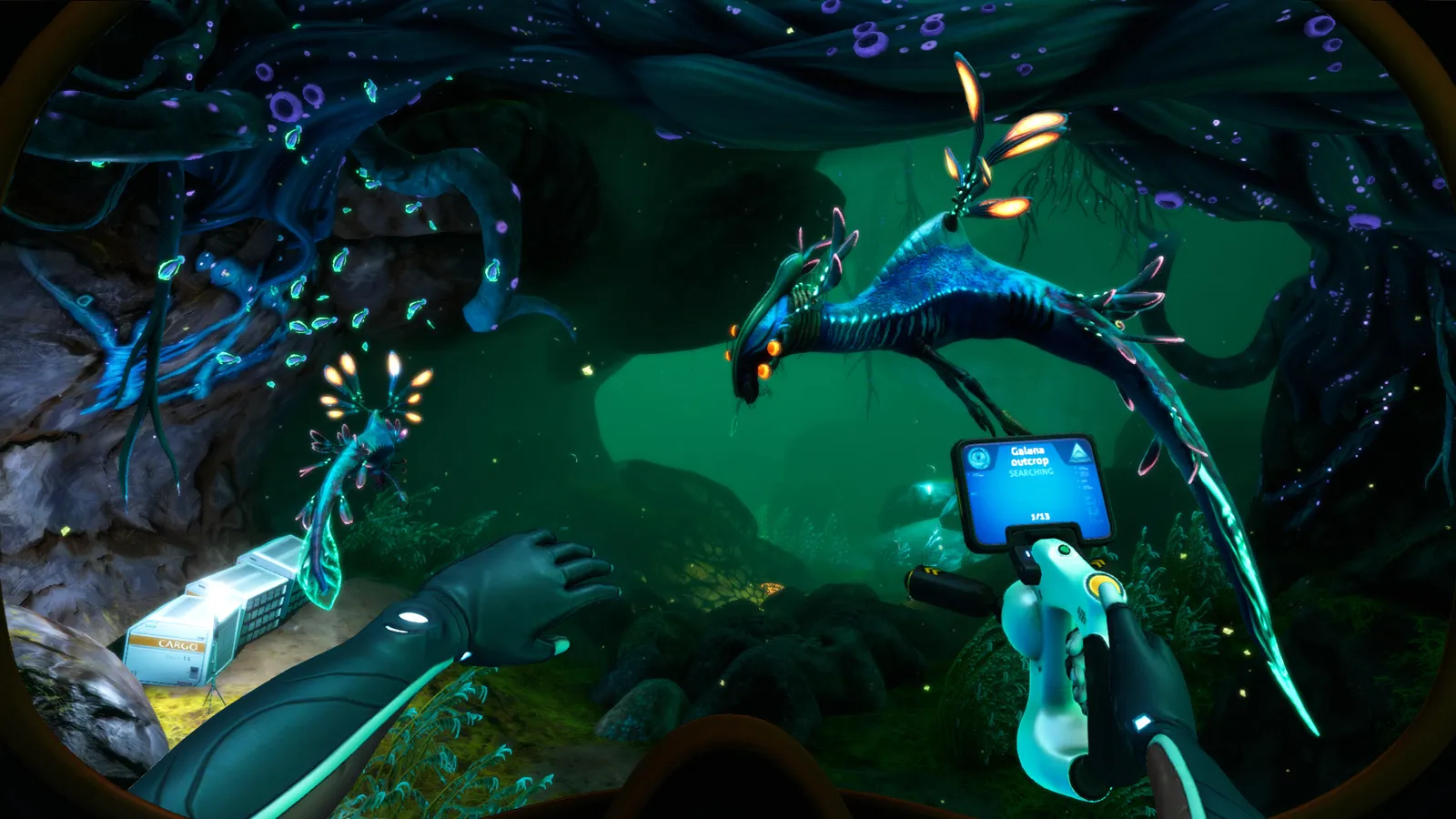
Subnautica Grand Reef biome guide: depth range, every resource and fragment, the Ghost Leviathans and Sea Treaders, and the Deep Grand Reef Degasi base.
Subnautica Grand Reef — Depth, Resources, Dangers and Points of Interest
The Grand Reef is the deep, glowing southern biome that sits under the Floating Island — roughly 90 to 620 meters deep, full of Anchor Pods, Membrain Trees, Rubies and Gel Sacks, and patrolled by two Ghost Leviathans. It's the game's best mid-game resource biome: the one place where you can collect Rubies and Gel Sacks (for Aerogel), diamonds, lithium and magnetite in a single dive, then drop into the Deep Grand Reef below for the Degasi storyline and the game's only scannable Alien Containment. It is also the biome where unprepared Seamoth drivers learn what a Ghost Leviathan sounds like. This guide covers the depth profile, the full resource and fauna lists, every point of interest with coordinates, and the safe way to farm it.
Here's what you'll learn:
- The exact depth range and temperature of the Grand Reef
- Every resource, fragment and creature that lives here
- Coordinates for the two large wrecks and the Degasi base
- How to farm Rubies and Gel Sacks without getting Ghost-bitten
- What's actually in the Deep Grand Reef below
Official resources: Steam store page · Official Subnautica Wiki — Grand Reef · Official Subnautica Wiki — Ghost Leviathan · IGN Subnautica page · MapGenie Subnautica map
Where Is the Grand Reef and How Deep Is It?
The Grand Reef covers a large area in the southern part of the crater, and the easiest way to find it is to use the Floating Island as a landmark — the biome sits directly below and around it. Per the official wiki, the surface depth range is 90–620 meters, with temperatures from 13.5°C at the bottom to 27°C at the surface.
| Stat | Value |
|---|---|
| Depth range | 90–620 m |
| Temperature | 13.5°C – 27°C |
| Harvesting nodes | Limestone, Sandstone and Shale outcrops |
| Notable features | 2 large wrecks, thermal vent clusters, Grand Reef Caves, Deep Grand Reef |
That 620 m floor matters: the base Seamoth crushes at 200 m and the MK1 module only takes it to 300 m. The Deep Grand Reef (below the main biome) sits at 390–640 m, so you need the Seamoth Depth Module MK1 or MK2, or a Cyclops, before a serious visit. Building those upgrades is covered in our Modification Station guide (the Modification Station you need comes from wrecks) and our Cyclops guide for the deep-vehicle route.
Per the official Subnautica Wiki: "Rubies and Gel Sacks are commonly found in the Grand Reef, along with many other rare materials and fragments. Due to the abundance of hazardous fauna, depth, and general difficulty of navigation, exploring this biome early on without adequate gear is not recommended."
Resources, Fauna and Flora
Resources
| Resource | Notes |
|---|---|
| Ruby | Abundant on the seafloor and around thermal vents — the main reason people come here |
| Gel Sack | Covers the cave and canyon walls; feeds the Aerogel recipe |
| Diamond | Shale outcrops |
| Lithium | Seabed and shale |
| Silver Ore | Sandstone outcrops |
| Gold / Copper / Lead / Quartz / Titanium | Standard outcrop mix |
| Uraninite Crystal | Deeper areas, near the thermal vents |
The Ruby + Gel Sack combination is why the Grand Reef is the best Aerogel farming ground in the game — one dive collects both ingredients for the recipe covered in our Aerogel guide.
Fauna
- Ghost Leviathan ×2 — the biome's apex threat, patrolling the open water.
- Sea Treader Leviathans — passive bottom-walkers whose steps kick up shale outcrops (diamonds and lithium). They only appear in the main biome, not the deep section.
- Crabsquid (deeper areas) and Jellyrays (deeper areas) — the Deep Grand Reef's signature residents; Crabsquids EMP your vehicles.
- Reefback Leviathans — pod above the biome; passive.
- Warper — can teleport you out of vehicles; keep moving.
- Bonesharks and Mesmers — along the Crag Field border.
- Bladderfish, Eyeye, Hoopfish, Peeper, Spadefish, Shoal of Fish — the edible filler.
Flora and Fragments
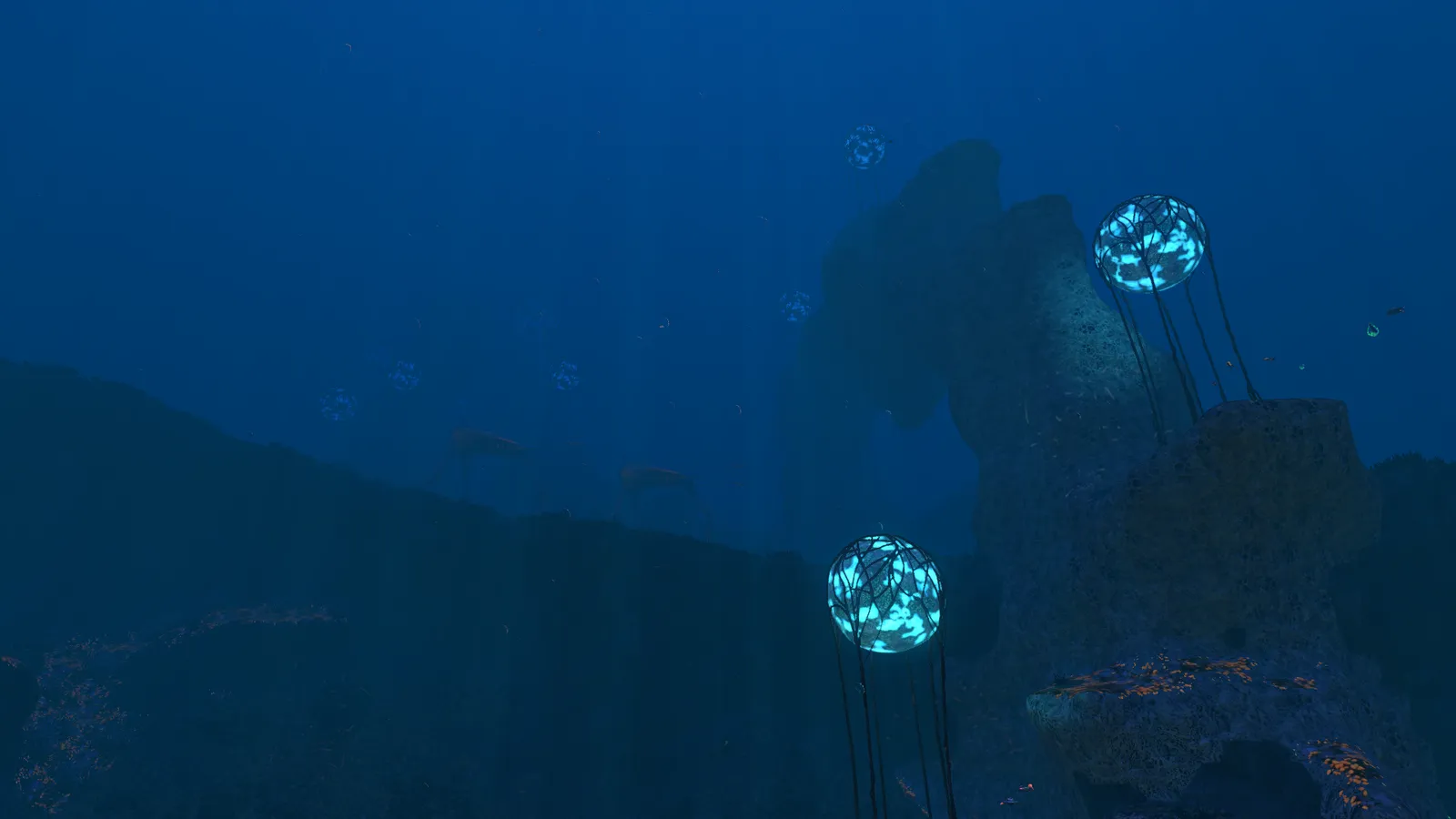
Flora: Anchor Pods (the glowing blue balloons), Membrain Trees, Gel Sacks, Purple Pinecones. Fragments: Moonpool Fragment and Thermal Plant Fragment — two blueprints you actually want, both scattered through the wrecks.
Two adult Ghost Leviathans patrol the Grand Reef's open water. They attack on approach, deal 84 damage to a player (250 to the Cyclops), and their spiral-up charge has almost no tell. Standard practice: do your collecting on the canyon walls and near the seafloor, keep the sonar or a lookout, and surface to your vehicle the second the water starts glowing blue. Full behavioral details and the kill strategy are in our leviathans guide.
Points of Interest (With Coordinates)
| Location | Coordinates | What's there |
|---|---|---|
| Large Wreck A | -284 -250 -850 | Cyclops fragments, databoxes; shallow-ish area |
| Large Wreck B | -865 -430 -1420 | Deeper wreck; more fragments and databoxes |
| Thermal Vent Cluster | -375 -203 -729 / -979 -393 -1372 / -447 -350 -1264 | Ruby farming hotspots |
| Grand Reef Caves entrance | -756 -430 -1444 | Cave network with resources |
| Deep Grand Reef entrances | -840 -450 -1335 and six more around -640..-510, -390..-440 | The route down to the Degasi base |
The Deep Grand Reef and the Degasi Seabase
Below the main biome, a system of caverns (300–500 m) holds the Deep Grand Reef Degasi Seabase — the third Degasi storyline base, where you find:
- The Alien Containment blueprint (scan the built tank — the full breeding mechanics are in our Alien Containment guide).
- A Cuddlefish Egg.
- A Power Cell Charger fragment location and multiple databoxes.
- The surrounding caverns are Crabsquid territory — bring the Perimeter Defense System or a Stasis Rifle.
Park your Seamoth (MK1 depth module) around 300–350 m near the western vent cluster, swim the walls with a High Capacity Tank, and collect in this order: Gel Sacks from the canyon walls → Rubies from the vents → Shale outcrops for diamonds/lithium → return. Total dive time with a Seamoth: 10–15 minutes for a full inventory. Skip the Deep Grand Reef until you have the MK2 module or a Cyclops.
Is the Grand Reef Worth It?
Yes — it's the single best mid-game resource biome and it gates the mid-game progression chain. Rubies and Gel Sacks unlock Aerogel, which unlocks the Prawn Suit, the Thermal Plant and the Cyclops fire suppression. The Moonpool and Thermal Plant fragments make it a two-bird stop for base builders. The cost is the two Ghosts and the depth requirement, which is manageable with one upgrade visit. After the Lost River opens up, the Grand Reef stays useful for rubies but stops being your main stop — the deep materials (nickel, kyanite) all live elsewhere, per our Lost River guide.
FAQ
How deep is the Grand Reef in Subnautica?
90–620 meters, with the Deep Grand Reef caverns below at 300–500 m. You need a Seamoth depth module MK1 (300 m) or MK2 before exploring seriously.
What resources are in the Grand Reef?
Ruby, Gel Sack, Diamond, Lithium, Silver Ore, Gold, Copper, Lead, Quartz, Titanium and Uraninite Crystal, plus Moonpool and Thermal Plant fragments in the wrecks.
Where are the Grand Reef wrecks?
Two large wrecks at -284 -250 -850 and -865 -430 -1420. The Deep Grand Reef Degasi Seabase entrance is around -840 -450 -1335 and nearby openings.
Is the Grand Reef dangerous?
Yes — two adult Ghost Leviathans patrol the open water, Crabsquids and Jellyrays live in the deep section, and Warpers teleport you out of vehicles. It's a mid-game biome, not a beginner one.
How do I get to the Deep Grand Reef Degasi base?
Find one of the Deep Grand Reef entrances (coordinates around -840 -450 -1335 and similar openings), descend through the caverns to roughly 450 m, and the base is inside. Bring a Crabsquid counter (Perimeter Defense or Stasis Rifle).
Related Guides
- Subnautica Aerogel Guide — How to Get It and All Recipes
- Subnautica Leviathans Guide — All Types and Locations
- Subnautica Alien Containment Guide — Breeding and Hatching
- Subnautica Lost River — Map, Entrances & Resources
- Subnautica Cyclops Guide — Fragments, Upgrades and Pilot Tips
Last updated: August 13, 2026.
More Subnautica Guides
Subnautica Alien Containment guide: where to get the blueprint, the 5 Glass + 2 Titanium recipe, how breeding and egg hatching work, and the best fish to breed.
Every leviathan in Subnautica and Below Zero: sizes, aggression, spawn biomes, health and how to deal with each — plus the extinct giants.
How to enter the Aurora in Subnautica: every door code (1454, 1869, 6483, 2679), the radiation suit requirement, what tools you need and all the loot inside.
All Subnautica Aurora door codes: 1454, 1869, 2679 and 6483, where each code is found, and exactly what's worth looting behind every door.
Subnautica Below Zero map explained: how big Sector Zero is, every biome with depth ranges, key coordinates, navigation tips and the best map mods.
Is Subnautica Below Zero multiplayer? No official co-op — but a full story-synced mod exists for Windows. Plus Nitrox and Subnautica 2's official co-op.
Subnautica Below Zero Picture Frame guide: the 16:9 aspect ratio you need for photos, where to get the blueprint, and how to load custom images.
Official Subnautica Below Zero pictures and 16:9 wallpapers: where to download store screenshots, wiki art and community shots in full HD.