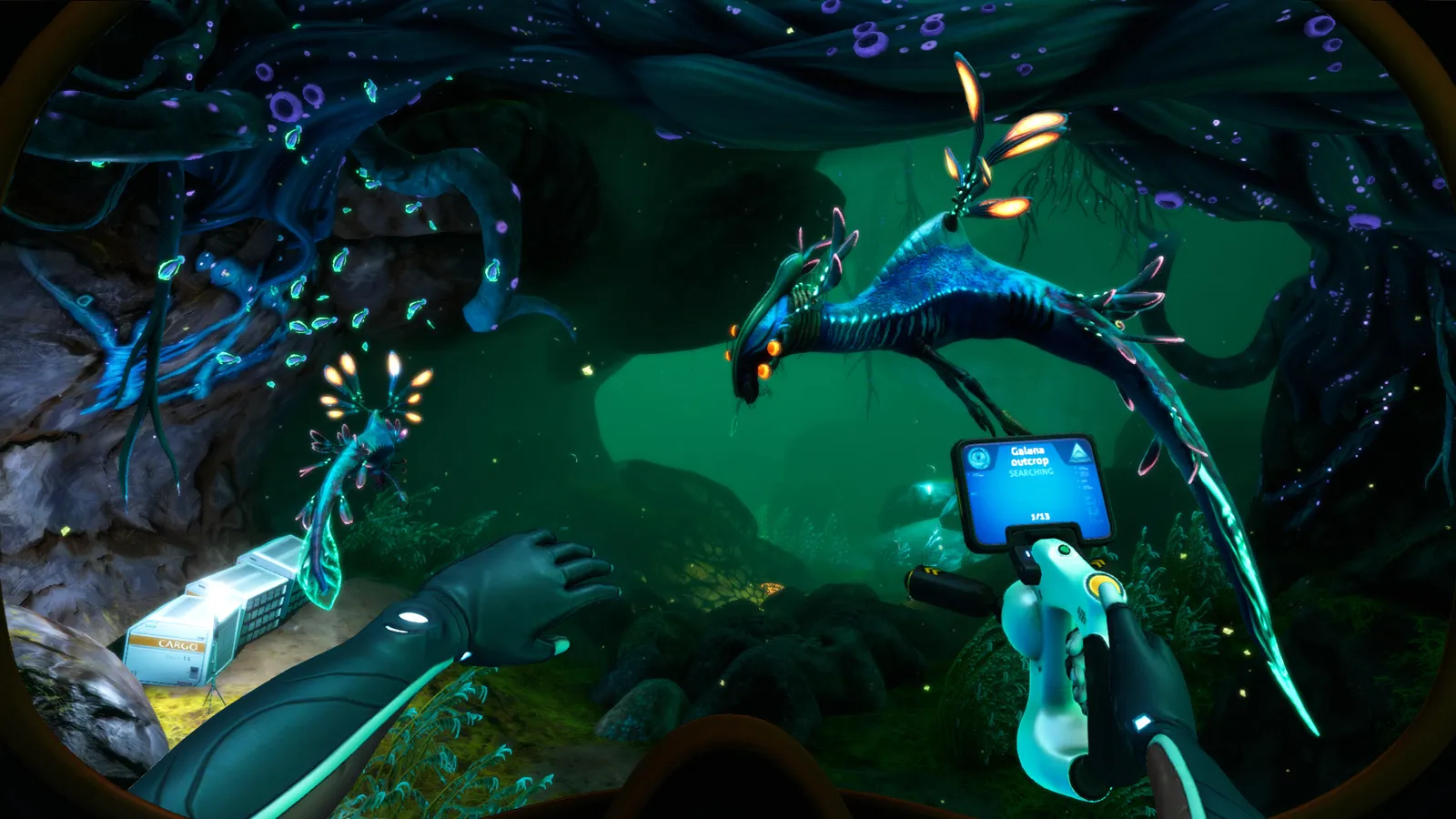
Subnautica Alien Containment guide: where to get the blueprint, the 5 Glass + 2 Titanium recipe, how breeding and egg hatching work, and the best fish to breed.
Alien Containment Subnautica — Breeding, Hatching Eggs and Best Fauna
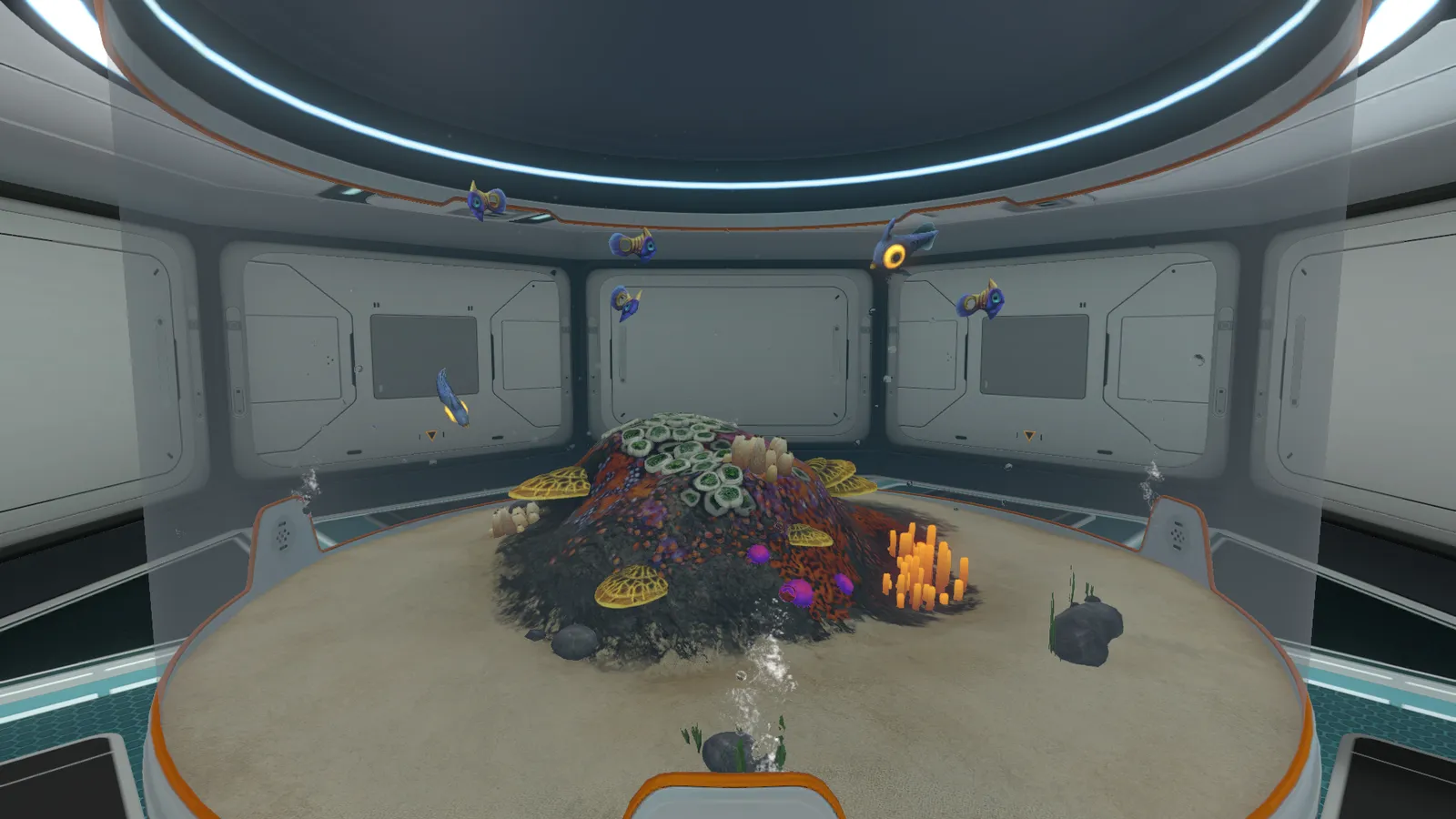
The Alien Containment is a large cylindrical aquarium you build with the Habitat Builder inside a Multipurpose Room, and it turns Subnautica's food and power problems into a solved problem: drop in two fish of the same species and they breed endlessly; drop in eggs and they hatch into pets and companions. The blueprint comes from a data box (Bulb Zone, Mountains or Underwater Islands wrecks) or by scanning the one at the Deep Grand Reef Degasi Seabase, and the build costs 5 Glass + 2 Titanium. This guide covers the full mechanics — breeding limits, hatch times, stacking tanks, the best species to breed for food, oxygen and bioreactor fuel — and the Cuddlefish, the one creature every player wants from it.
Here's what you'll learn:
- Where to get the blueprint and the exact build recipe
- How breeding works, including the 10/18 population caps
- How egg hatching works and how long it takes
- The best species to breed (food, water, oxygen, fuel)
- Every Cuddlefish egg location and how the pet behaves
- Whether the Cuddlefish plushie exists in real life
Official resources: Steam store page · Official Subnautica Wiki — Alien Containment · Official Subnautica Wiki — Cuddlefish · IGN Subnautica page
Getting the Blueprint and Building It
The Alien Containment blueprint is obtained one of two ways:
- Data box in the Bulb Zone wreck, the Mountains wreck, or the Underwater Islands wreck — pick whichever fits your current progression.
- Scanning the fully-built unit at the Deep Grand Reef Degasi Seabase (a storyline location under the Grand Reef — the full tour of that area is in our Grand Reef guide).
Once unlocked, build it with the Habitat Builder on the center of a Multipurpose Room floor (or in one of the three slots inside a Large Room, a 2.0-update addition):
| Component | Amount |
|---|---|
| Glass | 5 |
| Titanium | 2 |
Per the official Subnautica Wiki: "One circular Alien Containment can be placed in each Multipurpose Room. There are three oblong slots for an Alien Containment inside a Large Room."
Key building rules:
- You must add a Hatch to the side to enter; up to 4 hatches on a Multipurpose-Room tank, up to 6 in a Large Room.
- Stacking Multipurpose Rooms merges their tanks into one taller aquarium — and merges the breeding limits too. Three stacked tanks = one giant tower aquarium.
- In Large Rooms you can offset the tanks by one node to build terraces, zigzags and arches.
- The tank's floor is a 16-slot planter: you can grow aquatic flora (including Gel Sacks — see our Aerogel guide) right inside it.
How Breeding Works
Breeding is the containment's headline feature, and the rules are precise:
- Leave two creatures of the same species inside and, given enough time and space, they breed — edible fish reproduce roughly twice a day once mature.
- There's no limit on how many creatures you release into a tank, but breeding stops once the tank hits its population cap: 10 creatures per Multipurpose Room tank, 18 per Large Room tank. Each creature takes up as much "space" as its inventory width — a Peeper counts as 1, a Stalker as 3.
- Breeding continues as long as at least one slot is free, regardless of creature size.
- Eggs hatch in 3–5 in-game days (sometimes less), producing a hatchling at ~40% of adult size; you get a notification naming the species even if you're far away.
- Aggressive fauna hatched in the tank are passive toward you — a tank-raised Crabsquid won't attack you (it will still EMP, and Ampeels still shock).
- The Cuddlefish does not breed in the Alien Containment. There are only five eggs in the game, full stop.
- Infected fish spread the Kharaa bacteria visually inside the tank (cosmetic only), and releasing a Peeper carrying Enzyme 42 cures everything in the tank.
Breed Oculus (the eyeless fish found in the Blood Kelp and Lost River) and feed them to the Bioreactor: each Oculus provides 630 energy per slot — the most efficient fuel in the game. A full Bioreactor of Oculus holds roughly 10,000 energy, a bit over half of a Reactor Rod's 20,000. Breeding them costs nothing but time, which makes the containment + bioreactor combo the cheapest sustainable power for a mid-game base.
Best Fauna to Breed
| Species | Why breed it |
|---|---|
| Oculus | 630 energy/slot in the Bioreactor — the best fuel in the game |
| Reginald | 44 food when cooked — the highest of any edible fish, and the 2nd-best fuel (490/slot) |
| Bladderfish | The Swiss-army fish: cooked = 16 food; eaten raw restores 15 oxygen; converts to Filtered Water; 210 energy/slot |
| Peeper | The classic early food (21 food cooked); breeds fast; also unlocks the story cure when carrying Enzyme 42 |
| Stalker | Keep a pair to farm Stalker Teeth — they keep dropping them in the tank (needed for Enameled Glass) |
| Cuddlefish | Not breedable — hatch one of the 5 eggs for the game's best pet |
If you only keep one breeding pair, make it Reginald: it's the best food and the second-best fuel, so one tank covers both needs.
Hatching Eggs — and the Cuddlefish
Any egg you find in the world (except Cuddlefish eggs, see below) can be dropped into the tank to hatch. Eggs are worth collecting from almost every biome — the Bulb Zone, Grassy Plateaus and Lost River are the best hunting grounds, and hatching aggressive species gives you passive versions you can release.
The Cuddlefish
The Cuddlefish is a passive pet that can only be obtained by hatching one of five hidden Cuddlefish Eggs:
| Location |
|---|
| Dunes Sinkhole |
| Northeastern Mushroom Forest Caves |
| Northwestern Mushroom Forest Caves |
| Lost River Laboratory Cache |
| Deep Grand Reef Degasi Seabase |
Hatching takes about 20 real-life minutes (1 in-game day). The Cuddlefish follows you, warps to you if you stray too far, plays high-fives and magic tricks when you interact, and can be told to stay with the right mouse button. It has 10,000 health and cannot be hurt by you, but it can be killed by aggressive wildlife, which is the reason players panic-search "cuddlefish died" more than any other Subnautica topic. It does not breed — the five eggs are the only ones that exist.
A released Cuddlefish is a target. If you want it to live, keep it in the base tank or release it in the Safe Shallows near your base. A Reaper will absolutely grab it, and the game does not offer a replacement — see our leviathans guide for where the danger zones actually are.
Is there a Cuddlefish plush in real life?
Yes — and it's official. Unknown Worlds partnered with Youtooz for a Subnautica plush line featuring the Peeper, Bladderfish and Reaper Leviathan (and the Cuddlefish through the collector community on Etsy and similar marketplaces). The official pre-order announcement is on the Unknown Worlds news page. If "subnautica plush" is what you're after, that's the legit route: official-store plushies, not third-party rip-offs.
Common Questions, Answered Fast
- Does the Alien Containment need power? No — it runs free. The hatch, tank and planter all work with zero power draw.
- Can I build more than one? Yes, one per Multipurpose Room, and stacking rooms merges them into a taller tank.
- Do bred fish despawn if I leave the area? No — the tank's population persists and keeps breeding while you're away.
- Can I release hatched aggressive fish? Yes, and they'll behave aggressively toward other wildlife (and small vehicles) in the wild, but they stay passive toward you.
- Does Below Zero have it? Yes — Below Zero has its own Alien Containment with the same role, buildable in the Multipurpose and Large Rooms; the Sector Zero base-building map is in our Below Zero map guide.
FAQ
How do I get the Alien Containment blueprint in Subnautica?
Find a data box in the Bulb Zone, Mountains or Underwater Islands wrecks, or scan the built unit at the Deep Grand Reef Degasi Seabase. It costs 5 Glass + 2 Titanium with the Habitat Builder.
How do I breed fish in the Alien Containment?
Put two of the same species inside a tank with at least one free slot. They breed automatically over time (edible fish roughly twice a day) until the tank hits its cap — 10 for a Multipurpose Room tank, 18 for a Large Room tank.
How long does it take for eggs to hatch?
3–5 in-game days (an in-game day is 20 real minutes). Cuddlefish eggs take about 20 real minutes. You get a notification when an egg hatches, even far away.
Where are all the Cuddlefish eggs?
Dunes Sinkhole, Northeastern Mushroom Forest Caves, Northwestern Mushroom Forest Caves, Lost River Laboratory Cache, and Deep Grand Reef Degasi Seabase.
What is the best fish to breed for food and bioreactor fuel?
Reginald (44 food cooked, 490 energy/slot) covers both. For pure fuel, Oculus (630 energy/slot). For water and oxygen, Bladderfish.
Related Guides
- Subnautica Grand Reef Guide — Depth, Resources and Dangers
- Subnautica Leviathans Guide — All Types and Locations
- Subnautica Aerogel Guide — How to Get It and All Recipes
- Subnautica Biome Map — Every Biome and Depth Range
- Subnautica Below Zero Map — Biomes, Coordinates & Navigation
Last updated: August 13, 2026.
More Subnautica Guides
Every leviathan in Subnautica and Below Zero: sizes, aggression, spawn biomes, health and how to deal with each — plus the extinct giants.
How to enter the Aurora in Subnautica: every door code (1454, 1869, 6483, 2679), the radiation suit requirement, what tools you need and all the loot inside.
All Subnautica Aurora door codes: 1454, 1869, 2679 and 6483, where each code is found, and exactly what's worth looting behind every door.
Subnautica Below Zero map explained: how big Sector Zero is, every biome with depth ranges, key coordinates, navigation tips and the best map mods.
Is Subnautica Below Zero multiplayer? No official co-op — but a full story-synced mod exists for Windows. Plus Nitrox and Subnautica 2's official co-op.
Subnautica Below Zero Picture Frame guide: the 16:9 aspect ratio you need for photos, where to get the blueprint, and how to load custom images.
Official Subnautica Below Zero pictures and 16:9 wallpapers: where to download store screenshots, wiki art and community shots in full HD.
The Subnautica map explained: all 18 aquatic biomes with depth ranges, resources and dangers, plus how to navigate without an in-game map.