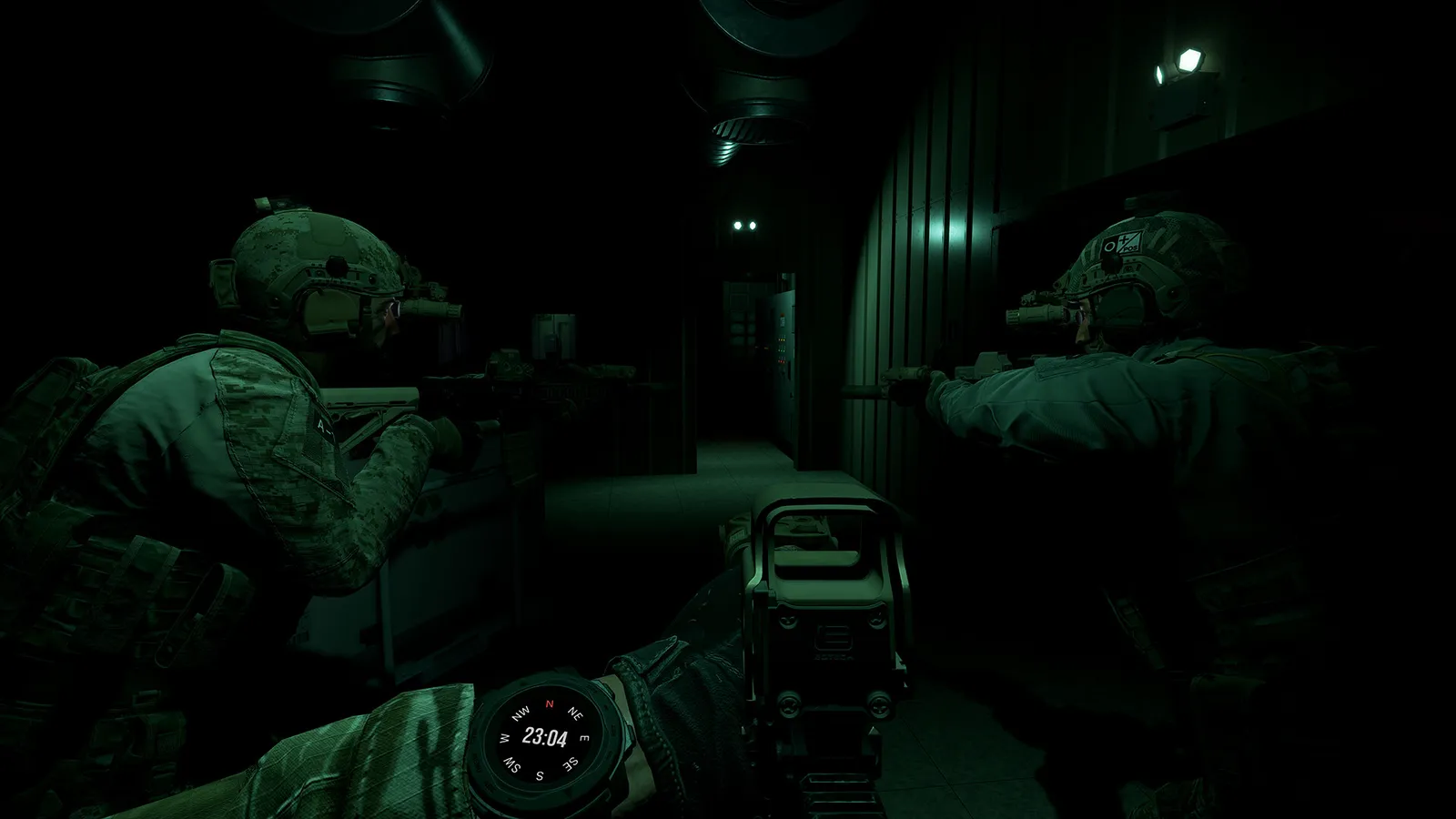
Ground Branch realism mechanics: no minimap, no HUD ammo, muzzle-origin ballistics, zeroing, limb damage, first aid, weapon positions and arm strength.
GROUND BRANCH Realism Mechanics — No Minimap, Real Ballistics & Arm Strength
GROUND BRANCH is the closest thing on Steam to the classic Rainbow Six and Ghost Recon school of realism, and its design philosophy has a name: NORG — the "Natural Order of Realistic Gameplay", described in the Tactical Operations Center wiki. Practically, that means: no minimap, no regenerating health, no floating ammo counter, bullets that leave the muzzle instead of your face, and a stamina/arm-strength system that punishes sprint-and-spray. This guide explains each system, why it exists, and how to play with it instead of against it.
Here's what you'll learn:
- The NORG philosophy and what "realistic" actually means here
- No minimap, no HUD ammo: how navigation and ammo tracking really work
- Real ballistics — muzzle-origin shots, mechanical offset and zeroing
- Health, bleeding, first aid and V1.0's limb damage changes
- Weapon positions (low ready, high ready) and the arm-strength system
- Night vision, suppressors and other realism that changes tactics
Official resources: Steam store page · Official FAQ · V1.0 release notes · PCGamingWiki
What "Realistic" Means in GROUND BRANCH
The official FAQ describes GROUND BRANCH as "a thinking man's first-person tactical shooter" built on the SAC/SOG (CIA Special Activities Center / Special Operations Group) setting. It's not a mil-sim like ARMA — maps are capped around 800×800 m and scope is squad-sized — but everything that touches your senses is modeled with intent:
- No third-person camera, ever. What you see is what your operator sees, including weapon positions that block your view.
- No hit markers, no kill feed, no x-ray. Confirmation of a kill is visual or verbal.
- No regenerating health and no medkits — a wound is a wound.
- Limited health and ammunition is a stated design pillar (the TOC wiki calls out that the game "omits non-diegetic heads-up-displays and encourages cautious play through limited health and ammunition").
The point isn't to be annoying — it's to make decisions matter. Peeking a doorway twice is a real gamble because information is the resource, not bullets.
No Minimap, No Ammo Counter: Navigation Without a HUD
There is no minimap in GROUND BRANCH, and the HUD shows no ammunition counter — you track both with your brain, the way the game intends:
- Navigation: learn the maps as places, not layouts. The map tablet (
Mkey) is a physical item your operator unfolds — it shows the mission area, objective markers and (for Intel Retrieval-style missions) the exfil point, but it doesn't show enemies or your live position on a grid you can game. Landmarks, road layouts and building names (Small Town, Hospital, Power Station) become your navigation. V1.0's rebuilt maps (Airbase, Hospital, Border, Outpost) all follow cleaner, more readable footprints for exactly this reason (release notes). - Ammo: count your shots, or check your mags visually. The reload system is manual — you can tactical reload (retain the partial mag) or emergency reload (dump it for speed), and the game tracks how much is actually left in each mag. Dropped mags are physical objects. When you pick up an operator's weapon, you inherit their magazine state — every round is accounted for.
The Ready Room range (part of The Farm) is where you internalize "30 rounds = one mag". Fire controlled bursts, note where the slide locks back, and you'll never again wonder whether you're about to click on empty mid-firefight.
Real Ballistics: Muzzle-Origin Shots & Zeroing
The single most misunderstood system in the game. From the official FAQ:
"Unlike many shooters, bullets in GROUND BRANCH originate from the muzzle of the weapon rather than the center of the screen... Players have to account for their weapon's mechanical offset — the distance between the barrel axis and the line of sight — as well as the zero distance — the range at which the sights are calibrated to coincide with the bullet's trajectory. Typically, rifle shots will hit low at very close ranges (below 20–25 m) due to mechanical offset and also at ranges beyond the zero due to bullet drop."
Consequences in practice:
- Close-range shots land low. Inside ~20-25 m, aim at the sternum, not the head — the barrel sits below your sight line.
- Bullet drop is real past your zero. Long shots (200+ m) need hold-over or range estimation; the DMR/sniper rifles shine here because their zeros are set for distance.
- Zeroing is per weapon/sight combination. Every combo has its own default zero, and the devs have said custom zeros are planned. Until then, learn your primary's zero and build the habit (see our weapon customization guide for optic picks that make zeroing easier).
Health, Bleeding & First Aid
There are no medkits and no health regen. V1.0's system, per the release notes and the official FAQ:
- Limb damage: shots to arms and legs hurt and impair (they can't be "popped" back to full), and Hotfix 1 made shots to non-vital parts less instantly lethal — closer to the extremity, less damage (Hotfix 1 notes). Center-mass and head remain the kill shots.
- Bleeding: wounds can cause bleeding; a teammate can administer first aid to stop the bleed-out and keep you combat-effective. The official FAQ describes first aid as prevention-focused: "players will be able to administer first aid to teammates (to prevent them from bleeding out) and possibly even retain some of their combat effectiveness after less serious injuries."
- Hit reactions: V1.0 added flinch — getting shot throws off your aim, so first contact wins fights.
- Armor changes the math: V1.0's plate/soft armor system means a torso hit may or may not put you down depending on your vest — see our loadout guide for the armor deep-dive. The missions guide notes that PvE AI target the pelvis by default, so face armor is less useful than leg discipline in Terrorist Hunt.
Weapon Positions & Arm Strength
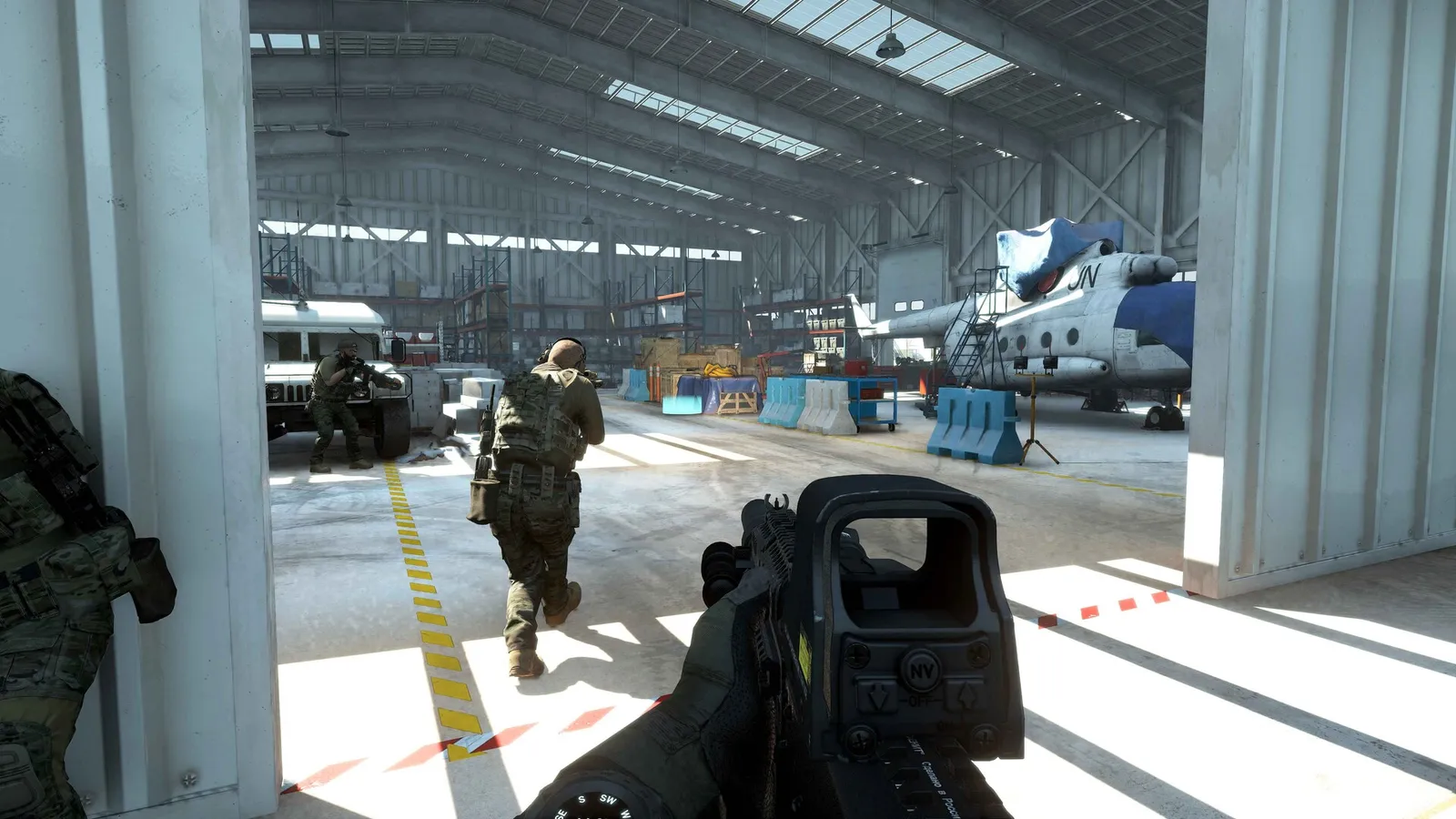
GROUND BRANCH has four weapon states (official FAQ): Low Ready (muzzle down), High Ready (muzzle up), Ready (pointed forward), and ADS. Scroll the mouse wheel to transition, and 1/2 to switch between primary and sidearm.
The catch: keeping the weapon up drains arm strength, which controls weapon sway. Pointing forward or aiming drains it; low/high ready regens it. Community-tested numbers (Steam guide): full drain at unmodified weight takes ~3 minutes at ready/walk, ~2 minutes ADS, ~40 seconds running, ~30 seconds sprinting — and weapon weight factors cut those times (an LMG drains 2.1-2.3× faster). Regain is ~30 s standing still, 60 s walking, 90 s running.
Sprint drains both stamina and arm strength fast. Arrive at the doorway with a wobbling rifle and the room wins. Walk the last 20 m at low ready — you'll arrive able to snap onto a target.
The practical loop every good squad runs: low ready in transit → ready at the threshold → ADS through the doorway → low ready again before the next move. Combined with the fact that this is a first-person-only game (no shoulder cam to peek around walls), positioning and timing replace reaction twitch. Our tactics guide builds the full movement doctrine on top of these mechanics.
Night Vision & Suppressors
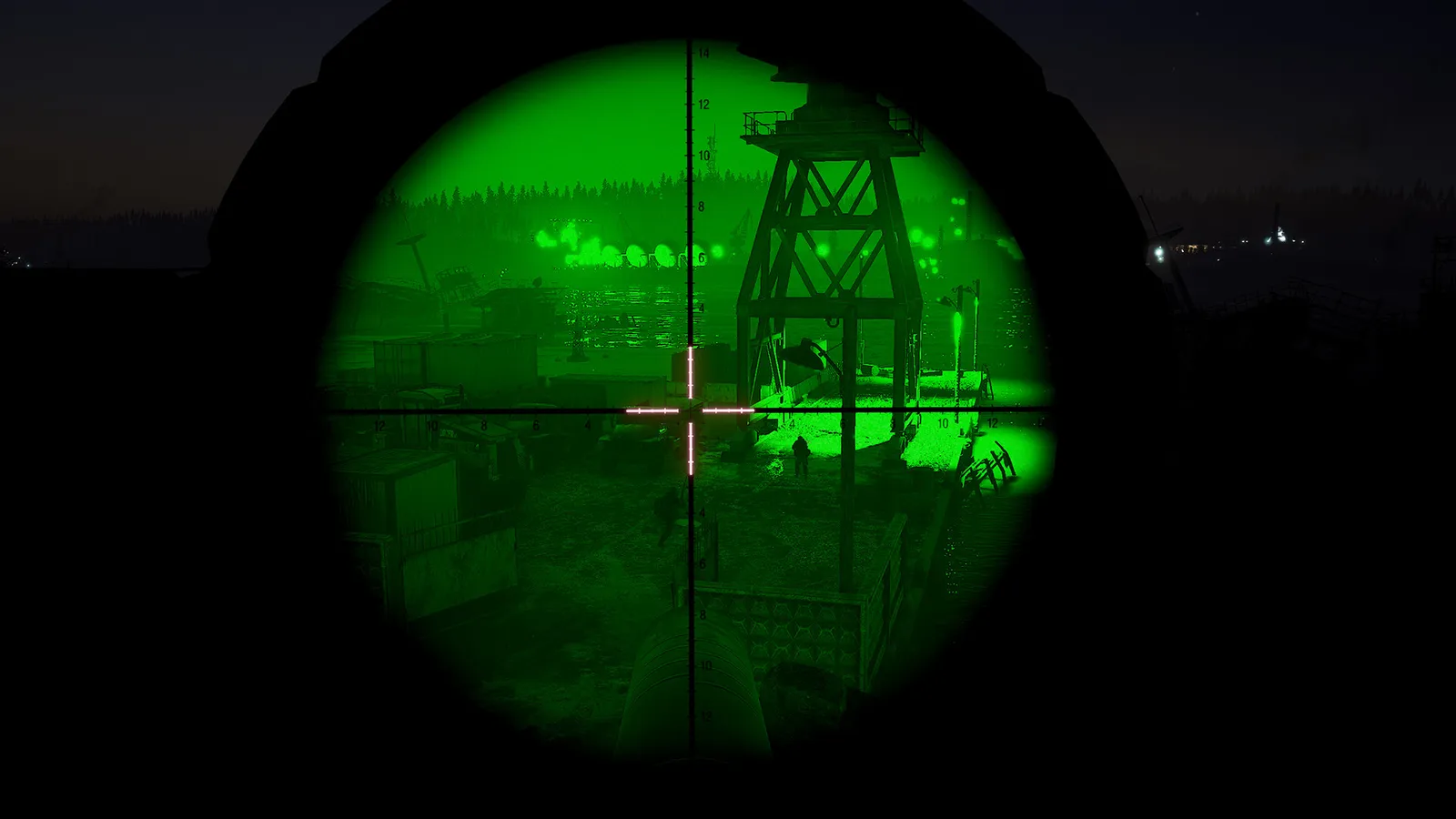
Realism extends to the dark. NVG (toggle N) has a fixed focal range — everything beyond a few meters blurs, and the official FAQ explains the workarounds: use the PEQ-15 IR laser (infrared beams are only visible through NODs), prefer red-dot/holo sights (their reticles stay sharp), and mount the AN/PVS-22 UNS in front of a scope for magnified night work. Moon phases are selectable in V1.0, and moonlight now casts shadows — concealment is genuinely physical.
Suppressors are similarly mechanical: no damage trade-off (see our weapon customization guide), but they change how the world reacts. Unsuppressed fire in co-op draws AI across the map; a suppressed squad can clear a compound before contact cascades. In PvP, a suppressed shot is nearly impossible to locate by ear.
Frequently Asked Questions
Is Ground Branch realistic? Yes — deliberately. No minimap, no regenerating health, no HUD ammo, muzzle-origin ballistics with real zeroing and bullet drop, weapon sway tied to arm strength, and limb-specific damage. It sits between arcade shooters and full mil-sims: squad-scale maps, infantry tactics, and punishment for recklessness.
Does Ground Branch have a minimap? No. You navigate with a map tablet (M), landmarks and learned layouts. There's no enemy radar or live minimap of any kind.
How do you heal in Ground Branch? You don't regenerate, and there are no medkits. A teammate can administer first aid to stop bleeding out; wounds otherwise persist for the life of the operator.
Why do my shots land low in Ground Branch? Bullets exit the muzzle, which sits below your sight line. Inside ~20-25 m the mechanical offset makes shots land low; beyond your zero, bullet drop does the same. Aim at the chest up close and hold over at range.
What are low ready and high ready in Ground Branch? Weapon positions that keep the muzzle off-target to conserve arm strength (reducing sway) and communicate non-hostile intent. Scroll the mouse wheel to cycle; low/high ready regen arm strength while ADS and ready drain it.
Related Guides
- Ground Branch Loadout Guide — Armor, Weight & Best Loadouts
- Ground Branch Weapon Customization — Zeroing & Attachments
- Ground Branch How to Play — Controls, Ready Room & First Missions
- Ground Branch Tactics Guide — Squad Movement & Positioning
- Ground Branch Best Settings — Performance & Sensitivity
- Ground Branch Beginners Guide — How to Play & First Hour
Last updated: August 14, 2026.
More GROUND BRANCH Guides
Ground Branch loadout guide: the loadout system, armor plates vs soft armor, encumbrance and weight, plus the best loadouts for every mission type in V1.0.
Ground Branch missions and modes: the Operations campaign Prologue, PvE quick missions, PvP modes, training areas, every map, and server mission setup.
Ground Branch has official mod support: Steam Workshop, the UE4 Mod Kit SDK, and hundreds of mods — weapons, missions, game modes. Install steps + top mods.
Ground Branch multiplayer guide: co-op and PvP modes, 16-player servers, the Ready Room, VOIP, server browser, hosting and dedicated servers with ports.
How GROUND BRANCH multiplayer works: 16-player servers, 8-player co-op, server browser (no matchmaking), joining friends, ping, and crossplay.
Ground Branch release date: V1.0 launched July 16, 2026 after 8 years of Early Access. Full EA timeline, platforms, price, and the 2026–2027 update roadmap.
Honest GROUND BRANCH review after V1.0: all-time Steam rating Very Positive (~84%), recent reviews Mostly Negative. Pros, cons, price, verdict.
GROUND BRANCH squad tactics for co-op and PvP: fireteam roles, movement formations, sectors of fire (AOR), comms discipline and contact drills that win rounds.