Ground Branch weapon customization: accessory rails, every optic type (red dots, LPVOs, scopes), suppressors, grips, lasers, zeroing and builds.
GROUND BRANCH Weapon Customization — Attachments, Optics & Builds
GROUND BRANCH's weapon customization is the deepest part of the game: every rifle has a full set of accessory rails, and attachments can be placed on any slot with few restrictions — no level-gated unlocks, no credits, no "attachment tree". You pick a real rifle, build it the way you'd actually build it, and then the ballistics decide if you made the right call. This guide breaks down every attachment category, what actually matters, and setups that work.
Here's what you'll learn:
- How the attachment system works (rails, slots, and what "few restrictions" means)
- Every optic type explained — red dots, holographics, LPVOs, high-power scopes, backup irons
- Suppressors, muzzles, grips, lasers and lights: what they do and what they cost
- How attachment weight, zeroing and mechanical offset affect your shots
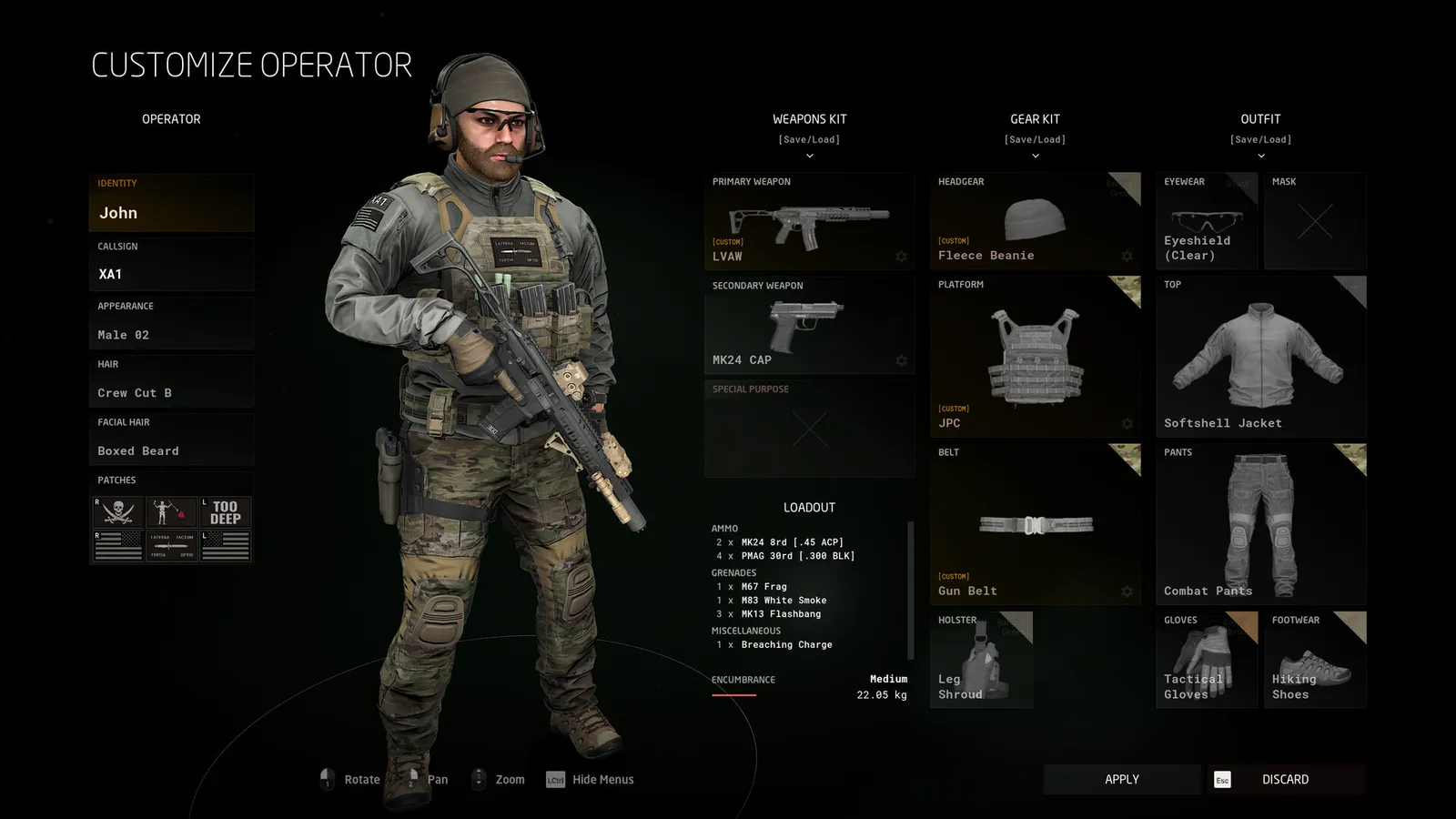
- Recommended attachment setups for CQB, DMR, and night roles
Official resources: Steam store page · Official FAQ · V1.0 release notes · PCGamingWiki
How Weapon Customization Works
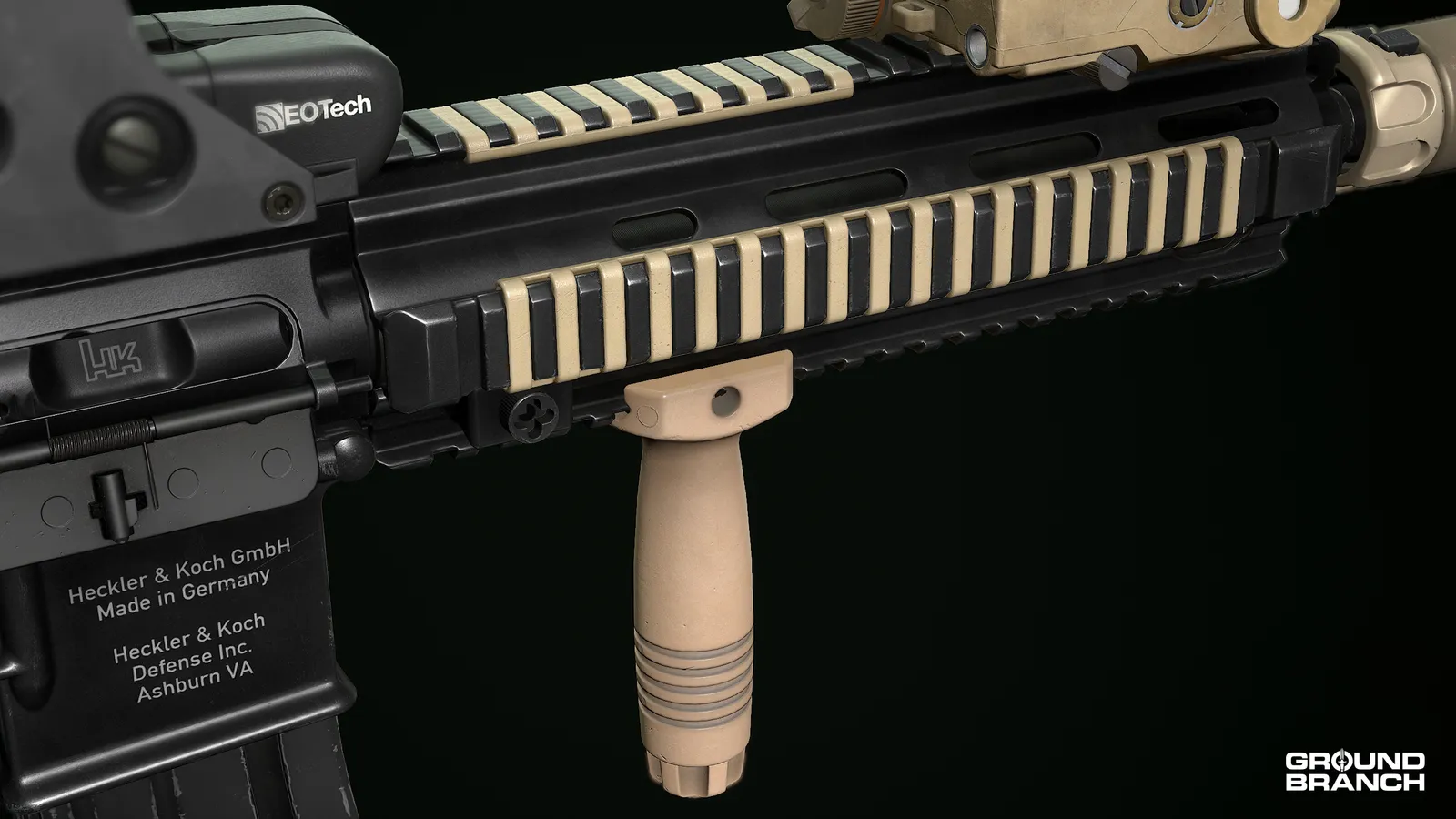
Open any weapon's attachment view (gear icon in the loadout menu) and you'll see its real-world rail system: a top rail for optics, side rails for lights and lasers, and an under-barrel section for grips. The official FAQ describes the rule directly: "Weapon attachments can be placed on any slot of the accessory rails, with few restrictions." That means you can run a suppressor, an angled light and a laser on a pistol-length MK18 without penalty beyond physics.
Two mechanics shape every build decision:
- Attachment weight is real. The arm-strength system drains faster with heavier weapons (see our loadout guide for the drain table). A laser module costs less than a vertical grip, which costs less than a magnifier — and a battle rifle with an LPVO plus suppressor runs dry fast if you hold it at the ready for long.
- Zeroing and mechanical offset matter. Bullets leave the muzzle, not your screen center. Each sight has a zero distance, and close-range shots land low (under 20–25 m) because the barrel sits below your line of sight. The game supports sight switching — scroll the mouse wheel while ADS to swap between your primary optic, backup irons, or a magnifier.
Every rifle has backup iron sight slots. In V1.0 you can scroll between optics on the fly — when your red dot dies at close range (or you push through a dark doorway), switching to irons is instant and costs zero extra weight.
Red Dots & Holographics
For anything inside 150 m, a reflex sight is the standard choice. Confirmed in-game optics (list compiled from the community reticle guide):
- Aimpoint Micro series (T1/T2) — compact, tiny footprint, the default carbine optic. T2 is the cleaner reticle.
- EOTech HWS series (551/552/553/EXPS3) — holographic with a large window; the donut-of-death reticle is excellent for fast target acquisition in CQB, and the EXPS3 sits at lower-third co-witness height.
- M68 CCO, PRO, MRO, CTRW, SRS — Aimpoint-style tube sights with varying reticle sizes; pick by reticle preference.
- RMR, Docter — micro red dots for the side or top; the Docter II received a reticle-position fix in Hotfix 2.
- Kobra EKP-8-18, OKP-7 — Russian-market options for the AK platform.
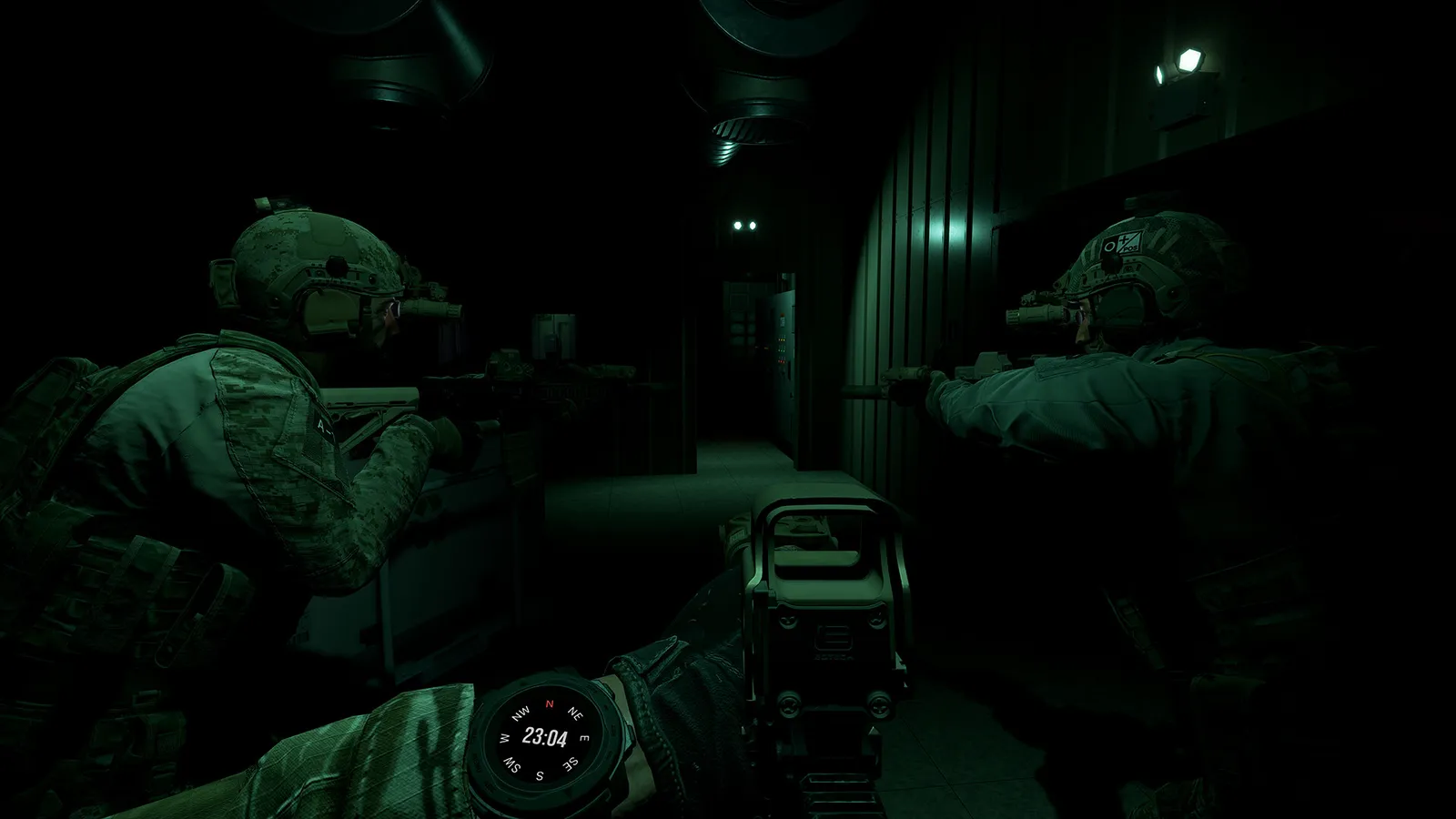
Red dots and holographics are the only optics that stay fully usable through night vision goggles — the reticle is projected, so it doesn't blur the way a magnified lens does. That makes a red dot the default for night maps.
LPVOs & Magnified Scopes
When the engagement range stretches, magnification wins:
- Low-power variables (LPVO): Razor HD 1-6x, Vudu 1-6x, ATACR 1-8x, MK8 CQBSS 1.1-8x — the 1x setting works like a red dot up close, and you can crank to 6-8x for precision. This is the most versatile class in the game.
- Dual-role: Specter DR 1x/4x — a fixed two-power optic, lighter than an LPVO.
- Fixed high power: ACOG 4x and 6x, MK4 3.5-10x, PMII 5-25x, 1P78 Kashtan 2.8x, PSO-1M2-1 4x. The PMII 5-25x is the long-range king for DMR/sniper roles, but it's heavy and slow.
- Magnifiers: a 3x (or higher) magnifier behind a red dot gives you the LPVO compromise at lower weight — but adds meaningful arm-strength drain.
A scope's lens glass blurs everything beyond a few meters when viewed through night vision — the official FAQ explains that NODs have a fixed focal range. If you need magnification at night, mount the AN/PVS-22 UNS in front of your scope to convert it into a night scope, or use the standalone AN/PVS-17C MNS (4.5x, with a red-dot aim point — new in V1.0 per the release notes).
Muzzles, Suppressors, Grips, Rails, Lights & Lasers
- Suppressors: they cut muzzle signature and, crucially, make you far less locatable — enemies and players react to the sound of shots. Suppressed shots still travel at full velocity; GROUND BRANCH doesn't apply a damage penalty to subsonic-versus-supersonic the way some games fake it, but the added weight is real. In co-op, a suppressed squad can clear a building before the AI outside knows where the shots came from.
- Muzzle brakes/flash hiders: flash hiders reduce your visibility to night vision; brakes are mostly cosmetic in feel but add weight — take them if the look matters, skip them if you're chasing arm strength.
- Vertical grips (A/B/C): the classic under-barrel choice. Vertical Grip A (the US-spec grip) is new in V1.0, and the old grips were renamed B and C. Grips improve the weapon's visual stability and give you something to pull into; in gameplay terms they add weight like any attachment.
- Rail panels (A and B): cover unused rail sections — Rail Panel B comes in three sizes. They're cosmetic (and weight-free).
- PEQ-15 laser module: the game-changer for night ops. Infrared output is visible only through NODs, giving you a zero-offset aiming point that works through NVG. Green/visible lasers are a fun way to blind enemies — and a great way to give away your position.
- Flashlights: side-rail mounted; use them to light doorways and blind opponents. Hotfix 1 and Hotfix 2 fixed lights/lasers turning off during item switches, so your beam stays on through reloads.
Weight, Zeroing & Performance Trade-offs
Three trade-offs define every build:
- Weight → arm strength. Every gram on the rifle shortens how long you can hold ADS before sway becomes unmanageable. A fully-loaded MK14 EBR with LPVO + suppressor + grip + laser will drain in well under a minute of sustained aiming. Our realism mechanics guide has the full arm-strength breakdown.
- Zero distance → hit placement. Rifles are zeroed for a specific range; inside ~20-25 m the mechanical offset makes shots land low relative to your aiming point — the official FAQ calls this out explicitly. For CQB, zero short (or aim high on the chest at close range); for DMR work, zero to match your expected engagement distance.
- PIP scopes → frame rate. Picture-in-picture magnified scopes render a second view, which costs FPS — the community performance guide and Hotfix 2 both note that verifying game files or lowering the PIP Scope Resolution Scale helps if scoped performance dips. See our best settings guide for the full fix list.
GROUND BRANCH is deliberately flat: a red dot doesn't grant +10% accuracy and a suppressor doesn't cost damage. Attachments change behavior (sound, light, zeroing, weight), not stats. Build for the mission, not the meta.
Recommended Attachment Setups
- CQB carbine (MK18 / HK416D CQB): Aimpoint T2 or EOTech EXPS3 → suppressor → PEQ-15 (IR for night) → backup irons. Skip the grip to save weight.
- All-rounder (M4A1 SOPMOD): Razor HD 1-6x LPVO → suppressor → vertical grip → PEQ-15. Handles everything from hallway to 300 m.
- DMR (MK14 EBR / M110): PMII 5-25x or MK4 3.5-10x → bipod-style grip → suppressor only if the mission is stealth; expect heavy arm-strength drain.
- Night build: red dot (any) → suppressor → PEQ-15 IR laser → optional AN/PVS-22 UNS in front of an LPVO if you need magnification.
Pair any of these with the right platform in our loadout guide, and check the weapons guide for which rifles suit which role before you spend time in the gunsmith.
Frequently Asked Questions
What attachments can you put on weapons in Ground Branch? Red dot and holo sights, low- and high-power scopes, backup iron sights, magnifiers, suppressors, flash hiders, vertical grips, rail panels, flashlights, laser modules (including the PEQ-15 IR laser) and the AN/PVS-22 UNS night sight. Over 50 unique attachments in total, per the official FAQ.
What is the best optic in Ground Branch? For general use, a 1-6x LPVO like the Razor HD — it works as a red dot at 1x and reaches out to 6x. For pure CQB, an Aimpoint T2 or EOTech EXPS3; for long range, the PMII 5-25x.
Do suppressors reduce damage in Ground Branch? No — suppressors keep full muzzle velocity and damage; they cost weight instead. Their real effect is sound: suppressed shots are much harder to locate, which matters more than any stat sheet.
How does weapon zeroing work in Ground Branch? Each weapon/sight combination has a default zero distance; because bullets originate from the muzzle, shots land low at close range (under ~20-25 m) and drop past the zero distance. Custom zeros are planned by the developers.
Does weapon weight matter? Yes — heavier weapons drain arm strength much faster, which increases sway. A fully-loaded LMG holds ADS for less than half the time of a pistol.
Related Guides
- Ground Branch Loadout Guide — Best Loadouts & Gear
- Ground Branch Weapons Guide — Every Weapon Class, Ranked
- Ground Branch Realism Mechanics — Ballistics, Zeroing & Arm Strength
- Ground Branch Best Settings — Performance & Sensitivity
- Ground Branch Tactics Guide — Squad Movement & Positioning
- Ground Branch Beginners Guide — How to Play & First Hour
Last updated: August 14, 2026.
More GROUND BRANCH Guides
Ground Branch loadout guide: the loadout system, armor plates vs soft armor, encumbrance and weight, plus the best loadouts for every mission type in V1.0.
Ground Branch missions and modes: the Operations campaign Prologue, PvE quick missions, PvP modes, training areas, every map, and server mission setup.
Ground Branch has official mod support: Steam Workshop, the UE4 Mod Kit SDK, and hundreds of mods — weapons, missions, game modes. Install steps + top mods.
Ground Branch multiplayer guide: co-op and PvP modes, 16-player servers, the Ready Room, VOIP, server browser, hosting and dedicated servers with ports.
How GROUND BRANCH multiplayer works: 16-player servers, 8-player co-op, server browser (no matchmaking), joining friends, ping, and crossplay.
Ground Branch realism mechanics: no minimap, no HUD ammo, muzzle-origin ballistics, zeroing, limb damage, first aid, weapon positions and arm strength.
Ground Branch release date: V1.0 launched July 16, 2026 after 8 years of Early Access. Full EA timeline, platforms, price, and the 2026–2027 update roadmap.
Honest GROUND BRANCH review after V1.0: all-time Steam rating Very Positive (~84%), recent reviews Mostly Negative. Pros, cons, price, verdict.