
Complete hololive Dreams guide: rhythm Live core loop, Dream Park building, holomem quests, team building, gacha, mini-games, multiplayer and priorities.
hololive Dreams Guide — Everything New Players Need to Know
hololive Dreams (nicknamed holodori) is the first official hololive mobile game — a six-lane rhythm game wrapped around a theme park building RPG. Developed by QualiArts (the studio behind Gakuen Idolmaster) together with COVER, it launched July 22, 2026 on Steam and July 23, 2026 on iOS and Android, free-to-play with in-app purchases. Instead of one isolated game mode, it runs an interconnected loop: you clear rhythm Lives for materials, spend those materials building Dream Park facilities, complete quests to unlock new hololive members and songs, then bring your trained team back into harder charts for higher scores.
This guide covers the whole loop in order: the rhythm system, the park pillar, member unlocks, team building, the gacha and its reroll, mini-games, multiplayer, and the first-week priorities that separate smooth progress from a stalled start. For a tighter day-one plan, see our beginner's guide.
Here's what you'll learn:
- What hololive Dreams actually is, who made it, and what it costs
- The core loop in four steps
- How Rhythm Live, scoring, and difficulty work
- How Dream Park, facilities, and areas connect to everything else
- How holomem quests unlock members and songs
- Team building: leader + five members, attributes, and the holomem Board
- Gacha basics, the Redraw Gacha, and whether rerolling is worth it
- Mini-games, multiplayer, and free-to-play economy
- The most common mistakes new players make
What Is hololive Dreams?
hololive Dreams is a rhythm RPG starring the virtual talents of Hololive Production. The premise is simple: the hololive members arrive on an uninhabited floating island and team up with you to build Dream Park, a theme park where fans can watch them perform. As you complete quests, more members appear and new facilities open.
The game is developed by QualiArts, a CyberAgent subsidiary best known for Gakuen Idolmaster, in collaboration with COVER Corporation, hololive's parent company. It's a deliberate hybrid — the developers told IGN that layering RPG systems on top of rhythm gameplay was a way to make the game bigger in scale while keeping it approachable for players who have never touched a rhythm game.
Key numbers to know before you install:
- 54 playable holomem at launch, across the JP, ID, EN, and DEV_IS branches
- 150+ songs at launch — hololive originals, unit songs, and covers
- 3 rarities per member: 3-star, 4-star, and 5-star cards
- 2 areas at launch: Harmony Garden and Mega Sphere
- Free to play on iOS, Android, and Steam (Windows)
Official source: the Steam store page describes the game as "The official hololive rhythm game and RPG," featuring "over 50 hololive members" and "150+ songs" at launch, with rhythm gameplay, park development, and mini-games.
The catch for PC players: the Steam version ships with a kernel-level anti-cheat component (usrdrv017964.sys) that gets flagged by some antivirus software and currently blocks Steam Deck and Linux. We'll get into that in the platforms section below.
The Core Loop in Four Steps
Every hour of hololive Dreams follows the same rhythm, and once you see it, the game stops feeling like twenty systems bolted together:
- Play Lives. Clear rhythm stages (and mini-games) to earn materials and currency.
- Build Dream Park. Spend those materials on facilities and park expansion, which unlocks shops, mini-games, and quests.
- Complete holomem Quests. Recruit new members and unlock their songs, one character and song at a time.
- Train and score. Level members, fill out their holomem Board, and push higher scores in Score Attack, events, and EXPERT clears — which pays out better rewards, feeding step 1.
Nothing is optional in the long run. Park quests gate some members and resources; Live clears fund the park; the holomem Board gates score ceilings. Minimal park engagement is possible, but the game deliberately pushes you toward the full loop. The Dream Park guide breaks the building side down in detail.
Rhythm Live: Six Lanes, Four Note Types, and the Score Formula
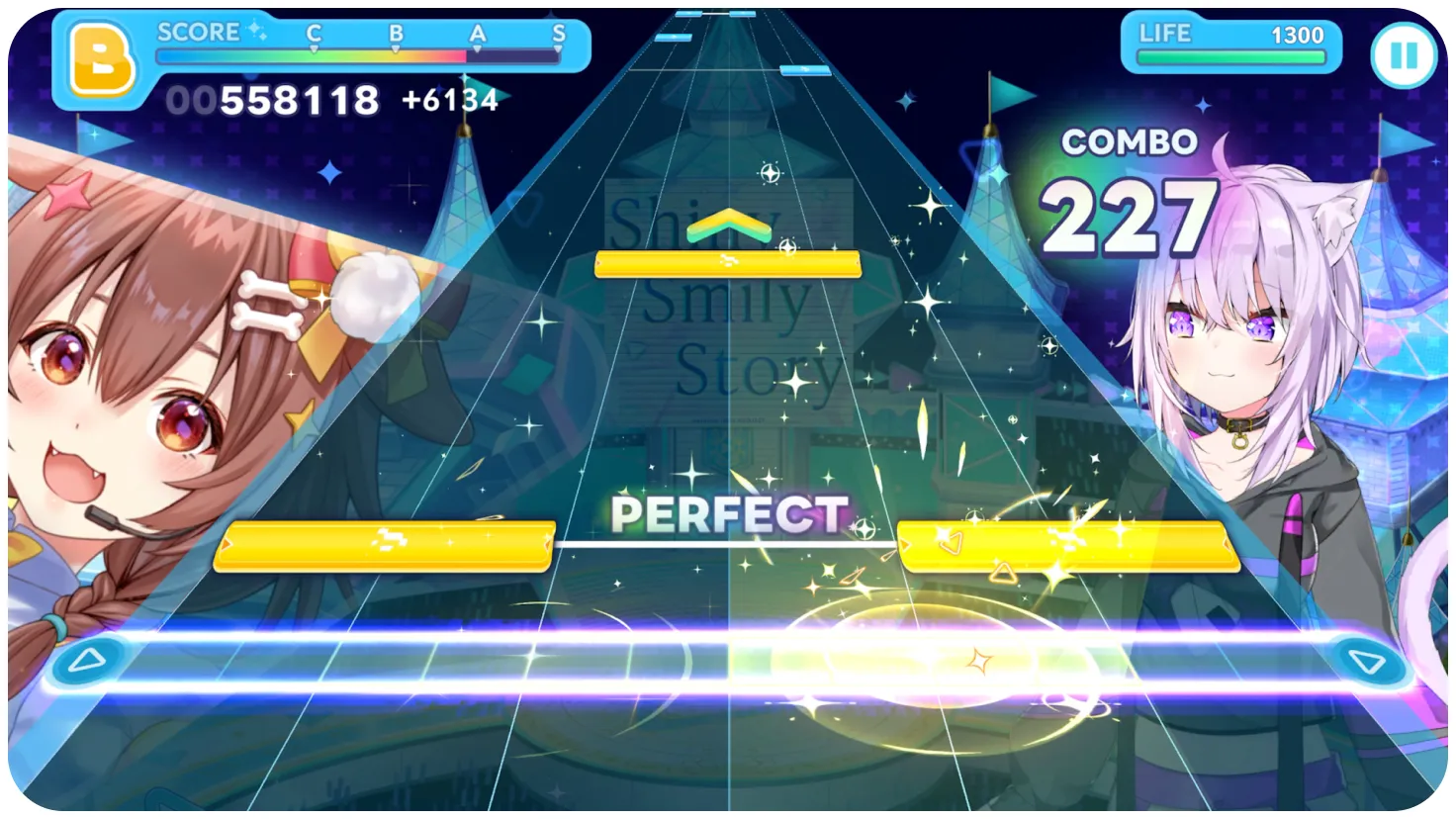
Rhythm Live is the heart of the game. Notes travel across six lanes (more than the four lanes of BanG Dream! or most Project Sekai charts), with music videos or live concert footage playing as the background.
Note types
- Blue notes — tap when they reach the judgment line
- Green notes — hold from the head to the tail
- Pink notes — flick in the direction of the arrow
- Yellow notes — easier tap notes with a louder sound (accent notes)
Judgments run PERFECT → GREAT → GOOD → BAD → MISS. Your accuracy matters, but it isn't the whole story: the final score is multiplied by your team's performance, the leader's costume skill, attribute and generation synergies, member levels, awakening, and holomem Board nodes. Two players hitting the exact same notes can walk away with very different scores depending on their teams — that's the RPG half doing its job.
Difficulties and auto-play
Every chart ships in four difficulties — EASY, NORMAL, HARD, and EXPERT — with level numbers per song (EXPERT charts around level 27-29 are common for the hardest songs). Difficulty is a property of the chart you pick, not a global setting. Note speed is adjustable per player, and most experienced players push it to 7-10 so dense patterns spread out and become readable.
If you just want to enjoy the music, auto-play clears songs for you. It's great for learning charts, testing team compositions, or simply watching the members perform. You don't lose access to anything by using it — it's an officially supported way to play.
Your team determines your score ceiling, but rhythm skill determines how close you get to it. In the options menu, turn on the FAST/SLOW display and the simultaneous-press guide line, and raise your note speed if you're misreading dense sections. These three settings fix more beginner frustration than any gacha pull.
Dream Park: The Theme Park Pillar
Dream Park is the persistent hub — a floating island you develop from empty shoreline into a working theme park. Playing Lives and mini-games earns park materials; those materials build facilities, each themed around hololive generations and inside jokes. Expanding the park unlocks new features: shops, additional mini-games, quest lines, and eventually new areas.
At launch the island has two areas:
- Harmony Garden — the first area, focused on performance venues and the opening story
- Mega Sphere — a games-and-casino themed area with the Mega Circuit and Pokajan! mini-games
The developers have confirmed new areas are planned at a pace of roughly one every few months. Each new area brings its own facilities, quests, and music.
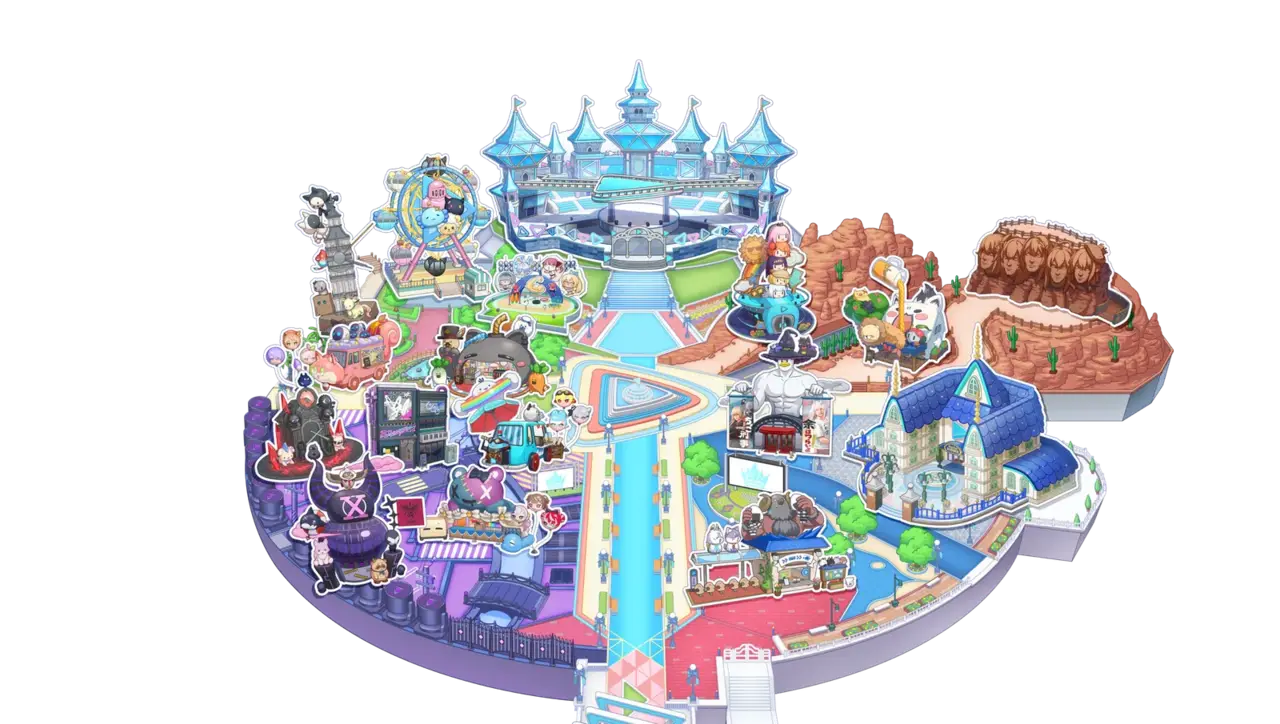
Facilities aren't just decoration — they're the progression map. Building and upgrading them unlocks shops, mini-games, and holomem quests, and some quests require a facility at a specific level. A common early trap is hoarding materials "for something good later"; spend them on the quest-required facilities first.
Holomem Quests: How You Unlock Members and Songs
There are two ways to add members to your roster: gacha pulls and holomem Quests. The quest route matters more than most new players expect.
Every day you receive two side quests that let you unlock a random playable member in the 3D world and one of their songs. There's also an item (the invitation ticket) that lets you start a specific member's quest of your choice. Completing a member's quest chain adds them as playable and unlocks their songs — which means you can build a full roster without spending a cent, just slowly.
Some hololive branches are not featured at launch: hololive English -Justice-, DEV_IS FLOW GLOW, and the HOLOSTARS branch sit out for now. Graduated talents who left during production appear in story segments by mutual agreement, but they are not playable.
Team Building: Leader Plus Five
For every Live you field a team of one leader plus five members — six cards total. The leader matters most: leaders equip special outfits (costumes) that carry a leader skill boosting the whole team, and completing a member's holomem Quest unlocks them as a leader. One rule trips people up constantly: the leader must be a singer on the song you're playing — for unit or ensemble songs, any participating vocalist works.
Cards carry three attributes — Cute, Happy, Pure — and an affinity: Performance, Sense, or Technique. Passive skills stack when members share an attribute with the leader or belong to the same generation, so team synergy multiplies score far beyond the sum of individual card strengths. Our team building guide has example compositions for new, score-focused, and park-focused teams.
The holomem Board
Each member also has a holomem Board, a skill grid with four types of nodes you unlock and level over time, plus Connect Nodes where you slot cards to amplify effects. The board is the long-term power sink — leveling a member's board is what turns a good card into a score anchor. It's also where your upgrade materials disappear, so it pays to focus resources on one leader core rather than spreading them thin across your whole roster.
Gacha, Currencies, and the Redraw Gacha
hololive Dreams monetizes through gacha: each member appears as 3-star, 4-star, or 5-star cards, with costumes as separate pulls on some banners. Two currencies matter: pink Diamonds (earned free from quests, achievements, login bonuses, and events) and blue Diamonds (bought with real money). Gacha tickets and Live Boosts (stamina) round out the economy.
Three banners exist at launch:
| Banner | Window | Currency | Notes |
|---|---|---|---|
| Holodori Gacha | Permanent | Pink/blue diamonds + tickets | Main pool; no rate-ups |
| Beginner Support | 7 days after Ch. 1 Ep. 1 | Pink diamonds OK | Pick 3 wishlisted 5-stars to rate up |
| Running Start | 48h after "The Beginning of a Dream" | Blue diamonds only | Guaranteed 5-star within 10 pulls |
Rate information collected by Gamezebo puts the permanent banner at roughly 5% for 5-star, 10% for 4-star, and 85% for 3-star — official published odds are not listed in detail on the store pages. Every pull earns Gacha Points; at 200 points you can exchange directly for a member of your choice, which is the de facto pity system.
Blue Diamonds are the scarce premium currency. The Running Start banner is the only one that requires them, and it expires 48 hours after you finish the opening quest — it's the best blue-diamond value in the early game. Pink Diamonds and free tickets should cover your pulls on the Holodori and Beginner Support banners.
The Redraw Gacha: hololive's friendly reroll
Right after the tutorial, before the story really starts, the game runs you through the Redraw Gacha — an unlimited redraw banner. Here's the clever part: the very first pull is guaranteed to be the 5-star of the member you picked at the start of the game. You can redraw infinitely, but redrawing randomizes the five-star across all members. In other words:
- Keep the first pull → you start with your chosen oshi's 5-star card
- Redraw → you gamble the guaranteed card for a random 5-star
For a step-by-step reroll route (including the fastest way to reset on both mobile and Steam), see our reroll guide. Short version: if you're chasing high scores or events, do your re-rolling early — a fresh account with two or three synergistic 5-stars saves weeks of grinding.
Mini-Games: The Third Pillar
Beyond Lives and the park, hololive Dreams ships a rotating lineup of mini-games that pay out upgrade materials and are often the most stamina-efficient farm in the game. At launch the lineup includes:
- Hoppin' Rope — a group jump-rope rhythm challenge
- Collect Cooking — a fast-paced matching/cooking puzzle (its ranking was reset in Ver. 1.0.100 after a scoring exploit)
- Mega Circuit — a chaotic obstacle race for up to 16 players, Fall Guys style
- Pokajan! — a card game where you build winning hands
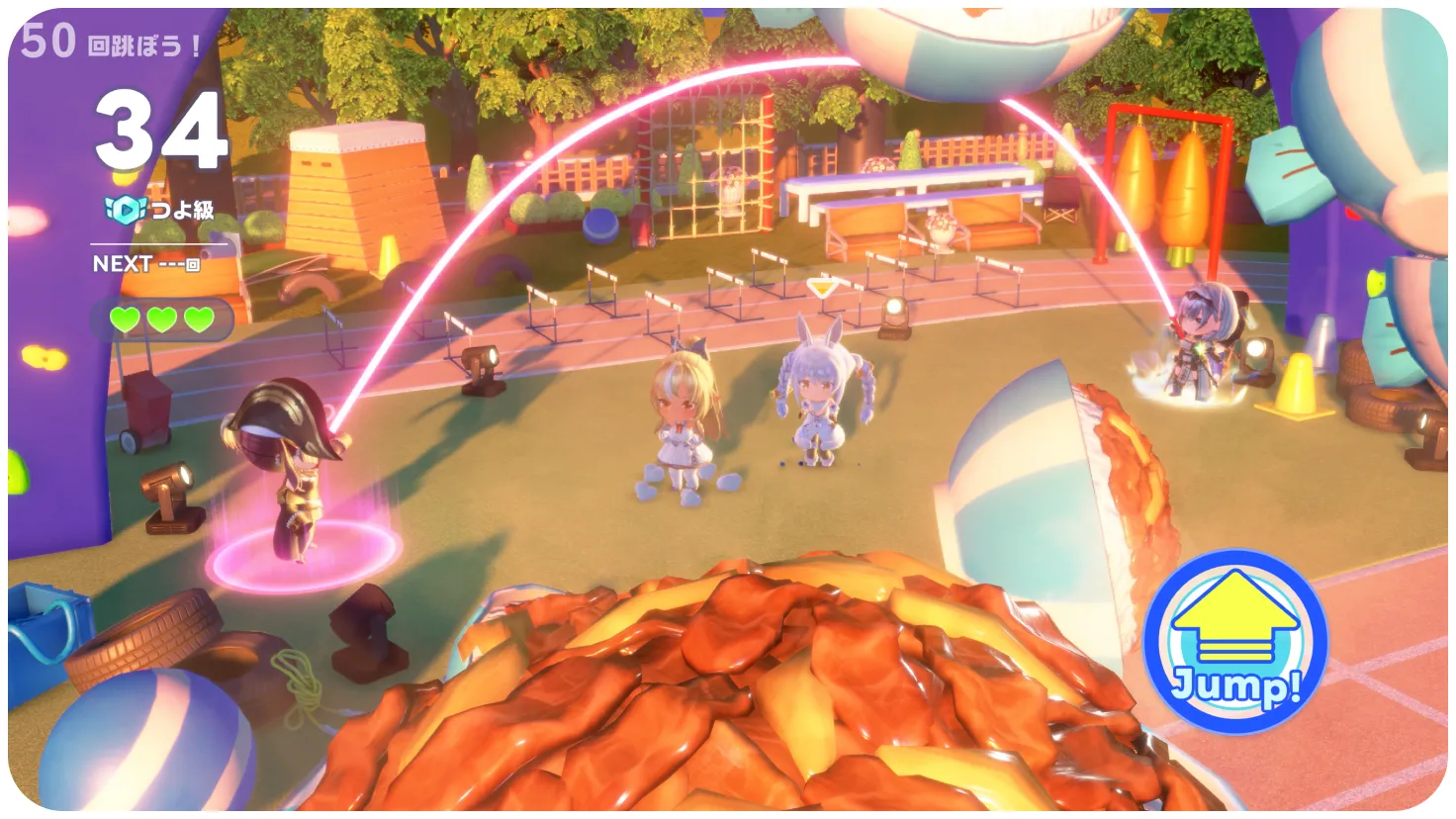
The daily mini-game rotation is one of the most efficient ways to stockpile upgrade materials for your park, so it belongs in your daily routine. A new multiplayer mini-game is scheduled for late August 2026.
Multiplayer
Multiplayer in hololive Dreams comes in two flavors: online Lives (co-op rhythm clears with up to five players) and multiplayer mini-games (like the 16-player Mega Circuit). You can also play everything solo — multiplayer is optional, not a gate.
Cross-platform multiplayer works across iOS, Android, and Steam, and the same account carries your progress between platforms if you link it. Note that leaderboards are separated per platform, and community reports flag desync and frame drops in multiplayer rooms on launch — the developers have been patching those. Full details in our multiplayer guide.
Currencies, Membership, and What's Actually Worth Paying For
The free-to-play economy is standard gacha: pink Diamonds and tickets come from play, blue Diamonds cost money, and the game also sells per-talent memberships — monthly subscriptions that grant skins and resources for a specific member. Memberships can be purchased in the mobile versions but not through the Steam build, which is a recurring player complaint worth knowing before you pick your platform.
What's genuinely worth paying for, if anything:
- Running Start banner is the highest-value paid purchase for a new account (guaranteed 5-star within 10 pulls)
- Memberships are fan-service purchases — if your oshi is in the game and you want their skin, that's the vehicle
- Live Boost refills are a trap unless a limited-time event demands them; the daily loop gives enough stamina for normal play
The core game is entirely completable without spending. HowLongToBeat currently lists the main story at about 22.5 hours and main-plus-side content at about 57.5 hours, though with only a handful of submissions so far — and as a live-service game, that number will only grow.
First-Week Priorities
If you only remember one section of this guide, make it this list:
- Claim everything in your mailbox. Pre-registration rewards (diamonds, the 4-star+ guaranteed ticket, Music Disks, and the Pixel Sunglasses) are waiting there — they fund your first real pulls.
- Finish the opening quests before touching the gacha. The Running Start and Beginner Support banners only open after specific story milestones, and their windows start ticking from there.
- Spend your first diamonds on the Beginner Support banner (pick three wishlisted 5-stars) and the Running Start banner. Skip the permanent pool until both are done.
- Pick one leader core and focus all upgrade materials on them. A 5-star leader with a leveled holomem Board outperforms six scattered half-leveled cards.
- Do the daily mini-game rotation and the two daily holomem quests. This is how free players unlock members and songs — missing days means missing roster progress.
- Link your account across platforms early (Settings → account link) so login bonuses and event progress register on whichever device you play that day.
- Set your rhythm options before grinding charts: note speed, FAST/SLOW display, and the simultaneous-press guide.
Common Mistakes New Players Make
- Ignoring the RPG side. The most common complaint from rhythm purists: 98% PERFECT accuracy and still no S-rank, because the team score multiplier was neglected. Team strength is half the score formula.
- Hoarding park materials. Materials sitting in your inventory don't unlock anything. Build quest-required facilities first, then expand.
- Rerolling past the guaranteed oshi. On the Redraw Gacha, rerolling discards the guaranteed 5-star of the member you chose. Do your gambling on the other banners, not the redraw.
- Skipping the daily holomem quests. They're the only reliable free source of specific members and their songs.
- Judging the PC version by mobile standards. The Steam build uses kernel-level anti-cheat (which blocks Steam Deck/Linux) and its keyboard layout feels like touch controls forced onto a keyboard. If rhythm is your focus, mobile or tablet is the smoother experience — and if PC is your only option, remap the keys and accept a calibration session first.
FAQ
Is hololive Dreams free to play?
Yes. The game is free to download on iOS, Android, and Steam, with optional in-app purchases: premium Diamonds, gacha tickets, cosmetic bundles, and per-talent memberships. The entire main loop — members, songs, and park — is completable without paying.
How many members and songs are in hololive Dreams?
54 holomem are playable at launch, drawn from hololive JP, ID, EN, and DEV_IS branches. The initial song list includes 150+ tracks — original songs, unit songs, and covers — with every featured member getting at least two songs.
What is the Redraw Gacha in hololive Dreams?
It's an unlimited redraw banner right after the tutorial. The first pull is guaranteed to be the 5-star of the member you chose at account creation; redrawing randomizes the five-star. Keep the first pull to lock in your chosen oshi, or reroll for a random 5-star.
Can you play hololive Dreams on PC and mobile with the same account?
Yes — the game supports cross-save between Steam and the mobile versions. Link your account once, and Dream Park progress, rhythm scores, and gacha inventory carry across platforms. Leaderboards remain separate per platform.
Is hololive Dreams worth playing for rhythm game fans?
It depends on your platform and expectations. The song library (150+ tracks), six-lane charts, Create Chart mode, and polished presentation are genuinely strong. But the Steam version's keyboard controls and kernel-level anti-cheat, plus gacha progression, push many rhythm purists toward mobile instead. It's an excellent hololive fan experience and a good casual rhythm game; it is not a hardcore arcade rhythm game.
Related Guides
- hololive Dreams Beginner's Guide — Day One Walkthrough
- hololive Dreams Tier List — Best Members and Leaders Ranked
- hololive Dreams Reroll Guide — Fastest Way to a Strong Start
- hololive Dreams Songs — Full Song List and Unlocks
- hololive Dreams Dream Park — Building and Facilities
- hololive Dreams Team Building — Leader, Attributes, Synergies
Last updated: August 13, 2026
More hololive Dreams Guides
hololive Dreams reroll guide: how the Redraw Gacha works, when rerolling is worth it, the fastest reset on mobile and Steam, and which 5-stars to aim for.
hololive Dreams codes: the current redeem code status, why there's no code redemption page yet, and the free-reward alternatives that actually work in holodori.
hololive Dreams Dream Park guide: the building loop, facilities and unlocks, resource priorities, and how the park feeds progression.
hololive Dreams events guide: event point rallies, the Hello! Brand New Summer! and Synchro Summer Sparkle events, the swimsuit gacha, and event song unlocks.
How long is hololive Dreams? Main story hours, side content, the 100% completion picture, and why a live-service game only gets longer.
How to play hololive Dreams: six-lane rhythm controls on mobile and keyboard, every note type, judgments, autoplay, and settings that fix accuracy.
hololive Dreams members: all 54 playable holomem by generation and branch, who's missing, how member quests unlock them, and where each roster pick ranks.
hololive Dreams mini games: Hoppin' Rope, Collect Cooking, Mega Circuit and Pokajan! rules, rewards, efficiency, and which daily rotation farms fastest.