Our complete ReStory: Chill Electronics Repairs guide — the cozy Y2K repair sim: repair loop, prices, platforms, endings, achievements and beginner priorities.
ReStory Game Guide — Chill Electronics Repairs, Everything You Need to Know
ReStory: Chill Electronics Repairs is a cozy, narrative-driven shop management simulator from Mandragora (the studio behind I Am Future), published by tinyBuild. You run a small electronics repair shop in mid-2000s Tokyo, taking in dusty flip phones, handheld consoles, digital cameras and officially licensed Atari hardware — then disassembling, cleaning, fixing and reassembling them for a stream of customers whose stories branch into multiple endings. It launched on August 6, 2026 at $19.99 and immediately landed as one of the year's surprise cozy hits: 98% positive on Steam, a Metacritic score of 84, and over 100,000 copies sold in its first 24 hours.
This guide is the hub for everything else on the site — the core loop, what the game actually is, how the systems connect, and where to go next for deeper coverage.
Here's what you'll learn:
- What ReStory actually is (setting, premise, tone)
- How the repair gameplay loop works step by step
- The shop management and narrative layers on top
- Price, platforms and system requirements
- How long it takes and whether it's worth it
What Is ReStory: Chill Electronics Repairs?
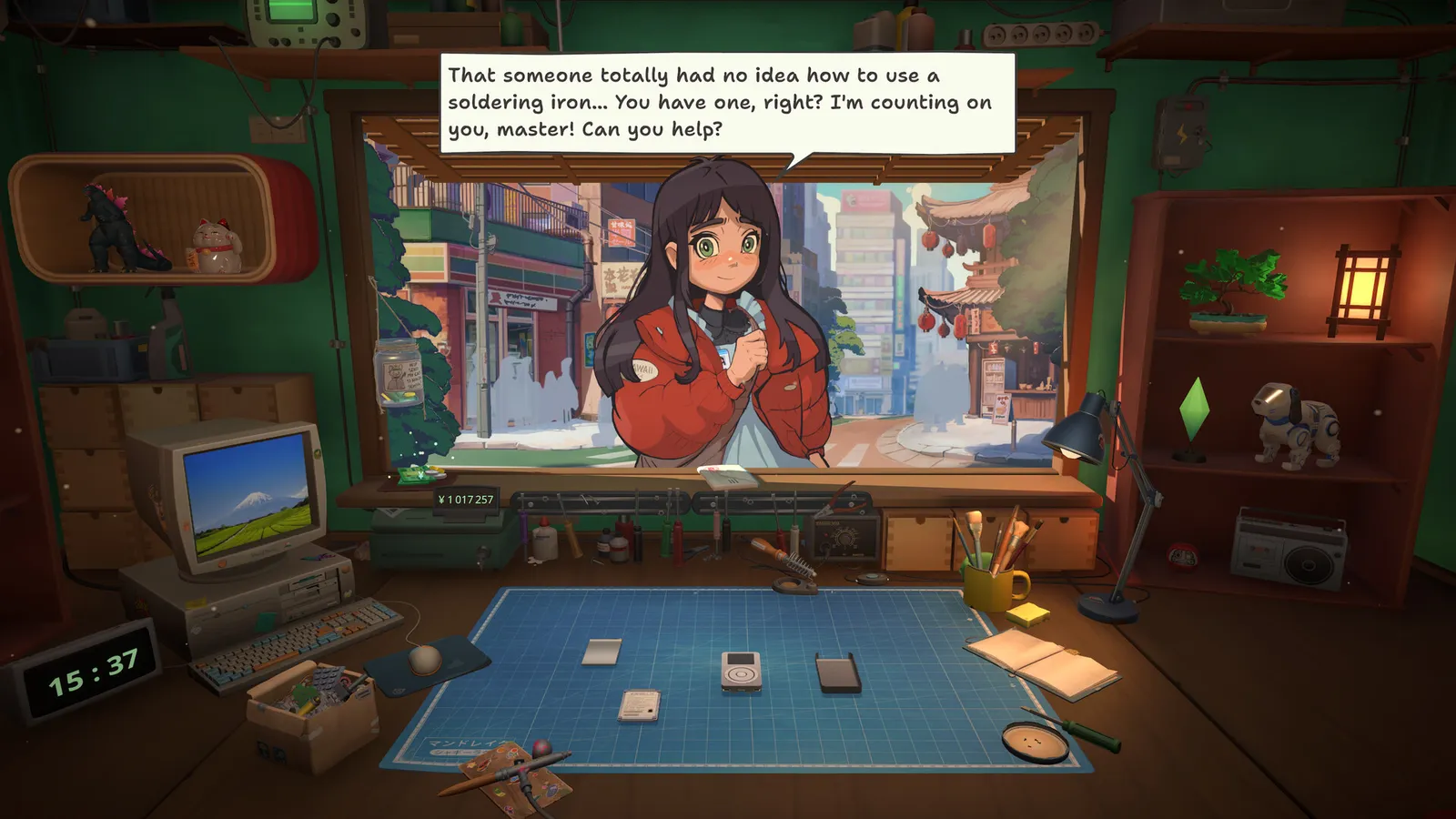
ReStory is a first-person, single-player repair sim set in Akihabara, Tokyo in the mid-2000s. The premise: a mysterious former shop owner has disappeared, and you inherit a tiny repair storefront — a sketchy landlord (Hashimoto), a barely functional computer, a screwdriver and a brush. Your job is to take in broken Y2K-era devices, restore them, earn yen, unlock new repair tools and licenses, and gradually piece together the stories of the customers who walk through your door.
The game is built around three interlocking layers:
- The repair loop — the tactile core: disassemble, clean, diagnose, replace parts, reassemble
- Shop management — finances, rent, spare parts economy, an in-game Y2K web browser for ordering
- The narrative — customers with unique stories, choices that matter, branching storylines and multiple endings
Mandragora's studio director Evgeny Kisterev described the project as nostalgia for the era of polyphonic ringtones shared via infrared ports and cassette tapes rewound with a pencil. That nostalgia is the whole point — every device is a period-accurate stand-in for real hardware (from the Not-PSP handheld to the officially licensed Atari 2600 and Jaguar), and the game treats them with tactile reverence.
ReStory is often grouped with "cleaning games," but it's deeper than that. Repairs involve diagnosis, soldering, reprogramming, painting and part-swapping across dozens of device types — plus a full shop economy and a branching story. If you came for the zen, you'll stay for the customers.
The Repair Loop: Step by Step
Every repair follows the same satisfying ritual, and it's the game's core identity:
- Take the order — a customer drops off a device and tells you what's wrong (or you accept an online order through the in-game browser)
- Disassemble — unscrew the case, remove ribbon cables, batteries and components in the right order. Use the correct screwdriver; rushing strips screws and makes the job harder
- Clean — most "broken" devices are just dirty. Dust, corrosion, sticky buttons and accumulated grime cause symptoms that look worse than they are. Cleaning first saves a fortune on replacement parts
- Diagnose — find the actual fault: a fried motherboard, dead battery, cracked screen, stuck button
- Replace or repair — swap in spare parts (bought online or harvested from donor devices) or fix the component itself
- Reassemble — put everything back in the correct order
- Deliver — return the device, take payment (or refuse it, which can unlock special moments — see the achievements guide for the Origami trick)
The game rewards patience, not speed. There are no timers on most repairs, and the loop is designed to put you in a flow state — the more devices you repair, the more familiar their layouts become, and the faster and more confident you get without ever feeling rushed.
The Daily Flow: What a Day in ReStory Looks Like
A typical day in ReStory has a rhythm that's easy to settle into, and understanding it early makes the first few in-game weeks much smoother:
- Morning — check your email for online orders, review outstanding jobs, and organize your desk (dirty items on the workbench slow you down and hurt your reviews)
- Repair session — work through the devices on your bench. The day's customers arrive one at a time, so there's no queue pressure: finish a repair, hand it over, take the next
- Afternoon — when the shop is quiet, use the in-game browser to order spare parts you'll need in the next day or two. Express shipping exists but quietly eats your margins — planning ahead is the real money skill
- Evening — close the shop, then decide how to spend the night: keep repairing, upgrade your workspace with cozy decorations (they grant Zen Points, which matter for a hidden achievement), or just walk the neighborhood and chat
The game lets you end the day at any point once the shop is closed, and time only moves while you're working. There's a subtle but important mechanic buried in this: the "Akiba Never Sleeps" achievement requires working 168 in-game hours (seven days) straight without using the bike — a detail our achievements guide walks through.
The tip jar deserves special mention. Once customers start paying you, a portion goes into the tip jar by the door, and it quietly compounds into one of your steadiest income streams. Empty it regularly. Paint jobs and personalized custom orders also pay well and count toward the painting-related achievements — see the repair mechanics guide for how painting and customization work.
Common Beginner Mistakes (and How to Avoid Them)
Between the community guides and the launch-week reviews, a handful of mistakes show up over and over. Avoiding these four will save you money and frustration:
- Buying parts before cleaning — the most expensive habit. Dirt, corrosion and sticky buttons cause symptoms that look like dead components. Clean first, test again, then spend
- Using the wrong screwdriver — every device expects a specific driver, and rushing with the wrong one strips screws, turning a simple repair into a salvage job. Match the tool to the screw and work in a consistent order
- Relying on express shipping — it's a trap early on. One express order can wipe out the profit from two repairs. Stock common parts (batteries, screens, buttons, charging ports) before you need them
- Ignoring the story — skipping dialogue saves minutes but costs you the branching narrative, hidden requests, and some of the best achievements. The customer conversations are where the multiple endings actually come from
The in-game notebook tracks repair instructions, device schematics and customer details. Community guides often treat it as flavor, but it's genuinely useful — check it when you're stuck on a disassembly order or want to confirm which device a customer's symptoms point to. It's also where your license progress and online orders live.
Shop Management: The Economy Underneath
Between repairs, you're running a business:
- Rent — Hashimoto the landlord collects 2,000 yen a week. Late rent has consequences
- Spare parts — order components through the in-game fake browser, or buy random boxes of parts from the Marketplace (risky but cheap). Planning ahead and stocking common parts — batteries, screens, buttons, charging ports — turns an average repair into a profitable one
- Online orders — once you get an internet connection, you can accept orders by email, which pay well but come with delivery deadlines
- Tools — upgrade from the basic screwdriver and brush to professional tools (an 11,000 yen pro screwdriver, ultrasonic baths, a shredder). Better tools mean faster, safer repairs
- Licenses — the real progression system: licenses unlock whole categories of devices (handhelds, consoles, cameras). See the licenses guide for the full system
The single biggest early-game money saver: a surprising number of repairs can be solved with cleaning alone. Dirt and corrosion cause symptoms that look like component failures. Open the case, clean everything, test again — then spend money on parts only when you've confirmed the fault.
The Fake Internet: Slow by Design
One of ReStory's most charming features is its in-game browser — a slow, period-accurate parody of the mid-2000s web (the browser is a Gozilla Fairfox-style stand-in). Ordering parts takes time; pages load slowly; express shipping costs a fortune.
This is deliberate. The "slow internet" is part of the atmosphere, and planning around it — ordering parts a few days ahead instead of reactively — is a core skill. If you were wondering whether your actual internet speed matters: it doesn't — the browser's speed is simulated and identical for everyone. Our online orders guide covers the browser, marketplace and order economy in detail.
The Narrative: Customers, Choices and Endings
ReStory's customers are the heart of the game. Regulars return, each with their own arc: the mail delivery guy, a weird cop, the sketchy landlord, a lovestruck student, a former gangster. Your choices during conversations — whether to reveal a shocking secret found in a gangster's phone, whether to play matchmaker, whether to charge a kid — genuinely shape the story.
The game advertises branching storylines with multiple endings, and players have confirmed a true ending among them. The exact number of endings hasn't been officially enumerated, so treat counts you see online with skepticism. For what we know and how the endings branch, see the endings guide, and for the full cast, the characters guide.
Price, Platforms and Requirements
- Price: $19.99 standard, with a 10% launch discount ($17.99) through August 20. The Supporter Edition bundles the digital artbook DLC ($4.99 separately) at a combined discount
- Platforms: PC (Windows) and Mac (Apple Silicon M1+) via Steam. No Switch, no PS5, no console version announced — those search spikes are people asking, not announcements. No Game Pass
- Steam Deck: officially rated Playable (not Verified) at launch; the developer says full verification is being worked toward
- System requirements: Windows 10 64-bit, 2-core/4-thread CPU, 4 GB RAM, GTX 750 Ti, DX11, 1 GB storage. Mac: macOS 14+, Apple M1, 8 GB RAM. Full breakdown in the system requirements guide
How Long Is ReStory?
The developer's own pre-launch FAQ estimates 15+ hours for the main story, with significant replay value from the branching storylines, randomized device orders and multiple endings. The 100% journey (all 50 achievements) stretches well beyond that — the "Galactic Cleaning" achievement alone requires cleaning 1,000 parts, and "Millionaire!" needs a cumulative 1,000,000 yen. See our playtime guide for the breakdown.
Reviews and Reception
ReStory launched to exceptional reception:
- Steam: 98% positive (588+ reviews at launch week; Overwhelmingly Positive)
- Metacritic: 84 from critics
- OpenCritic: "Mighty" with a 90% critic recommendation rate
- Sales: over 100,000 copies and 15,000 concurrent players in the first 24 hours; the game paid back its budget within 12 hours
- It converted a 700,000-strong wishlist into launch-week sales, one of 2026's biggest cozy-game debuts
Critics praised the tactile repair loop, the atmosphere and the narrative; the main complaints center on a handful of launch bugs and some players wanting deeper diagnostic mechanics. Our full verdict is in the review.
The developer's launch-day announcement listed known bugs: the "How Did I Do It" and "Frugal" achievements unlocking early, a firmware update bug affecting the Guitar Legend and MyPod devices, an inventory error in competition mode, and a disassembly error with the 'IDM device'. Most were scheduled for the first patch. If you hit the firmware issue, see the firmware update guide.
The AI Art Question
Because "does ReStory use AI" is one of the most-searched questions around the game: the developer has publicly denied using AI art on the Steam forums, and shared the evolution of the key art on social media. Some players on Reddit and X still argue the art shows "hallmarks" of AI enhancement. We cover the full controversy, with sources on both sides, in the AI controversy guide — the short version is: officially denied, community debate ongoing.
Beginner Priorities (TL;DR)
- Clean before you buy parts — most "broken" devices are just dirty
- Pay rent on time — Hashimoto doesn't forget
- Upgrade your screwdriver first — the pro screwdriver (11,000 yen) transforms the repair speed
- Plan spare parts ahead — stock batteries, screens, buttons and charging ports; avoid express shipping
- Order online orders early — they're the best money once you have internet
- Don't throw away broken components — they're harvestable for parts
- Use the tip jar — it quietly becomes one of your best income sources
- Chat with every customer — the story (and some achievements) live in the conversations
- Get licenses as soon as possible — they unlock the device categories that pay the most
FAQ
What is ReStory: Chill Electronics Repairs? A cozy, first-person repair-shop management simulator set in mid-2000s Akihabara, Tokyo. You restore nostalgic Y2K devices — including officially licensed Atari consoles — manage a shop economy, and navigate a branching narrative with multiple endings. Developed by Mandragora (I Am Future), published by tinyBuild, released August 6, 2026.
How much does ReStory cost? $19.99 standard; a 10% launch discount ($17.99) runs through August 20. The Supporter Edition bundles the $4.99 digital artbook DLC at a combined discount. See the price guide for editions and bundles.
Is ReStory on Switch or PS5? No. ReStory is PC (Windows) and Mac (Apple Silicon) only via Steam. No Switch, PS5, or other console versions have been announced, and it's not on Game Pass. The platforms guide has the full status.
How long is ReStory? The developer estimates 15+ hours for the main story, plus significant replay value from branching endings and randomized orders. A full 100% run (all 50 achievements) takes considerably longer.
Does ReStory use AI art? The developer has publicly denied using AI art on the Steam forums. The question remains debated in some communities; we cover both sides with sources in the AI controversy guide.
Is ReStory worth it? At $19.99 with a 98% positive Steam rating, an 84 Metacritic and a genuinely unique repair loop, it's one of the best-value cozy releases of 2026 — assuming you enjoy tactile, low-pressure sims. Our full verdict: ReStory review.
Related Guides
- ReStory Beginner's Guide — How to Start
- ReStory Review — Is It Worth It?
- ReStory Repair Mechanics — Tools & Process
- Does ReStory Use AI Art? The Facts Behind the Controversy
- ReStory Mods — Trainers, Cheats & Custom Content
Official resources: Steam store page · Steam news hub · Gematsu announcement · Metacritic · IGN game page · GOG store page Last Updated: August 12, 2026
More ReStory: Chill Electronics Repairs Guides
The ReStory: Chill Electronics Repairs mod scene — trainers like WeMod and PLITCH, cheats (money, time freeze), and the state of official modding support.
Our ReStory: Chill Electronics Repairs review — 98% positive on Steam, a Metacritic 84, what it does brilliantly and the honest caveats before you buy.
Official ReStory system requirements: Windows and Mac minimums from the Steam page, plus what hardware actually matters for a smooth repair-shop session.
12 ReStory: Chill Electronics Repairs tips from launch-week players — cleaning order, spare-part economy, tool priorities and the story choices that matter.
Every ReStory: Chill Electronics Repairs update — launch-day known issues (firmware bug, achievement unlocks), the first patch timeline and developer promises.
A practical ReStory: Chill Electronics Repairs walkthrough — opening script, weekly rhythm and the milestone order for tools, licenses and online orders.