How to survive 7 Days to Die singleplayer: day-by-day plan for your first week, water and food, best early weapons, XP and max level, horde night prep.
7 Days to Die Singleplayer: How to Survive (2026 Guide)
Surviving 7 Days to Die singleplayer is a seven-day loop: scavenge and build by day, hide and plan by night, and never enter a Blood Moon unprepared. The first horde night arrives on Day 7 at 22:00 and every horde after scales with your game stage, so your entire first week is really preparation for that one night. The good news: solo play is the mode the game is best balanced around — no shared-loot arguments, no one else waking the sleepers, and you control the difficulty sliders. This guide walks the full first-week plan: where to base, what to craft, how to solve water and food, which weapons deserve your ammo, and how progression and the level cap actually work in the current version.
Official resources: Steam store page · Official wiki: Farming · Official wiki: Character Level · Official 1.0 launch announcement · Wikipedia overview
What 7 Days to Die Gameplay Actually Looks Like in 2026
Before the plan, the shape of the game. 7 Days to Die is a voxel-based open-world survival RPG: you mine, chop, build and destroy terrain block by block (structural stability is real — knock out the wrong pillar and the roof lands on you), scavenge over 700 hand-built Points of Interest, craft across 500+ recipes, and fight nearly 60 zombie archetypes. There is no story campaign to follow — the plot is the world and your own choices in it. In singleplayer everything scales to one player: zombie counts, loot, and quest difficulty all adjust, which is why solo is the most forgiving way to learn the systems before taking the game online (see the server IP guide when you do).
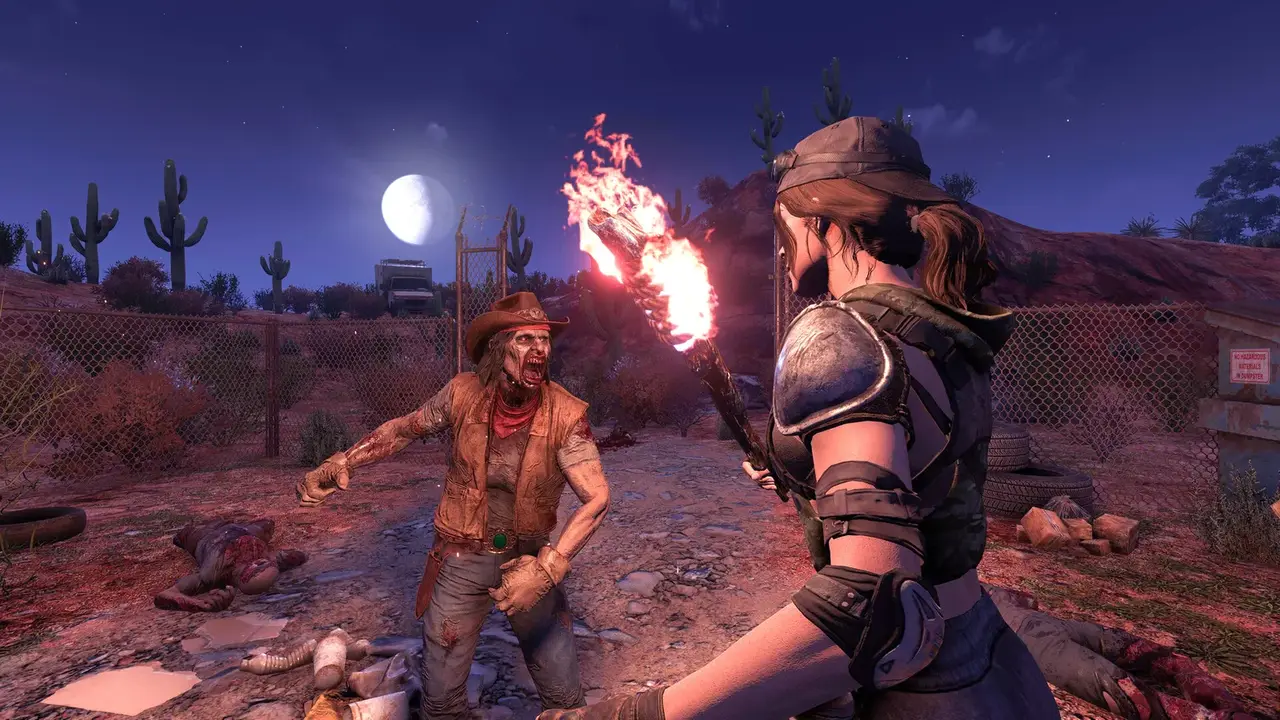
Day/night is the core rhythm: zombies are slow and barely notice you in daylight, but from 22:00 to 04:00 they turn feral — faster, sharper senses, and the night belongs to them. Plan every day so you're inside a defensible position by dusk.
The First Seven Days, Day by Day
The standard solo opening, refined over a decade of community play:
| Day | Priority | Do this |
|---|---|---|
| Day 1 | Shelter + tools | Complete the tutorial challenges (they hand you free XP and gear), craft a stone axe and stone spear, find a POI to claim — a small house with one entrance. Board up doors/windows. |
| Day 2 | Water + food | Scavenge kitchens for canned food and water; find or craft a Dew Collector (see below) so water stops being a daily crisis. |
| Day 3 | Forge + workbench | Hit Working Stiffs crates for a wrench and mechanical parts; unlock the forge and workbench — the entire mid-game flows from these two stations. |
| Day 4 | Armor + weapon | Craft your first armor set (see the armor sets guide) and a bow with stone-tipped arrows — silent, cheap, and strong enough for the first two hordes. |
| Day 5 | Base hardening | Upgrade your walls from wood to cobblestone at minimum; add spikes around the perimeter and a second exit. |
| Day 6 | Ammo + repairs | Craft hundreds of arrows, repair everything, and decide your horde-night position — see the base designs guide for what survives. |
| Day 7 | Blood Moon | Eat, drink, and be at your fighting position by 21:30. Details in the blood moon guide. |
Put your first three skill points into Mother Lode (Mining) and Salvage Operations (Intellect) before anything else. More resources per swing and more parts per salvage accelerate every other goal in the game — better base, better gear, better ammo stock. Combat perks matter less than the economy that buys them.
Water: The Dew Collector and Beyond
Water is the singleplayer killer that catches everyone — dehydration drains health and stamina silently. The clean solution since Alpha 21 is the Dew Collector, a workstation that passively produces water when placed outside (it collects condensation and rain). You can also drink directly from lakes and rivers with an empty hand in the current version, but untreated water risks dysentery, so boil it or purify it first. The collector costs common materials, and multiple units scale your production — three collectors solve solo water permanently.
"Drink from a water source with E" is a great emergency option, but every sip of untreated water rolls a dysentery check that will wreck a multi-day expedition. Boil what you collect, or run the water through a purifier. The mechanical parts guide covers the crafting economy that makes the purifier affordable.
Food and Farming: Stop Relying on Canned Goods
Canned food runs out; farms don't. The current farming system is simple once you know it: most crops grow in Farm Plot blocks (unlocked by reading Southern Farming magazines), they need sunlight (value 8+ out of 15), take 63 minutes per growth stage, and you harvest with a melee hit — a planted crop yields 2 items plus a 50% seed chance, boosted by the Living Off The Land perk.
Start with corn and potatoes — they appear in the most useful recipes and stay relevant all game. Mushrooms are the exception that grows anywhere (no plot, no sunlight), so line a wall with them early. The end-game crop is Super Corn, which only comes from the recipe at Bob's Boars & Carl's Corn on Navezgane — see the maps guide for the coordinates.
Per the official wiki's Farming page: "Crops (with the exception of Mushrooms) require sunlight to grow," which is why basement farms need carefully placed skylight shafts.
Best Weapons for Singleplayer: Spend Ammo Wisely
You don't need a weapon for every situation — you need the right three:
- Bow + stone arrows — your day 1 to day 14 workhorse. Silent, infinitely craftable, and one-shots most early zombies with a sneak headshot. Never stop carrying it.
- A blunt weapon (club/sledge) — stamina-efficient melee for clearing sleepers without noise. The club's Power Attack stun locks basic zombies.
- One firearm, matched to your perk tree — the pipe pistol early, then commit to a class: 9mm pistols (Gunslinger), shotguns (Boomstick), rifles (Dead Eye), or SMGs/auto rifles (Machine Gunner). Spreading ammo types across three guns means three under-stocked ammo piles; one committed tree means a workable reserve.
Every round you spend clearing a house is a round you don't have for the horde. Sneak attack everything possible, melee the rest, and let the horde night be the only thing that spends bullets until you're swimming in ammo.
XP, Levels, and the Max Level Cap
Progression is XP-driven: nearly every action grants XP — killing, harvesting, looting, crafting, questing, even upgrading blocks. Each level gives one skill point into the five-attribute perk trees. The cap is level 300, per the official wiki's Character Level page — XP requirements grow through level 60, then plateau per level to 300. Dying costs XP (scaled by a "death penalty protection" early on), so deaths early matter less than deaths late. Two solo-specific tips: upgrade blocks for free XP (concrete → steel upgrades are worth thousands), and wear Nerd Goggles for a permanent XP boost when you're not in combat gear.
Playing Solo With Mods — Or Without
You asked, and the answer is yes: the current vanilla game is a complete singleplayer experience with zero mods. But if the solo grind ever feels flat, the best mods guide covers QoL picks that respect vanilla balance, and overhauls like Darkness Falls rebuild the whole loop when you want a new game in the same engine. One vanilla note: there are no recruitable NPC survivors in the base game — the only friendly humans are the five traders (Rekt, Jen, Bob, Hugh, Joel). Any "NPC survivor" system you've seen is a mod; the review guide breaks down what's actually in the box.
FAQ
How do I survive my first 7 days in 7 Days to Die singleplayer?
Follow the day-by-day table above: shelter and tools day 1, water and food days 2–3, forge and armor days 3–4, base hardening day 5, ammo stockpile day 6, and hold your position through the Day 7 Blood Moon (22:00–04:00). The whole game is a loop of "prepare for seven days, survive one night."
What is the best weapon early in 7 Days to Die?
The bow with stone-tipped arrows for ranged (silent, free ammo, one-shot sneak headshots) and a club for melee. Pick your first firearm by the perk tree you commit to and never spread ammo types across three guns in the first month.
How do I get water in 7 Days to Die singleplayer?
Craft one or more Dew Collectors and place them outside — they passively produce water. You can also drink from rivers/lakes with an empty hand (rolls a dysentery chance), so boil or purify that water first. Three collectors solve solo hydration permanently.
What is the max level in 7 Days to Die?
300, per the official wiki. XP requirements grow through level 60 and then plateau to the cap. Each level grants a skill point for the perk trees, and dying deducts XP (with early-game protection).
Can I play 7 Days to Die singleplayer without mods?
Yes — vanilla is a complete solo experience. Mods are entirely optional: QoL modlets for polish, overhauls like Darkness Falls for a rebuilt loop. There are no recruitable NPC survivors in vanilla; the only friendly humans are the five traders.
Related guides: 7 Days to Die Blood Moon — horde night guide · 7 Days to Die Base Designs — horde-proof bases · 7 Days to Die Armor Sets · 7 Days to Die Maps — Navezgane and pregen · 7 Days to Die Review (2026)
Last updated: August 13, 2026.
Related Guides
More 7 Days to Die Guides
7 Days to Die cooking pot locations: loot kitchen cabinets, ovens and campsites, buy from traders, or craft one at a Forge (25 forged iron + 5 clay).
7 Days to Die creative mode: how to enable it, cm/dm/god/fly commands, the U item menu, giveself spawn commands, and server setup (BuildCreate).
7 Days to Die crossplay guide: PC, PS5 and Xbox Series X|S play together since V1.2. Requirements, how to enable, limits, cross-save truth, troubleshooting.
7 Days to Die Darkness Falls guide: KhaineGB's V6 overhaul, the 8 classes, 96-slot backpack, titanium and laser tech, and how to install it.
7 Days to Die maps explained: Navezgane cities and POIs, random-gen world sizes (4K-10K), Pregen maps, teleport commands and console map differences.
7 Days to Die maps guide: Navezgane and its biomes, random gen, pregen sizes 4K-16K (including the A20 10k map), Bob's Boars location, and PS4 legacy maps.
How to get mechanical parts in 7 Days to Die: salvage list (wrench/ratchet), cars and engines, scavenge spots, perks, trader buying, and every crafting use.
Best 7 Days to Die mods 2026: QoL picks (Bigger Backpack, HUD Plus, SMX), EAC-friendly server-side mods, Rebirth, in-game flashlight mods and how to install.