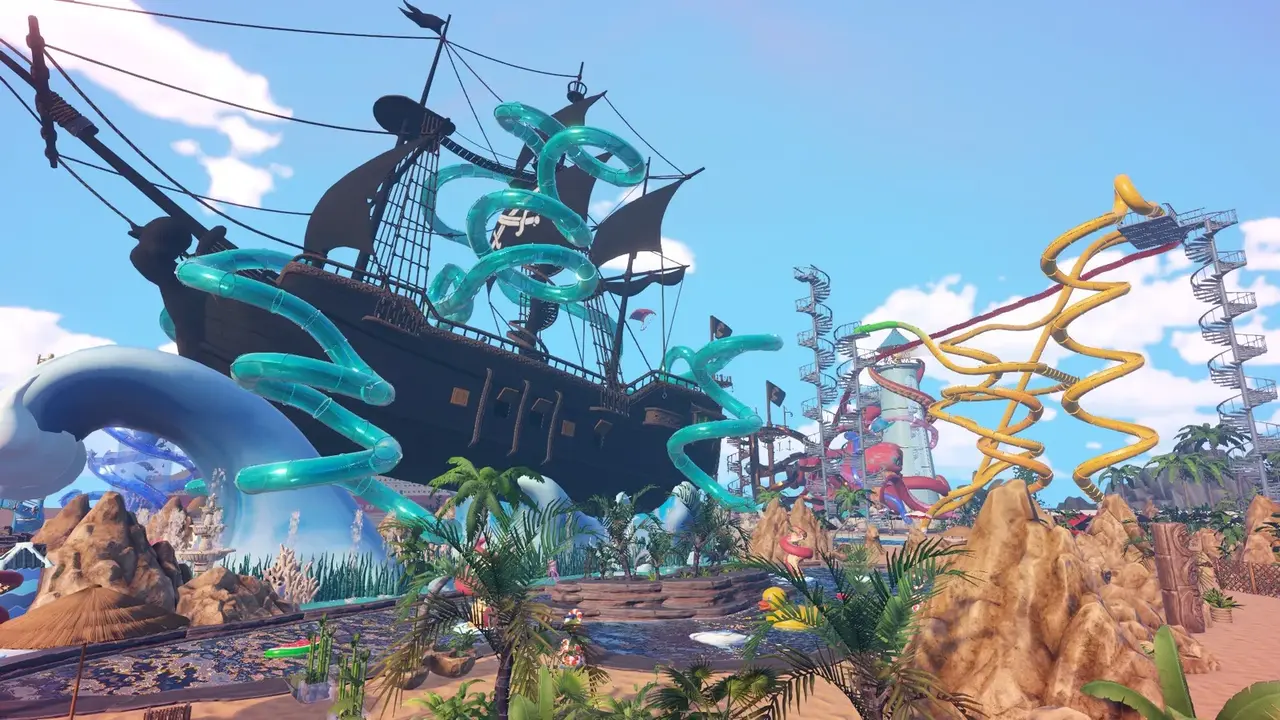
Waterpark Simulator research points: how to get them (smart people icons, water gun, tickets, maintenance), the research tree, and the best unlock order.
Waterpark Simulator Research Points — How to Get & Spend Them (2026)
Research points are the real progression currency of Waterpark Simulator. Stars tell you where you are, but research points decide what you can do: every staff role, tool, ticket upgrade, hiring slot, and late-game system like Chlorine is locked behind the research table, and points come in far slower than cash. This guide covers every way to earn them, how the "smart people" science icons work, what the research tree actually contains, and the unlock order that stops you from wasting a day's grind on the wrong node.
Here's what you'll learn:
- What research points are and why the research table gates everything
- Every way to earn them, ranked from fastest to slowest
- How the smart people / science-icon system actually works
- A full look at the research tree and its main branches
- The best unlock order (bottleneck-first, not shiny-first)
- Farming tricks for when you're stuck a few points short
Official resources: Steam store page · Steam Global Achievements · Steam News & Patch Notes · GameRant research points guide
What Are Research Points in Waterpark Simulator?
Research points are an unlock currency separate from money. You earn them slowly through gameplay, then spend them at the research table (in your office, under the Park tab) to unlock new staff roles, tools, buildings, ticket machines, hire limits, and utility upgrades. Cash buys what already exists; research points buy what becomes buildable at all.
Two rules shape the whole system:
- The research table itself unlocks as your star rating rises — it's tied to completing your task list, so it appears somewhere around the first star and opens new branches as you climb (community discussion).
- There is no way to buy points with money. Every point is earned through hands-on work or quests, which is exactly why it bottlenecks your progression.
The end of the tree is tracked by an official achievement — and it's rare for a reason:
Per the official Steam Global Achievements page, "Nothing Left to Learn" (Unlock all research on Normal or Hard Difficulty) sits at about 8% global unlock. A full tree is a genuine endgame grind, not a mid-game checkbox.
How to Get Research Points Fast
GameRant's testing (source) ranks the methods clearly. From fastest to slowest:
- Water gun on guests — the fastest. Unlock the water gun around your first star, then spray visitors a few times. After about three or four sprays they react, and you get roughly 6–9 points per visitor. A sweep of a busy park beats an hour of chores.
- Sell the correct ticket. Every guest asks for a specific ticket type; handing them the right one awards research XP, while the wrong one makes them leave. This pays off automatically at the gate — you're earning points while doing your job.
- Maintenance work. Cleaning dirty attractions, repairing broken ones, and mopping puddles all feed your research bar. This is the "passive grind" that adds up across a full day.
- Trash pickup. Every filled bag gives progress. The community trick: fill a trash bag, throw it against a wall to spill the trash out, then pick it all up again — doing this next to a dumpster turns a slow chore into a repeatable loop.
Spraying guests earns points; spraying toilets, puddles, and messes cleans them but awards nothing — a trade-off the community guides flag explicitly. If your goal right now is research, make people the target; if it's hygiene, aim at the mess.
Graffiti is a bonus source: cleaning it up gives solid points, and an upgraded mop makes the job faster — the item locations guide covers where the spray-can cleanup chains start. Daily tasks and 1.0's Museum questlines also hand out points as quest rewards, so keeping one active quest that overlaps work you already do is free research progress.
Smart People and the Science Icons, Explained
The "smart people / smart guy" NPC is the community name for the system that feeds you points: small floating science-book icons spawn at random spots around your park, and you collect them by walking into them. Some quests literally read "collect research points 10 times" and point you toward the local smart-guy NPC who emits the icons (GamerBlurb's breakdown).
What the guides agree on:
- Spawns are random — there are no fixed coordinates. The icons appear on the ground in different areas, so you earn them by patrolling your normal management route, not by memorizing spawn points.
- Ticket sales add a small amount on top of the icons — enough to matter over a long day, not enough to fund big unlocks alone.
- The system is slow by design. The official game doesn't publish a spawn schedule, so treat icon collection as a bonus on top of the active farming methods above, not a primary income source.
You don't need to wander aimlessly for icons. Run your normal loop — ticket booth, food, toilets, pools, trash — and you'll cross most spawns anyway. The players who "never find icons" are the ones standing in one spot building slides all day.
The Research Tree: What Unlocks What
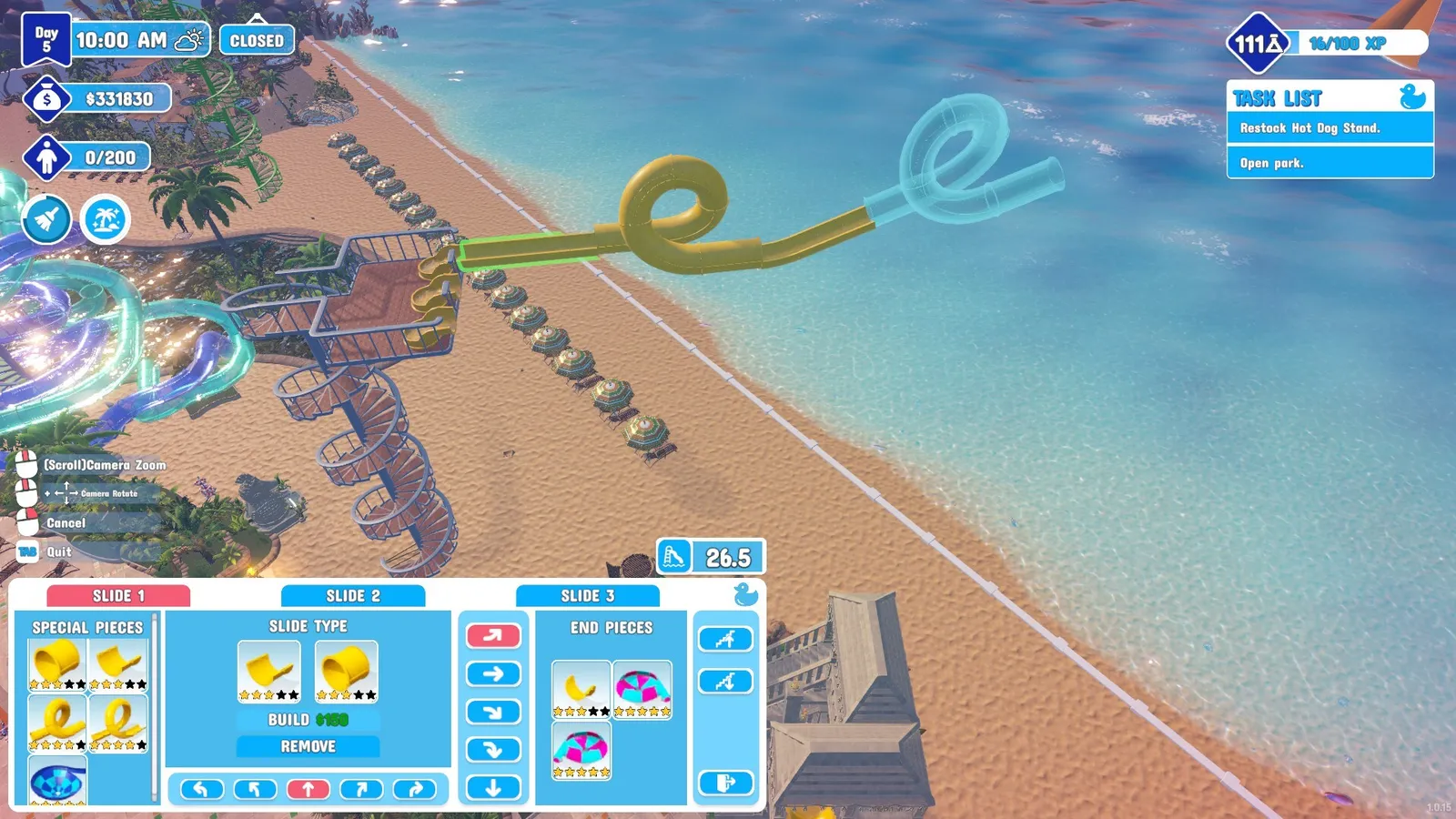
The tree is organized into branches that open progressively as your star level rises. Based on tested 1.0 runs (whisperofthehouse's Hard-mode notes) and community overviews, the main branches are:
| Branch | What it contains | When it matters |
|---|---|---|
| Utility | Modern Toilets, Mop Upgrade, then Chlorine (dirty-pool cleaner) | When pools keep going green and you're draining by hand |
| Tickets | Cashier upgrades, the Ticket ATM (automates card customers) | When the entrance queue is the daily bottleneck |
| Vending | Vendor Training, vending support, Restocker access | When machines empty faster than you can refill |
| Staffing | Hiring Level Up (more employee slots), new role unlocks | When you hit the staff cap mid-game |
| Land | Park Size expansion, new build zones | Only after the current area is stable |
| Tools & late | Hammer upgrades, movement tools, trash solutions, lifeguard coverage, maintenance automation, slide parts, theme branches | The long tail that feeds the endgame |
The 1.0 wellness content added more: Wellness Facilities Training (maintenance staff can run hot tubs and saunas) and Staff Overflow (hire past your cap, paying a daily tax) were both research nodes in the post-1.0 tree. Staff hiring itself is research-gated — the community sums it up as "finding staff is limited by research points" — so the tree is your ceiling on manpower as much as on buildings.
Best Research Points Unlock Order (Bottleneck-First)
Every tested guide converges on the same principle: don't buy the most exciting node — buy the one that removes the job costing you the most time right now (whisperofthehouse). In practice:
- Ticket processing first if guests are physically waiting at the entrance — the Cashier upgrade or Ticket ATM beats a new slide every time.
- Then the utility branch (Mop Upgrade → Chlorine) if dirty pools force repeated drain-and-refill trips. In one Hard-mode run, the remaining route through Modern Toilets + Mop Upgrade + Chlorine was about 16 points, with Chlorine appearing at Research Level 7 — a multi-day commitment, so start it before the pools become a daily crisis.
- Hiring Level Up before unlocking roles. This is the classic trap: the tree offers Lifeguard, Security, and Restocker nodes while your park is already at its staff cap — and unlocking a role does not create a slot. In the tested run, 6 points bought the next hiring limit and opened room for two employees.
- Vending/vendor training when empty machines are a recurring interrupt.
- Park Size last, only when the active section can survive more walking and upkeep — a 7-point choice between Vendor Training, a hammer upgrade, and Park Size went to Park Size in the tested run because the service loop was already stable.
Unlocking a role without a free hire slot wastes points and leaves you staring at a role you can't use. If the staff cap is the wall, the Hiring Level Up node comes first — the full hiring logic is in the staff guide.
Don't end the day when the financial report pops. Run one full cleaning-and-repair circuit after closing — entrance, food, toilets, pools, outer attractions — then spend points. It's the calmest research window of the day, and it turns ordinary chores into deliberate progress.
Farming Research Points When You're Short
- The closing-time circuit (above) is the most reliable farm: after guests leave, the park generates fewer interrupts, so every minute of work counts toward points.
- Trash-bag recycle loop: fill a bag, throw it at a wall to spill it, pick it up again, next to a dumpster — the fastest pure-trash repetition the game allows (GameRant).
- The decor-bush exploit: a community video reports that placing cheap $10 decor bushes grants research XP (roughly 4 points per 100 bushes) and that demolishing them refunds about 80% of the cost — spending $10,000 supposedly nets ~40 points with $8,000 back. Treat those numbers as community-reported and unpatched-exploit territory, not a balanced strategy.
- Know that staff cut your points. When employees do the work, you get half points for building and mopping, and only a flat 1 point for repairs and cleaning that would give you 1 point per 10% done yourself (community report). If you need a personal research push, temporarily lean on fewer janitors — the tested run found two janitors reached every puddle before the player could mop it, which is great for satisfaction and terrible for your research bar.
- In co-op, the host can restrict guests' spending — the 1.0.50 lobby settings include using research points as a host restriction, so you can keep a shared park's unlocks on plan (multiplayer guide).
Points and cash are separate problems: if money is the bottleneck instead, the money-making guide covers the income side, and the walkthrough shows where each research gate sits in the star ladder.
Frequently Asked Questions
How do I get research points in Waterpark Simulator? By collecting science icons that spawn around the park (the "smart people" system), spraying guests with the water gun (~6–9 points per visitor after a few sprays), selling the correct tickets, and doing maintenance like cleaning, repairing, mopping, and trash pickup. Cleaning graffiti and completing daily/Museum quests add more.
What are smart people in Waterpark Simulator? The community name for the NPC tied to the research system. Small science-book icons spawn randomly around your park, and you pick them up by walking into them; some quests point you at the smart-guy NPC and ask you to "collect research points" a set number of times.
What should I unlock first with research points in Waterpark Simulator? Whatever removes your current bottleneck: ticket processing upgrades when the entrance queues, the Mop Upgrade → Chlorine utility route when pools keep going dirty, and Hiring Level Up before unlocking any new staff role. Never buy the exciting node while a utility problem repeats daily.
Does staff work give research points? Yes, but at a reduced rate — community reports say building and mopping done by staff earns about half the points, and repairs/cleaning give a flat 1 point for the whole job instead of per-10% progress. If you need a personal research push, temporarily run with fewer janitors.
How many research points does Chlorine need? The game publishes no fixed price, and costs vary by difficulty and patch. In one tested Hard-mode run, the full route through Modern Toilets + Mop Upgrade + Chlorine cost about 16 points, with Chlorine appearing at Research Level 7 — treat those as reference numbers (pending verification), not a guaranteed bill.
Related Guides
- Waterpark Simulator Beginner's Guide — Your First Shift
- Waterpark Simulator Guide — Park Management Explained
- Waterpark Simulator Walkthrough — Full Progression & Endgame Order
- Waterpark Simulator Staff Guide — Hiring, Roles & Overflow
- Waterpark Simulator Item Locations — Chlorine, Water Gun, Zen Towel
- Waterpark Simulator Achievements — All 71 Unlocks
- Waterpark Simulator Money-Making & Best Layout
Last updated: August 14, 2026.
More Waterpark Simulator Guides
Waterpark Simulator mods: no official Workshop, but Nexus mods via BepInEx/MelonLoader — install steps, the 8-player mod, graffiti mod, and updates.
Waterpark Simulator money making: every income source, the tips multiplier, best layout principles, what to sell, and how to hit the $500K 5-star goal.
Waterpark Simulator multiplayer: online co-op up to 4 players, hosting and invites, lobby privacy, voice chat, permissions, and 8-player mods.
Waterpark Simulator PS5 guide: release date, price, PS Plus co-op, trophies, performance, mods and cross-save — how the console build differs from PC.
Waterpark Simulator review: Steam rating, critic consensus, pros and cons, performance and co-op verdict — is the $12.99 first-person park sim worth it?
Waterpark Simulator staff guide: every role (cashier, vendor, janitor, lifeguard), how to hire, staff overflow fixes, wages, and the best hiring order.
How Waterpark Simulator runs on Steam Deck: Proton Experimental setup, controller layouts, performance settings, FPS expectations, and known Deck issues.
Waterpark Simulator system requirements: official minimum and recommended PC specs (CPU, GPU, RAM, 20GB), what hardware actually runs it, and Steam Deck notes.