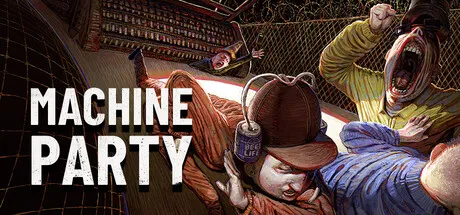
Machine Party lore explained: the unnamed facility, why you're test subjects, the lethal party rules, and how it fits Mike Klubnika's shared universe.
Machine Party Lore — The Facility, Test Subjects & the Klubnika Universe (2026)
Machine Party is a game that feels like it has a story even though it never tells you one. You and up to three friends are dropped into a brutal industrial facility, forced through a gauntlet of 15 lethal minigames, and the last one standing walks out. There are no cutscenes, no named characters, no dialogue — just environment, mechanics and dread. That's deliberate: the game is set in the Klubnika universe, the shared industrial-horror world of creator Mike Klubnika (Buckshot Roulette, s.p.l.i.t.), and the lore is told through the facility itself. This guide assembles everything the game, the developer and the official materials actually confirm.
Here's what you'll learn:
- What the game's premise says about its world
- The facility: what it is, what happens inside, why it stays unnamed
- Test subjects: your actual role, and why customization is your identity
- The "party rules" lore baked into the minigames
- How it connects to Buckshot Roulette and the wider Klubnika universe
- Why the lore is minimal on purpose

Official resources: Steam store page · Mike Klubnika's dev log · Games Press — official launch press release · Oro Interactive
The Premise: A Party Where Survival Is Unlikely
The official pitch, straight from the store page, is the entire lore setup in two sentences: "Gather your friends and endure high stakes situations to prove your life is worth more than theirs. Survival is unlikely." Machine Party, published by Oro Interactive and released July 30, 2026, reframes the party-game genre as a death tournament: four people, one facility, fifteen games, zero survivors guaranteed.
From Mike Klubnika's official development log: "There's a lot of fucked up stuff happening in the facility."
That sentence is the closest thing the game has to an author statement — and it's more honest than any codex page.
The Facility: An Unnamed Industrial Hell
The entire game happens inside one brutalist industrial facility. No name is ever given to it, no logo explained, no narrator introduced — and per the developer's own design notes, that's intentional: Klubnika's games tell stories through spaces, not text.
What the environment and official materials establish:
- It's a factory repurposed as an arena — the minigames happen on the facility's own infrastructure: an assembly line (firearm building), a rail yard (train dodging), a field (mine crossing), a mess hall (the pea-eating contest at gunpoint)
- It's an experiment, not a show — nothing suggests an audience or broadcast; the facility exists to run lethal trials on test subjects
- The industrial soundtrack (by Alex Peipman) carries the mood — grinding machinery, alarms, the wrongness of a party held in a works factory
The facility is a character in the same way the bathroom-turned-arena in Buckshot Roulette is: a space that says more about the world than any line of dialogue would. For the full 15-game rundown, see our minigames guide.
Test Subjects: Your Role in the Experiment
You are a test subject — one of several anonymous "customers" of the facility. The key lore detail: you're not characters, you're specimens.
- There are no named characters in the game — no backstories, no dialogue, no portraits
- Customizable test subjects are the entire identity system: you dress up your anonymous subject, and that's the only characterization the game offers
- Death is permanent per round and graphic — when you lose a minigame, you lose the game (and your limbs, per the reviews)
That design choice is the lore: the facility doesn't care who you are, only that you perform. The game's 18+ rating (extreme violence, per the German and Brazilian boards) isn't shock value — it's the subject-treatment made literal. Our how to play guide covers what a session actually looks like from the inside.
The Party Rules: Lore Baked Into Mechanics
Each minigame's premise is a small worldbuilding beat — the "highly illegal party game formats" the store page mentions:
- Chisel Gauntlet — a memory round, played for keeps
- Firearm Factory — assemble a gun faster than your rivals; the factory floor is the game
- Tunnel Hazard — the train yard as a death trap
- Pea eating — a mess-hall contest where losing means the gun goes off
These aren't random party games; they read as the facility's chosen trials — workplace tasks, mess-hall rituals and gameshows twisted into executions. The full list with rules is in our minigames guide.
Mike Klubnika has said the team deliberately cut dialogue and transitions to keep the game lean. Don't expect a story mode or codex — the story is the facility, and the facility is the game.
The Klubnika Universe: One Connected Horror World
Machine Party is officially described as containing minigames "set within the Klubnika universe" — the shared setting across Mike Klubnika's games. What that means in practice:
- Buckshot Roulette (2024, his breakout): the same industrial-brutalist aesthetic, the same unnamed antagonist in a dead-end space, the same "consequences for every mistake" design DNA
- s.p.l.i.t. and his earlier works: alternate dystopias, handcrafted industrial environments, visual storytelling over exposition
- Machine Party extends the universe sideways — it's the party-game branch of the same factory-world, and its trailer debuted at the Triple-i Initiative alongside the Buckshot Roulette lineage (see the official premiere trailer)
It's not a connected narrative with shared characters — it's a shared mood and world logic: machine horror, institutional cruelty, and games played for keeps. Our review has the Buckshot comparison from the player side.
What Isn't Confirmed (Be Honest About It)
The community speculates about a grander backstory — the facility's owner, the experiment's purpose, a possible tie-in with Buckshot Roulette's dealer. As of August 2026, none of that is in the game or official materials. What's confirmed: the facility, the test subjects, the lethal party formats, and the Klubnika universe branding. Everything else is atmosphere, and the game is happy to keep it that way. Future updates may add context — our update guide tracks the patch notes.
Frequently Asked Questions
Is there a story in Machine Party?
Not a traditional one — no cutscenes, dialogue or named characters. The lore is environmental: you're test subjects in a brutal industrial facility running lethal party games, and the story is told through the setting.
What is the lore behind Machine Party?
Players are anonymous test subjects forced through 15 lethal minigames in an unnamed industrial facility, run as an experiment where "survival is unlikely." The developer confirmed "there's a lot of fucked up stuff happening in the facility."
Who is in Machine Party?
No named characters exist. Players control customizable test subjects — the customization is the only identity system in the game.
Is Machine Party connected to Buckshot Roulette?
Yes — both are set in the "Klubnika universe," Mike Klubnika's shared industrial-horror world, sharing the same brutalist aesthetic and "consequences for every mistake" design DNA. No shared characters or narrative though.
What is the Klubnika universe?
The shared setting of Mike Klubnika's games (Buckshot Roulette, s.p.l.i.t., Machine Party): alternate dystopias, handcrafted industrial environments, and visual storytelling over exposition. Machine Party's minigames are officially described as set within it.
Related Guides
- Machine Party Guide — How to Play & Every Minigame
- Machine Party Minigames — All 15 Explained
- How to Play Machine Party — Controls & What to Expect
- Machine Party Review — Worth It?
- Machine Party Update — Patch Notes & Roadmap
Last Updated: August 13, 2026
More Machine Party Guides
New to Machine Party? Learn the controls, how to set up your first lobby, how the minigame gauntlet works, and what actually matters in your first session.
Every Machine Party minigame explained — Minefield, Chisel Gauntlet, Firearm Factory, Wrong Way, Duck Hunt and 10 more — with rules and win conditions.
Machine Party mods guide: how to install the godot-mod-loader (Windows), where mods go, how to switch vanilla/modded, and the best community mods.
How Machine Party multiplayer works: 18-digit room codes, online co-op for 2–4 players, Steam invites, why there's no matchmaking, and how to find players.
Every Machine Party platform: Windows and Linux on Steam (native), the macOS situation, and why there's no Xbox, PS5 or Switch version yet.
How much does Machine Party cost? The $7.99 launch price, the 15% discount until August 13, what you get for the money, and whether it's worth it.
Machine Party review: 89% Very Positive Steam rating, 15 minigames, half a million week-one sales — the honest verdict on whether it's worth buying in 2026.
Where Machine Party saves are stored (Godot user data + Steam Cloud), how to back them up, and how to restore progress after a reinstall.