Machine Party Guide — How to Play, Every Minigame & Pro Tips (2026)
The complete Machine Party guide: how the 15-minigame death party works, how to play online with friends, every minigame explained, and the tactics that win rounds.
Machine Party Guide — How to Play, Every Minigame & Pro Tips (2026)
Machine Party is the violent party game from Mike Klubnika — the creator of Buckshot Roulette — and GDeavid, published by Oro Interactive. It launched July 30, 2026 on Steam for $7.99 (15% off launch price through August 13), sold half a million copies in its first week, and sits at 89% Very Positive across more than 800 reviews. Two to four players run a gauntlet of 15 lethal minigames, and only one test subject leaves the facility alive. This guide is the full picture: how the game works, how to set up a session, every minigame, and the tactics that actually win rounds.
Here's what you'll learn:
- What Machine Party is and where it came from
- The core "last one standing" loop and how a session flows
- Every one of the 15 minigames, with rules and win conditions
- How to set up a 2–4 player lobby with room codes
- General tactics that win across every minigame type
- Whether it's worth your money in 2026
Official resources: Steam store page · Steam news hub · Mike Klubnika official site · Oro Interactive
What Is Machine Party?
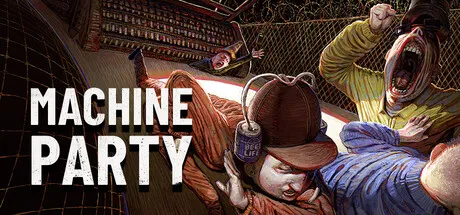
Machine Party is a collection of violent party games where failure is lethal. The pitch, straight from the store page: "Gather your friends and endure high stakes situations to prove your life is worth more than theirs. Survival is unlikely." You and up to three friends get dropped into a brutal industrial facility, then fight through a rotating gauntlet of absurd, lethal minigames — stuffing peas at gunpoint, dodging trains, assembling firearms faster than your rivals — until one player is left standing.
The game comes from Mike Klubnika (creator of the breakout hit Buckshot Roulette) working with GDeavid, published by Oro Interactive. It carries the same design DNA as Buckshot Roulette: dark humor, dread-soaked machinery, an industrial atmosphere, and consequences for every mistake. Where Buckshot Roulette is a tense 1v1-vs-the-dealer gamble, Machine Party is a fast-paced party-game collection built for 2–4 players.
If you liked Buckshot Roulette's tone but want something to play with a group, Machine Party is the party-game evolution of that vibe — same machine horror aesthetic, but built around 15 quick, brutal minigames.
Why It Blew Up
Machine Party hit half a million copies in its first week (reported by App2Top), with a peak of roughly 6,000 concurrent players and an 89% Very Positive Steam rating. The recipe:
- Buckshot Roulette's audience following Mike Klubnika
- A simple, watchable formula — short lethal minigames are perfect for streaming and clips
- A tight 2–4 player scope — easy to jump into with friends, hard to put down
How the Core Loop Works
Every Machine Party session follows the same skeleton:
- Set up a room — 2–4 players join via an 18-digit room code (there is no matchmaking; more on this below).
- Play minigames in sequence — the facility throws one lethal challenge after another at the group.
- Eliminations accumulate — losing a minigame usually means death, and death removes you from the running.
- One player remains — the last one standing wins the session.
Most minigames resolve in a minute or two, and a full 15-minigame rotation runs about an hour. Winning one minigame doesn't crown a champion — consistency across the gauntlet is what matters. Each minigame is a fresh set of stakes, and the game keeps score by who survives the longest across the whole rotation.
Machine Party is pure competition. There's no co-op safety net, no team win, no mercy. Alliances may form, but they last exactly until a round where betraying a friend wins the round.
The 15 Minigames, Explained
Machine Party ships with 15 minigames, each tied to one Steam achievement (the achievement descriptions name their game, which confirms the roster). Here's every one of them with its win condition:
| # | Minigame | What happens | How to win |
|---|---|---|---|
| 1 | Minefield | Run down a corridor while a bladed vehicle chases you; the floor hides invisible mines | Stand still to ping mines, weave through, reach the exit alive |
| 2 | Chisel Gauntlet | Memorize the missing pieces of a 3×3 cube, then carve your cube to match | Carve the cube correctly before the timer gun fires |
| 3 | Firearm Factory | Grab weapon parts from the floor and assemble a gun at your table | Be the first to assemble and shoot someone before they shoot you |
| 4 | Wrong Way | An escalator crushes you at the bottom; directional buttons appear above | Enter the correct sequence in rhythm to climb and survive |
| 5 | Duck Hunt | One player is the Hunter sniping from a vantage point; the rest run an open corridor | Runners: use cover to reach the building. Hunter: eliminate everyone |
| 6 | Stable Footing | Stand on a 6×8 grid of tiles over a pit; panels light the safe tiles | Follow the correct tiles and push rivals into the pit |
| 7 | Table Manners | Eat peas with a fork while a murderer reads the newspaper; freeze when he looks up | Fork and eat your whole plate without moving while watched |
| 8 | Tunnel Hazard | A train barrels through a room with six alcoves; one green light hides a safe spot | Hide in the lit alcove, avoid the pillar drop, survive the train |
| 9 | Inside Job | Search an office for a syringe; the finder becomes the hunter and infects everyone | Hunter: infect all. Runners: find and escape without being infected |
| 10 | Smoke Break | Inhale and exhale a cigarette with perfect timing | Most successful puffs wins; the loser gets executed by a trolley gun |
| 11 | Debris Platforms | Stand on a platform as debris drops from a piston overhead | Keep your platform clean — or throw your debris onto rivals' platforms |
| 12 | Spine Breaker | A mechanical spider hunts you through a room of cover | Throw the spider off if it latches on; dump it on someone else |
| 13 | Lethal Rebound | Spinning blades launch from three crawlspaces and ricochet around the room | Stay out of their paths; last one standing wins |
| 14 | Forklift Certified | Drive a forklift and bank as many boxes as possible in 20 seconds | Most boxes banked wins; lowest count gets executed |
| 15 | The Filter | Sort items on a conveyor: art into the furnace, machine parts through | Most points wins — sort fast and correctly |
The minigame categories map onto skill types: reflex challenges (Duck Hunt, Stable Footing, Wrong Way, Minefield, Lethal Rebound), social deception (Tunnel Hazard, Inside Job, Table Manners, Smoke Break), assembly & precision (Firearm Factory, The Filter, Chisel Gauntlet), and hazard routes (Debris Platforms, Spine Breaker, Forklift Certified). A good Machine Party player is decent across all four categories — that's the real skill test.
How to Set Up a Machine Party Session
Because there's no matchmaking, every session starts with someone hosting:
- Buy and install on Steam — Windows or Linux (there's no macOS build, and no console versions exist yet).
- Host a lobby — the game gives you an 18-digit room code.
- Share the code — friends join from the main menu with the code (or via Steam friend invite).
- Pick a session length / rotation — the gauntlet runs until one player is left standing.
- Play — rounds rotate through the 15 minigames; eliminations stack until a champion emerges.
The room code is the core path, but a Steam friend invite is more reliable if the code ever fails to connect — it bypasses typing errors entirely.
If you have more than four people, rotate players between sessions — the four-player cap is a hard ceiling, not a soft suggestion.
Tactics That Win Machine Party Sessions
These general rules apply across most of the 15 minigames:
- Read the room before the round — most minigames telegraph their danger in the first seconds. Don't commit to a "strategy" before you've seen the trap layout, the timer, or the arena.
- Rhythm beats panic in timed games — pea-stuffing and escalator rhythm games reward steady, consistent inputs over frantic mashing. Missing fewer beats beats hitting more.
- Don't be the first to move in survival rounds — early movers trigger traps; late movers get cornered. The middle of the pack is usually the safest lane.
- Commit in decision games — hesitation is the #1 cause of death in quick-decision minigames like Chisel Gauntlet and Firearm Factory.
- Use sabotage — many minigames let you interfere with rivals (pushing, throwing debris, blocking alcoves). A well-timed sabotage wins a round outright.
- Survive > win — you don't need to win every minigame; you need to survive them. When elimination is on the line, prioritize staying alive over scoring points.
In Stable Footing and other hazard minigames, players routinely die trying to push a rival when they should have stepped to safety. The win is the session, not the single round — play the long game.
Customization and Extra Systems
Machine Party lets you customize your test subject — outfits and colors that make you readable (and memeable) in lobbies. It's cosmetic, but worth setting up before a session night, since readability helps friends (and enemies) track who's who during chaotic rounds.
The game also ships with an industrial soundtrack by Alex Peipman, matching the machinery-dread aesthetic of Buckshot Roulette. There's no single-player mode — every mechanic is built around the 2–4 player lobby, so this is strictly a friends-night game.
Common Mistakes That Get Players Eliminated
The fastest way to improve at Machine Party is to stop making the mistakes everyone makes in their first sessions:
- Moving before reading the arena. In Minefield, Duck Hunt and the hazard minigames, the first seconds are pure information — mine patterns, safe lanes, alcove lights. Players who sprint immediately die immediately. Wait a beat, read, then move.
- Mashing timed inputs. Table Manners, Wrong Way and Smoke Break punish panic. The inputs aren't hard; the rhythm is the game. Steady beats fast, every time.
- Camping what looks safe. Tunnel Hazard's green alcove turns red, Stable Footing's tiles shrink, Debris Platforms' piston falls. "Safe" in this game always has an expiration date.
- Hunting instead of surviving. Going for kills in Duck Hunt or Inside Job leaves your own survival wide open. The session winner is the survivor, not the hunter.
- Solo-playing a party game. Machine Party's meta is social — reading who panics, who sabotages, who waits. Players who treat it as a mechanical skill check miss half the game.
Treat your first three rounds as intelligence gathering. Who folds under pressure? Who targets the leader? Who plays safe? The player who answers these questions first usually wins the session.
The Social Game: Reading Your Group
Machine Party is secretly a social deduction game wearing a party-game costume. The minigames are the mechanics, but the session is won by reading people:
- Alliances are real, and they're temporary. Two players can team up to squeeze out the third — until the round where betraying the alliance wins.
- Revenge is a strategy. If you sabotage someone visibly, they'll target you for the rest of the night. Either sabotage secretly (debris looks accidental) or save it for the final rounds.
- The quiet player wins. In 4-player sessions, the player who avoids attention while others eliminate each other is consistently the last one standing.
- House rules multiply the fun. Many groups add spectator betting or "winner of the round picks the next lobby" rules — cheap, social, and they keep everyone invested between rounds.
The takeaway: Machine Party rewards the player who watches the group, not just the arena. That's what separates the player who wins one round from the player who wins the night.
Machine Party in Context: Worth Buying in 2026?
At $7.99 (or $6.79 with the launch discount through August 13), Machine Party sits in impulse-buy territory, and its 89% Very Positive rating backs that up. What you're paying for:
- 15 distinct, polished minigames with real tension and strong meme potential
- A two-hour party-night formula that's easy to teach and hard to master
- An active, fast-growing community (half a million copies in week one)
What you're not getting:
- No matchmaking — you need friends or a community to play with
- No local co-op at launch — couch play is planned for a late August update
- No console or macOS versions — Windows and Linux Steam only
- A short content pool — the 15 minigames are the whole game; variety comes from the group, not the content
If you have a regular group of 2–4 people and you liked Buckshot Roulette's energy, it's an easy recommendation. If you're playing solo or hoping for a deep single-player experience, it's not that game.
The launch build is online-only. The developer confirmed local/couch co-op is planned for a late August 2026 update, with Steam Remote Play Together as a workaround until then.
FAQ
What is Machine Party? A violent party game from Mike Klubnika (Buckshot Roulette) and GDeavid where 2–4 players compete in 15 lethal minigames — failure is fatal and one player ends up last one standing.
How do you play Machine Party? Host a lobby, share your 18-digit room code, then survive a rotating gauntlet of 15 minigames. Lose a round and you're usually eliminated; the last player alive wins the session.
How many minigames are in Machine Party? 15 minigames at launch, each with its own lethal scenario and matching Steam achievement.
Is Machine Party worth buying? At $7.99 with an 89% Very Positive rating and half a million week-one sales, it's an easy yes if you have 2–4 friends to play with. No matchmaking and no local co-op at launch are the main caveats.
How many players can play Machine Party? 2 to 4 players per room — 2 is the minimum, 4 is the documented maximum.
Related Guides
- Machine Party Minigames — All 15 Explained
- How to Play Machine Party — First Session Guide
- Machine Party Multiplayer — Room Codes & Online Co-op
- Machine Party How Many Players — 2–4 Player Cap
- Machine Party Review — Worth Buying in 2026?
- Machine Party Mods — Install Guide & Best Mods
Last updated: August 12, 2026