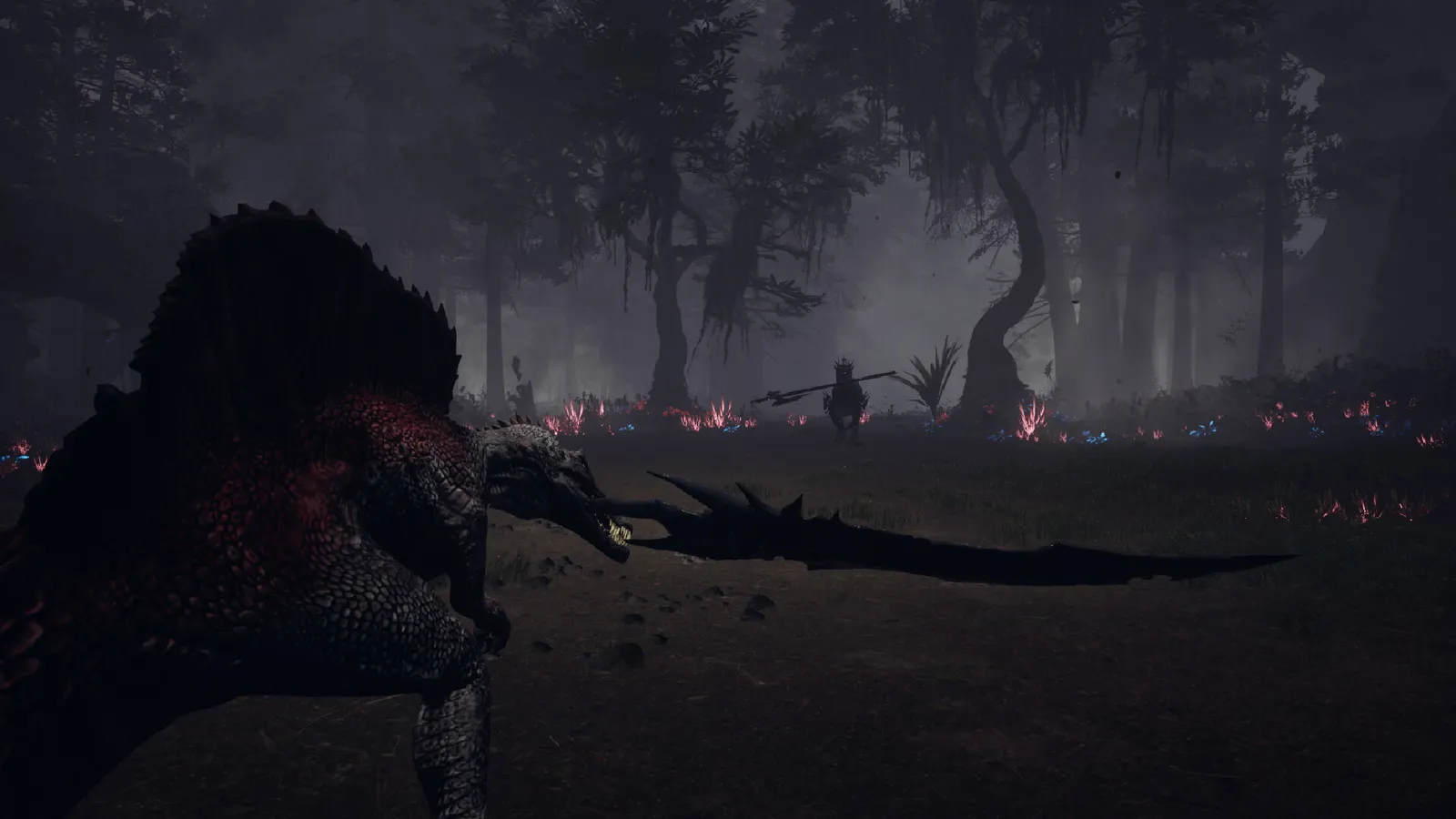
Dinoblade playtime explained: 2-3h focused, ~6h typical, 8h+ for 100%, plus the 16-boss gauntlet, Boss Rush replay, and the demo as a measuring stick.
Dinoblade How Long to Beat — Full Playtime Breakdown (2026)
There is no official Dinoblade playtime figure, but the community data is consistent: a focused run takes about 2–3 hours, a typical playthrough runs ~6 hours, and 100% completion lands around 8+ hours. That makes Dinoblade a short, dense soulslike — a boss-rush-shaped campaign of 16 fights connected by short treks — where your actual time depends almost entirely on how fast you master the parry system. Here's the full breakdown.

Here's what you'll learn:
- The verified community numbers: 2–3h / 6h / 8h+ playthrough estimates
- Why the game is shaped like a boss rush (16 fights, short treks)
- Where players actually lose time (the walls: Kasei, Shield)
- How much replay value exists after the credits (Boss Rush, summons)
- How to use the demo as your personal measuring stick
Official resources: Steam store page · IGN game page · Metacritic · Game8 review
How Long Is Dinoblade? The Numbers
No developer-announced campaign length exists, and crowd-sourced completion data is still forming — but three independent community estimates agree with each other:
| Run type | Time | Source |
|---|---|---|
| Focused main path | ~2–3 hours | Launch-week players on the Steam forums |
| Typical playthrough | ~6 hours | A player who finished with 26/29 achievements reported 6 hours |
| Full completion (100%) | ~8+ hours | A launch review with full exploration |
These figures are consistent with the critical consensus: GamingBolt called Dinoblade "a short and sweet experience," and Worth Playing noted it "doesn't require a high double-digit investment of hours."
The 2–3 hour focused figure assumes you're comfortable with parry timing. Dinoblade's entire difficulty is gated on one system: learn the parry-and-posture loop and the 2–3 hour pace is realistic; fight the parry system and every boss wall can double your time. Individual results vary more than in most games this size.
Why Dinoblade Is Shaped Like a Boss Rush
The playtime structure explains the numbers: 16 boss fights connected by short treks. The campaign is region-by-region — dry canyons, mist-shrouded jungles, frozen mountain basins, forgotten ruins — and each region is ruled by an Alpha predator guarding the path forward. Nearly all of the runtime is boss encounters, which is why:
- A skilled player blazes through the treks and spends time only on the fights
- A stuck player loses hours to a single Alpha (see below)
- The game feels "all meat" — dense, but short by soulslike standards
The walkthrough has the full route; the all bosses guide lists the 16 fights in order.
Where the Time Actually Goes: The Walls
The live Steam achievement data shows exactly where players lose time:
- Kasei, the Tyrant — only ~52% of players have beaten him; the first big parry-and-posture check
- Shield (the defender right after Kasei) — the worst pass-through rate in the entire game
- The final boss, Maakyuurii — only ~11% have the kill achievement (I AM the Meteor)
- Boss Rush Mode — cleared by just ~3.3% of players
If you're time-boxing your playthrough, invest in the fundamentals before Kasei: the combat guide explains the posture/Resolve loop, and the final boss guide covers the endgame walls.
If you're time-boxing your playthrough, invest in the fundamentals before Kasei: the combat guide explains the posture/Resolve loop, and the final boss guide covers the endgame walls.
Also worth knowing: the final stretch itself is a two-part wall — the Kasei Horde gauntlet immediately before Maakyuurii, then the two-phase final fight with its health-bar reset. Even players cruising through the campaign report the last hour-plus stretching out while they learn those two encounters. And because the developer has patched boss balance nearly daily since launch (Kasei, Red Ash, and the final boss all received balance passes), early-playthrough times from launch week may not match your experience — some fights got easier, and hitbox fixes changed what's punishable. The updates and patch record tracks what changed when.
In a game where nearly all runtime is boss fights, the parry system IS the length modifier. Players who parry through the campaign finish in 2–3 hours; players who dodge-tank everything can spend 10+ hours on the same route. A few parry drills in the opening region (see the beginner guide) pay back the entire playthrough.
Replay Value After the Credits
Short campaigns get a pass when the replay loop is strong, and Dinoblade's is confirmed:
- Boss Rush Mode — unlocked by beating the final boss: a continuous back-to-back boss gauntlet with official Steam leaderboards. This is the intended post-game loop, and leaderboards give it a competitive hook
- Summons — every defeated boss becomes an AI ally with a passive perk, so collecting them all is a completionist track
- Legendary weapons — hidden in the world and confirmed to change how your Spinosaurus plays; hunting them is the community's open discovery project
- Build variety — Soul Arts (Meteor Slice / Dash / Zone lines) and attribute choices (Health/Strength/Resonance/Stamina) reward multi-run experimentation
New Game+ is not currently in the game — the store page doesn't list one, and forum threads asking for it are requests, not confirmations. Post-game replay is Boss Rush + leaderboards, not NG+. The price guide weighs that replay package against the $19.99 price tag.
Use the Demo as Your Measuring Stick
The demo (October 2025 to pre-launch) covered the opening route through Kira, Axe, and Kasei — roughly the first third of the campaign's checkpoints — in about 45–90 minutes. That's a solid scale model: if the demo's pacing felt right, the full game runs roughly three times that length; if it felt thin, the full campaign will feel thin proportionally. More on what the demo covered in the demo guide.
Frequently Asked Questions
How long does it take to beat Dinoblade?
A focused run is ~2–3 hours, a typical playthrough ~6 hours, and 100% completion ~8+ hours — per consistent community reports. There is no official figure.
Is Dinoblade a long game?
No — it's a short, dense soulslike: 16 boss fights connected by short treks. Length is the game's most common criticism even among positive reviews.
How many hours is Dinoblade 100% completion?
About 8+ hours, including all Alphas, legendary weapon hunting, and Boss Rush attempts.
Why is Dinoblade so short?
The campaign is boss-rush-shaped by design: nearly all runtime is boss encounters, with minimal exploration between them. The post-game (Boss Rush + leaderboards) is where the long tail lives.
Is there replay value after beating Dinoblade?
Yes — Boss Rush Mode (back-to-back boss gauntlet with leaderboards), boss summons, legendary weapon hunting, and Soul Arts build variety. New Game+ is not currently in the game.
Related Guides
Last updated: August 14, 2026.
More Dinoblade Guides
Is Dinoblade multiplayer? No — single-player only. No co-op, no PvP, no crossplay, and no console versions. Here's the full multiplayer status.
Dinoblade demo explained: what the free Steam demo covers (Kira, Axe, Kasei), how long it takes, its 97% rating, and whether demo progress carries over.
Dinoblade final boss guide: Maakyuurii the Ice King and the Flame Reborn phase, how to reach the meteor fight, prep loadout, and the Boss Rush unlock.
Was Dinoblade on Kickstarter? No campaign exists — the real story is a 2022 viral animation, 500K wishlists, a 97% demo, and a July 23, 2026 launch.
Dinoblade mods, save files and OST explained: no Steam Workshop, a small Nexus mod scene, Steam Cloud saves, and the 8-track Boss Theme Collection.
Dinoblade price explained: $19.99 on Steam, the 10% launch discount ($17.99), regional pricing, no DLC or bundles, and whether it's worth the money.
Dinoblade release date confirmed: July 23, 2026 at 10 AM on Steam (PC, Windows-only). Full timeline from the 2022 viral clip to launch, plus console status.
Dinoblade on Steam Deck: Valve's official Playable rating, what works and what doesn't, best graphics settings, and community performance reports.