Big Walk Tools & Communication Gear — Every Item Explained
Every Big Walk tool explained: walkie-talkies, laser pointers, binoculars, megaphones, flares, flashlights, and the comedy items (cowbell, whiteboard, golden head) — what each does and when it matters.
Big Walk Tools & Communication Gear — Every Item Explained
Big Walk has no weapons, no combat, and no gear stats — every item in the game exists to help you communicate, find each other, or solve a puzzle. The tool set is the game's answer to "what do we do when the voice cuts out?" Here's every tool we've confirmed, what it does, and when it actually matters.
Here's what you'll learn:
- Every communication tool and how it works
- Which tools are limited (and why that's the point)
- The proximity voice chat system that tools layer on top of
- The comedy items — and the one that secretly matters
Official resources: Steam store page · IGN game page · IGN review · Wikipedia
The Tool List, Explained
From the Steam description and IGN's review, the confirmed tool set:
| Tool | What it does | When it matters |
|---|---|---|
| Walkie-talkie | Long-range voice relay; crackles over distance | Split-up puzzles; only 1–2 exist per area, so they become bargaining chips |
| Laser pointer | Silent, precise pointing and countdown signals | Signaling "watch me" or counting down a synchronized button press |
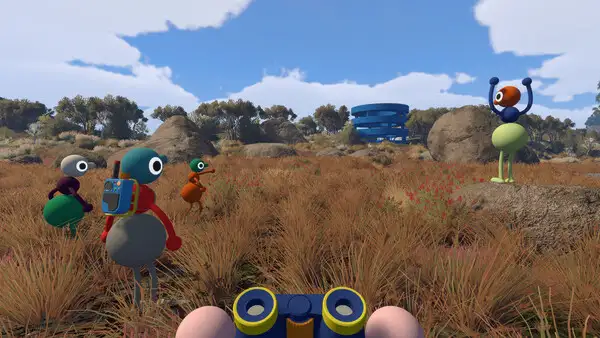
| Binoculars / telescope | Spot far-away puzzles and positions | Coordinate hunting and the telescope+button puzzle family |
| Megaphone | Project your voice further | Getting a stranded player's attention at range |
| Flare | Visible signal from far away; lights up the night | Night rescues and regroup signals |
| Flashlight | See in the pitch-dark night | The night cycle turns darkness into a real obstacle |
| Cowbell | Pure comedy communication | Attention-grabbing chaos; the IGN group "obnoxiously clanged" it |
| Whiteboard | Written messages | The Steam description literally lists it with a "(?)" — its exact role is part of the fun |
| Big golden head | ?? — the Steam description lists it with a "(???)" | The game's most mysterious item; community theories say it has a purpose |
You equip tools from your hand and swap from hand to belt. Tools aren't instanced — there's a finite supply in the world, and only 1–2 walkie-talkies exist per area. Sharing (and not losing) them is part of the puzzle.
The Walkie-Talkie: The Most Important Tool
The walkie-talkie is Big Walk's long-range communication channel. Its mechanics define how split-up puzzles work:
- Voice relays through it with a crackle — the game's audio design makes walkie voice feel like a real radio
- Only 1–2 exist per area — you can't all have one; groups must decide who carries it
- Losing it is an emergency — IGN's group kicked their only walkie-talkie off a cliff and spent a significant chunk of time retrieving it, because without it they "could easily lose each other in the dead of night"
Practical rules: the walkie carrier is the pivot point for split-up puzzles; if you separate, the carrier should stay with the group's "base" while the scout takes the other tool.
Proximity Voice: The System Underneath
Big Walk's proximity voice chat is the primary communication channel, and tools layer on top of it:
- Voices fade with distance — walk too far and you simply can't hear each other
- Voices echo down corridors and muffle through walls
- Walkie-talkies crackle — your voice quality changes based on the channel you're using
- Many puzzles remove your voice entirely — at those moments, only gestures and tools work
The practical implication: position matters as much as volume. The game doesn't let you just "be heard" from across the map — you need tools, or proximity, or both.
Most groups keep Discord open for the moments the game mutes you. That's fine for practicality, but you'll miss the game's best moments: the puzzles designed around the limitation of communication are the ones critics rave about. Save the external channel for when you're stuck.
The Comedy Items (and the One That Matters)
The Steam description lists the whiteboard, cowbell, and big golden head with escalating question marks — "(?), (??), (???)." These are the game's personality layer:
- Cowbell — the "obnoxious" attention tool. The IGN group spent early time clanging it while testing movement
- Whiteboard — written messages for when voice fails; exact mechanics still being mapped by the community
- Big golden head — the game's most talked-about mystery. Community theories range from a pure joke item to a puzzle key; as of the launch window, its real purpose is still being discovered. If you find one, experiment
The Night Cycle: Where Tools Earn Their Keep
Big Walk's day-night cycle makes tools necessary, not optional:
- Pitch-dark nights — without a flashlight, navigation slows to a crawl
- Flares become rescue beacons — IGN described finding friends "from a flare in the distance" as one of the game's magic moments
- Getting separated at night without gear is the game's signature panic scenario — losing your tools to a cliff drop is a real emergency
Before any long trek or night exploration, make sure at least one player holds a flashlight and one holds a walkie-talkie. The group that loses both to a cliff is the group that spends an hour crawling through the dark — and it's a genuinely memorable hour.
FAQ
What tools are in Big Walk? Walkie-talkies, laser pointers, binoculars/telescopes, megaphones, flares, flashlights, plus comedy items: a cowbell, a whiteboard, and a big golden head.
How does the walkie-talkie work in Big Walk? It relays your voice over long range with a crackle. Only 1–2 exist per area, so groups must decide who carries it — and losing it is a real emergency.
Can you lose tools in Big Walk? Yes — items are physical objects in the world. You can drop them off cliffs, and tools can be lost permanently until you retrieve them. IGN's group lost their walkie-talkie off a cliff and spent significant time getting it back.
How does proximity voice chat work in Big Walk? Voices fade with distance, echo in corridors, muffle through walls, and crackle through walkie-talkies. Many puzzles remove your voice entirely, forcing gestures and tools.
What are the comedy items in Big Walk for? The cowbell is an attention tool, the whiteboard is for written messages, and the big golden head's purpose is still being discovered by the community — treat it as the game's mystery item.
Related Guides
- Big Walk Controls & Gestures
- Big Walk Multiplayer & Co-op Guide
- Big Walk Puzzle Solutions — Every Puzzle Solved
- Big Walk Guide — Everything Before Your First Walk
- Big Walk Coordinates & Secret Locations
Last updated: August 12, 2026.