Big Walk Guide — Everything You Need to Know Before Your First Walk
The complete Big Walk guide: what it is, how progression works (gourds, keys, key cutters), how to set up your group, every communication tool, and the tower order that gets you to the ending.
Big Walk Guide — Everything You Need to Know Before Your First Walk
Big Walk is a cooperative multiplayer adventure from House House, the studio behind Untitled Goose Game — but instead of honking at villagers, you and up to 11 friends walk through a hand-crafted open world where the puzzles are about communication. It launched August 4, 2026 on PC, macOS, PS5 and Nintendo Switch 2, published by Panic. This guide covers what you need before your first session: the core loop, the group setup, every tool, and the tower order that actually gets you to the ending.
Here's what you'll learn:
- What kind of game Big Walk actually is (and isn't)
- The progression loop that powers every area: gourds → keys → key cutters
- How to set up your group and session (Join Codes, player counts)
- Every communication tool and how the game takes your voice away
- The recommended tower order and what each key unlocks
- Answers to the questions everyone asks before buying
Official resources: Steam store page · IGN game page · IGN review · Wikipedia
What Is Big Walk?
Big Walk is a 2–12 player online co-op adventure set in an open-world Australian bushland. It's published by Panic (Untitled Goose Game, Firewatch) and developed by Melbourne studio House House. The Steam description sums up the pitch in one line: "a cooperative online walker-talker."
The twist that makes it special: communication is the gameplay. You're dropped into a beautiful island and never given an objective marker, a quest log, or even a HUD. You and your friends simply walk, explore, and solve puzzles together — and the game constantly takes away your ability to talk, forcing you to build a shared body language out of gestures, walkie-talkies, laser pointers and flares. IGN's review called it "unlike any other co-op game around" and scored it 89/100; the game's Metacritic score sits at 92, and Steam shows over 10,000 recommendations in its first week.
The best sessions treat Big Walk like a recurring social event — you can sit and watch sunsets, steal a friend's binoculars and kick them into the ocean, or get lost for an hour in the mountains. That's not wasted time; that is the game.
What Big Walk Isn't (Set Expectations Early)
Before you rally a group, know the limits — they shape how you play:
- No solo mode. You can load in alone and explore the starting area, but every puzzle physically needs at least two players. Progression stops the moment you hit a challenge.
- No local co-op or splitscreen. One player per device, online only. No couch co-op.
- No Xbox version. PC (Windows/macOS), PS5 and Switch 2 only — and no Game Pass.
- No matchmaking. Sessions are host-based with Join Codes. You organize the group yourself.
These aren't gaps — they're deliberate. House House built the whole game around a group that knows each other and can build a private communication language.
The Core Progression Loop: Gourds, Keys, Key Cutters
Every region of Big Walk runs on the same loop. Learn it once and every area stops feeling overwhelming:
- Solve 4–5 mini-puzzles scattered around the area
- Each puzzle rewards a gourd — the pear-shaped collectible (IGN's reviewers called them "red beans"; the community calls them gourds or beans interchangeably)
- Slot all gourds into the area's key machine to pull out a key
- Cut the key into shape at key cutter pedestals — each cutter shows an arrow pointing to the next one, and the final cutter tells you where the key goes
- The shaped key unlocks the next area or transport (drawbridge, tower door, chairlift, train, tunnels)
There's no HUD, no quest log, no objective marker. Orientation comes from landmarks, the key-cutter arrows, and the world itself. This sounds stressful but it's the point — Big Walk wants you to talk about where you're going, not follow a marker.
Big Walk constantly strips your voice. Before each puzzle, agree on signals: "one jump means yes, repeated jumps means change it" is a system that carries you through almost every puzzle in the game.
Setting Up Your Group: Players, Join Codes, Voice
Player count: 2 to 12
The official press kit describes the range perfectly: "as few as 2 players (a focused co-op experience) or as many as 12 (an absolute mess)."
- 2 players — fully supported, the most common way to play. Puzzles scale down.
- 3–6 players — the comfortable sweet spot. Enough hands for split-up puzzles without voice chaos.
- 8–12 players — chaos by design. Some puzzle rooms physically can't fit everyone.
Puzzles officially scale for 2/3/4-player groups — bigger groups get more buttons, more pieces, higher point targets, but the core logic stays the same.
Join Codes, not matchmaking
The host starts a session and generates a Join Code. Share it with friends (any platform), they enter it, done. There's no automatic matchmaking and no platform-specific friends list requirement — crossplay between PS5, PC, Switch 2 and macOS works through the same codes.
Voice chat is the game's real engine
Big Walk ships a proximity voice chat system with real physics: voices fade with distance, echo down corridors, muffle through walls, and crackle through walkie-talkies. When a friend wanders too far, you simply can't hear them anymore. IGN's review spent a whole section on this — getting separated without tools is the game's signature panic moment.
Practical setup advice:
- Test voice before session one: can everyone hear proximity voice? Does push-to-talk trigger while you're holding an object?
- Keep an external voice channel open (Discord etc.) for the parts where the game mutes you — some puzzles are dramatically easier when you can still coordinate.
- PC players should remap push-to-talk to a key reachable while holding grab, or you'll drop the key mid-transit every time you talk.
Every Communication Tool and What It Does
Tools are Big Walk's answer to "what do we do when the voice cuts out." You'll find them scattered across the world:
| Tool | What it does | When it matters |
|---|---|---|
| Walkie-talkie | Long-range voice relay; crackles over distance | Split-up puzzles; only 1–2 exist per area, so they become bargaining chips |
| Laser pointer | Silent, precise pointing and countdown signals | Signifying "watch me" or counting down a synchronized button press |
| Binoculars / telescope | Spot far-away puzzles and positions | Coordinate hunting and the telescope+button puzzle family |
| Megaphone | Project your voice further | Getting a stranded player's attention at range |
| Flare | Visible signal from far away; lights up the night | Night rescues and regroup signals |
| Flashlight | See in the pitch-dark night | The night cycle turns darkness into a real obstacle |
| Cowbell, whiteboard, big golden head | Pure comedy communication | The game's personality layer — and yes, the golden head has a purpose |
There's no weapon in Big Walk. No combat, no enemies to fight. Every tool exists to help you communicate, find each other, or solve a puzzle — which is why losing your only walkie-talkie off a cliff is a genuine emergency.
The Recommended Order: Five Towers and the Ending
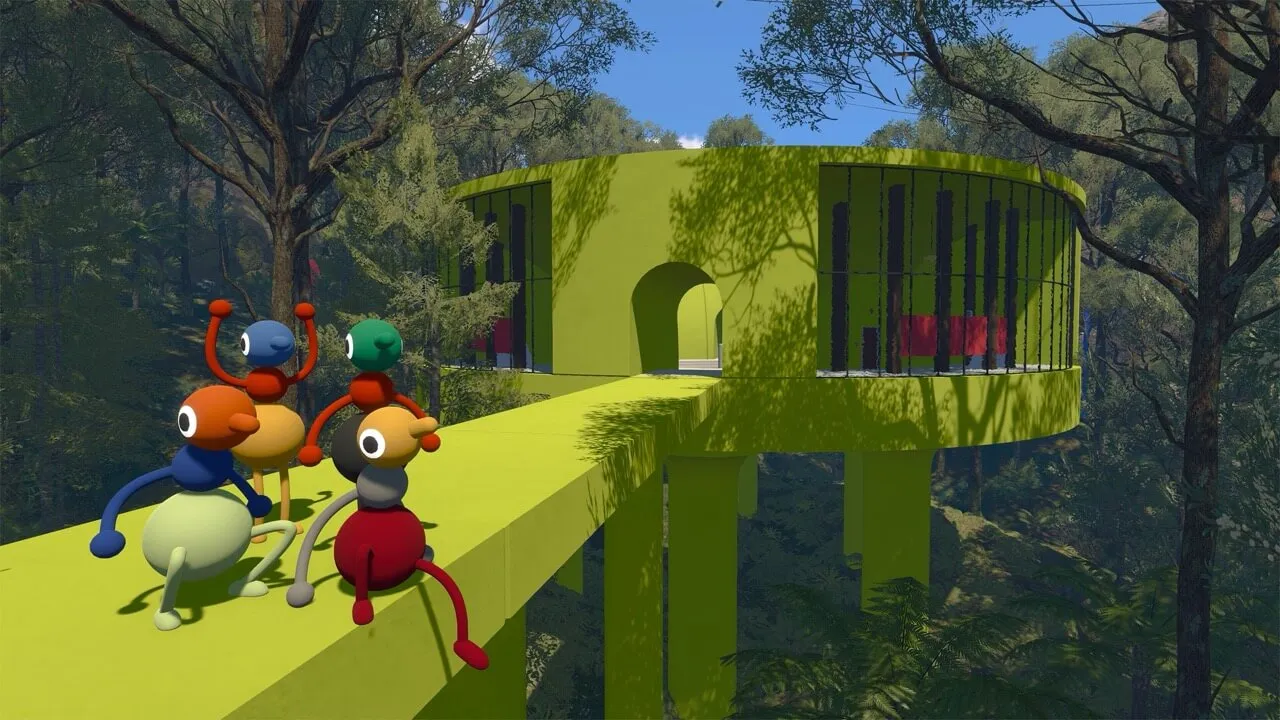
The island has five main regions: the starting drawbridge area, four colored towers (Red, Green, Blue, Yellow), and a finale. There's a natural order that minimizes backtracking:
Step 1: The Drawbridge (starting area)
Four puzzles — the Blue Room pattern match, the Green Structure simultaneous button press, the Mechanical Arm stack, and the Cave telescope grab. Slot the four gourds, pull the key, cut it, and the drawbridge lowers. This is the game's gentle on-ramp.
Step 2: Red Tower → the Map Room
The Red Tower needs five gourds (including a basketball hoop puzzle and a gesture-copying mountain puzzle). Its key unlocks the Map Room — which contains the foldable map and the GPS. This is the single most important unlock in the game. Every coordinate puzzle afterward, including the famous 4166 1899 puzzle, needs that map. Do not skip it.
The Green Tower and later areas are full of coordinate-hunting puzzles. The foldable map from the Map Room is required — without it you can't plot where to go.
Step 3: Green Tower → the chairlift
Five puzzles including the 4166, 1899 coordinate puzzle (plot the numbers on your map, walk to the rock, press the button). The Green Tower key activates the chairlift — a fast way across the map and the gateway toward the Blue and Yellow areas.
Step 4: Blue Tower → the train
Five puzzles near the lighthouse (Heavy Ball, Locked Yellow Room, Scaffold House, Color Tile, Beach Tower). The Blue Tower key activates the train station — three trains start looping the map, and it's also the route to a secret "shiny" room near the lighthouse. See the train guide for the full chain.
Step 5: Yellow Tower → the tunnels
The hardest area: a five-minute countdown, a double-telescope puzzle, a pattern house with turnstiles, a green flare gun puzzle, and more — plus a control-panel set (Easter Egg Hunt, Sound Check, Music Room) that houses its own secrets. The Yellow Tower key opens the tunnels toward the finale.
Step 6: The Black Tower & ending
Take the Yellow key to the barred wall — the point of no return — and the destination becomes visible: a large black sphere in the distance. Walk to it together, clear the final puzzle run, and the first ending plays. Afterward the game offers a remixed endgame with seven remix challenges — a different arrangement of the island with new secrets.
How Long Does Big Walk Take?
- Main path, focused group of 2–4: roughly 6–7 hours
- Exploring every puzzle, secret and the endgame remix: well past 10 hours
- IGN's review group: spent "nearly 20 delightful hours" across several sessions
The day-night cycle, group-size scaling, hidden secrets and the remix endgame all add replay value — and because progress lives in the host's save, a weekly recurring group session is exactly how the game is meant to be played.
Your First Session: A 10-Minute Setup Checklist
Before the group hits the open world, run through this once and you'll save an hour of mid-puzzle confusion later:
- Solo prep, five minutes. Have the future host load in alone, tune audio, confirm push-to-talk works while holding an object, and scout the starting playground. Everything done solo carries over when friends join.
- Host decides first. Agree on the permanent host before anyone creates a session — the host owns the save, and swapping hosts mid-run resets the world to the new host's state.
- Voice test in the tutorial. Everyone joins, then spread out until proximity voice fades to confirm you can hear each other at range. Test the walkie-talkie channel. If a player's voice is missing or distorted, fix it now — not inside the first locked-room puzzle.
- Agree on the signal language. "One jump means yes, repeated jumps means change it" plus "left point, right point, both arms up" covers 90% of the game's silent moments. Write it in the group chat before you need it.
- Decide the first goal. The natural first target is the drawbridge's four puzzles (Blue Room, Green Structure, Mechanical Arm, Cave Telescope). Getting the first key teaches the whole gourds → key → key-cutter loop in under an hour.
- Set the session cap. A first session with 3–4 players is the sweet spot. Twelve players on night one is chaos you can't hear over.
That's it — six decisions, ten minutes, and your group is set up for the exact experience the game was designed around. The biggest source of frustration in Big Walk isn't the puzzles; it's groups that never decided who hosts, never tested voice, and never agreed on signals.
Buying Advice: Price, PS Plus, and Who It's For
Big Walk costs $19.99 on Steam and consoles (launch discount brought it to $14.99 in week one). Two things make it even cheaper:
- PS Plus Essential members got Big Walk free in August 2026 as part of the monthly games lineup (confirmed by the PlayStation blog's August 2026 announcement)
- There's no demo and no free-to-play tier
Who should buy it: anyone with a regular co-op group. It's the rare game where the hang-out is the content. Who shouldn't: solo players, anyone expecting a single-player campaign, and anyone looking for combat. If you don't have a consistent group, you're buying a reason to organize one.
FAQ
What is Big Walk? A 2–12 player online co-op adventure by House House (Untitled Goose Game studio), published by Panic, where communication is the core mechanic. Out August 4, 2026 on PC, macOS, PS5 and Switch 2.
How do you progress in Big Walk? Every area runs on the same loop: solve 4–5 mini-puzzles, collect gourds, slot them into the key machine, cut the key at key cutters, and use it to unlock the next area or transport.
How many players do you need for Big Walk? Two is the minimum for a full playthrough; 3–6 is the comfortable sweet spot; up to 12 can join a session. Puzzles scale for 2/3/4-player groups.
Is Big Walk crossplay? Yes — PS5, PC, Switch 2 and macOS players play together via Join Codes. There's no Xbox version and no Game Pass.
How long does it take to beat Big Walk? A focused group finishes the main path in roughly 6–7 hours; full exploration plus the endgame remix pushes past 10 hours. IGN's group spent nearly 20 hours.
Can you play Big Walk solo? You can start a session alone and explore the starting area, but there's no solo mode — every puzzle requires at least two players.
Does Big Walk have local co-op? No — online co-op only, no couch co-op or splitscreen. One player per device.
Related Guides
- Big Walk Walkthrough — Complete Guide to Beating the Game
- Big Walk Puzzle Solutions — Every Puzzle Solved
- Big Walk Multiplayer & Co-op Guide — Player Count, Join Codes & Voice
- Big Walk Crossplay Guide — PS5, PC, Switch 2 & macOS
- Big Walk Coordinates & Secret Locations
- Big Walk Review — Is It Worth It in 2026?
- How to Start the Train in Big Walk
- Big Walk Price & PS Plus Free Month
Last updated: August 12, 2026.