Corsair Cove Guide — How to Play, Core Systems & Everything New (2026)
The complete Corsair Cove guide: what kind of game it is, Story vs Uncharted Mode, vertical city building, production chains, the Compass victory paths, Deeds, ships, naval combat, and how to start well in the pirate city builder from the Tropico 6 studio.
Corsair Cove Guide — How to Play, Core Systems & Everything New (2026)
Corsair Cove is a pirate-themed city builder from Limbic Entertainment (the studio behind Tropico 6), published by Hooded Horse and released on July 31, 2026 for PC and Xbox. Instead of building on a flat grid, you stack taverns, forges, and camps across cliff faces and hilltops, manage complex production chains from ale to flintlock pistols, and send fleets out to raid the Crown's ships. It's currently 86% positive on Steam (Very Positive) with a Metascore of 80 — a strong launch for the genre.
This guide walks through everything a new player needs: the two game modes, the vertical-building loop, how production chains and population work, what the Compass victory paths actually require, and how naval combat plays in practice.
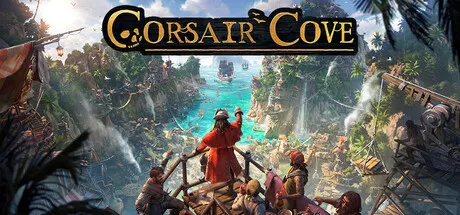
What Kind of Game Is Corsair Cove?
Corsair Cove is a vertical pirate city builder with a naval combat layer. The core fantasy: the Golden Age of Piracy is ending, the Crown's pirate hunters are taking over the seas, and you build one last pirate haven that can fight back. The official description from the Steam store page sums it up: "Build a sprawling pirate haven, raise a fleet to explore the high seas, and take on the Crown to keep the Age of Piracy alive!"
Concretely, the loop is:
- Build vertically — construction is not grid-bound; you place buildings on cliff faces, hilltops, and ledges, and move goods between levels with bridges, ziplines, and elevators.
- Run production chains — from raw materials (logs, rope fiber, cassava, stone, fish) to processed goods (planks, booze, rum, wine, cannonballs, black powder) to crew consumables (stew, hardtack, tobacco, medicine).
- Keep your population happy — Drifters work, Pirates fight, and every person needs food, booze, housing, and Cohesion (more on that below).
- Sail and raid — build piers, launch ships, explore a fog-of-war world map, and fight the Crown in turn-based dice-and-card naval battles.
- Progress the Compass — the game's four victory paths (Notoriety, Empire, Seafaring, Wealth), each with its own deeds and unlocks.
If you've played Tropico 6, the loop will feel familiar (same developer); if you're coming from Manor Lords or Against the Storm, the vertical logistics are the new muscle to learn. Either way, the first three hours are about food stability and links — everything else follows once your settlement stops leaking. Read on for the mode choice, the building order, and the mistakes that end first runs.
Corsair Cove is closer to Tropico 6 or Against the Storm than to Sid Meier's Pirates. There is no real-time sailing and no action combat — naval engagements are turn-based. Reviews (including Destructoid's 8/10 review) praise the settlement layer but warn that combat is an acquired taste.
Story Mode vs Uncharted Mode
At the start of a new game you pick one of two modes:
- Story Mode — the game opens with a guided tutorial (you escape Amara's ship and found the Plunderer's Pier), then follows a questline across the island: stabilize food and planks, earn your first Compass points, survive the first Crown attack, and unlock the world map. This is the recommended starting point and the mode the wiki content references.
- Uncharted Mode — a sandbox variant with no scripted intro; the IGN wiki describes it as "turning you loose on the seven seas" immediately. You still have the same core loop, but you set your own pace and goals.
The differences are mostly onboarding — the underlying production, population, Compass, and combat systems are identical in both modes.
The First Hour: Building Your First Settlement
The opening sequence in 1.0 follows a clear ladder (matching the structure laid out in the official wiki's Buildings section):
- Escape and land — the tutorial has you escape a Crown ship, land at a cove, and claim your first camp.
- Campfire first — the humble Campfire provides Stew at 16/min, which feeds your Galley. This is your food lifeline; don't let it stop.
- Planks and a Galley — you need planks from logs (saw pit or workshop) to build a Galley, which turns stew ingredients into meals your Drifters actually eat.
- Warehouse and links — build a Warehouse as a distribution hub; link production buildings to it so goods flow where they're needed. Warehouses can also act as transit hubs between far-flung camps.
- A pier and your first ship — once you have planks and rope, build a Shallow Pier or Trade Pier and launch your starter ship (the Landlubber).
The Campfire's 16/min output gets outgrown fast. The IGN tips guide recommends investing Notoriety points in Fireside Feast (16 → 31/min) and eventually switching to a Buccaneer's Grill, which converts Pigs into Stew at 35/min.
Vertical Building & Logistics
The defining twist of Corsair Cove is that buildings don't snap to a grid. You build on cliff faces and hilltops, which means:
- Ziplines and elevators move goods across chasms and up/down cliffs. These are logistics buildings, not decorations — a production chain that crosses a gap needs a link or your goods stall.
- Warehouses act as transit hubs — request resources in one Warehouse, then request the same goods from a second Warehouse to form a supply chain. The IGN wiki's Tenkiei warns: keep the number of resources stored in transit Warehouses low, or "thousands of resources rot in your supply chains."
- All Hands on Deck doubles worker count at a building for +50% output (with +50% input cost). Pair it with an Entertainers' Guildhall (Notoriety tree) to push the buff to +80% with no extra resource cost.
Population: Drifters and Pirates
There are two population types:
- Drifters are your workers — they staff production, gather resources, and keep the settlement running. You gain more through world-map events (rescuing castaways, community events, and prison-ship encounters) rather than just building more housing.
- Pirates are your fighting population — they crew ships and man defensive towers. Keeping them fed and supplied matters: an unhappy pirate base will constantly demand supplies from other bases, which is a common early complaint in Steam reviews.
Every person needs food, booze, and housing. Housing ranges from cheap Tents to Cabins (better satisfaction). Cohesion — the settlement-wide morale stat — drops when needs aren't met, and at zero Cohesion the game ends (game over).
Cohesion is the settlement's lifeline. It ticks down from unmet food, booze, and housing needs, and some events (refugee choices, bombardment losses) hit it directly. Treat Cohesion like a health bar — if it bottoms out, the run is over.
The Compass: Four Victory Paths
The Compass is Corsair Cove's tech/ambition tree and its victory system. It has four Principles, each a distinct path (matching the four ways to "win"):
| Principle | What it favors | Key unlocks (early) |
|---|---|---|
| Notoriety | Tavern culture, zipline logistics, crew scale | Fireside Feast, Entertainers' Guildhall, ziplines |
| Empire | Multi-camp expansion, governance, territory | Cabins, second camps, Iron Fist destroyer (late) |
| Seafaring | Fleet, hull upgrades, supply range, naval deeds | Moonlight prowler chain, better ships |
| Wealth | Trading, warehouse hubs, guilds | Trading Post, transport deeds, guild buildings |
Each Principle grants Principle Points when you complete Deeds — the game's 160 small quests (e.g., "stockpile 50 planks," "sell 100 coins' worth of goods," "win a naval battle"). Every region usually has at least one Ambition deed tied to it. The IGN Compass and Deeds guide notes you don't need to commit to one path forever — points spent can be reconsidered, though progress is best kept focused on one or two paths in the early game.
Core Buildings Quick Reference
Knowing which buildings matter (and when) is half the game. The official wiki's building list organizes everything into four classes — Community, Housing, Principal, and Production. The early-game ones worth memorizing:
| Building | Class | What it does | Notable cost (early) |
|---|---|---|---|
| Campfire | Production | Stew at 16/min — your food base | Cheap; upgrade via Fireside Feast / Grill |
| Galley | Community | Converts stew ingredients into meals | 20 Planks |
| Warehouse | Community | Distribution + transit hub | 10 Planks / 25 Coins |
| Tavern | Community | Consumes Booze/Rum/Wine for morale | 15 Planks |
| Shallow Pier | Community | Dock for your first ship | 30 Planks |
| Trade Pier | Community | Bigger dock, import/export capacity | 60 Planks / 60 Stone / 20 Rope / 500 Coins |
| Trading Post | Principal | Sells stockpiled resources for Coins | 50 Planks / 100 Coins (0 Wealth) |
| Small Gun Tower | Community | Early defense | 50 Stone / 10 Black Powder |
| Great Lighthouse | Principal | Halves global Pirate Upkeep | Mid-game principal |
Two notes from the data: Warehouse is dirt cheap and unlocks the whole logistics game, and Trade Pier is your first big plank/rope sink — plan plank production before you hit it (the resource area guide has the production planning details).
Logistics: Warehouses, Ziplines & Elevators
Corsair Cove's vertical world means logistics are a first-class system, not an afterthought:
- Warehouse chains — a Warehouse can demand goods, and a second Warehouse can then draw those goods, forming a transit line across your island. This is the fix for the "pirate base demands supplies from another base" friction that new players hit (see the pirates guide).
- Ziplines — the Notoriety tree's answer to moving goods across chasms; you unlock mast-and-elevator pairings that let production on one cliff feed consumers on another.
- Elevators — vertical transport between cliff levels; a full vertical layout runs harbor-floor industry up to peak-level luxury through a chain of these.
The community layout consensus (from the vertical-layout guides circulating in week one): keep raw flows short — process logs, stone, and cassava close to their deposits — and push finished goods up the cliffs. Long raw-material hauls are the #1 hidden production killer.
Region Progression: Skull Rock and Beyond
The world map opens after your first ship, and the region order shapes your mid-game (full detail in the walkthrough):
- Skull Rock — the first real region: salvage, Ambition deeds, and the first Crown fights. Your Tier 1 fleet's proving ground.
- Barbos Bay — a mid-game wall; the multi-turn defense encounter here is where unprepared players lose ships.
- Devil's Basin — a hostile basin with stronger Crown presence and harder salvage.
- House of Fortune — the gambling region (dice bets, house-favored odds, and a launch-week resolution bug — see the House of Fortune guide).
Each region carries at least one Ambition deed tied to its theme, and region exploration is its own Deed category — sailing everywhere is how you bank exploration progress without grinding fights.
What Players Actually Debate (Steam & Reddit)
The launch-week community conversation (from Steam reviews, discussions, and r/CorsairCove) clusters into five threads:
- Combat pacing — "turn-based menu clicker" vs "tense attrition war". The loudest split in the playerbase.
- Base supply friction — pirate bases demanding supplies that sit in other bases. Players either automate with Warehouse chains or get annoyed.
- House of Fortune bug — the dice-win-loses bug is the top bug thread (see the update guide).
- Tropico DNA — veterans of Limbic's Tropico 6 recognize the production/satisfaction loop instantly; newcomers find the first 2-3 hours rough.
- Demo-to-full progression — demo saves don't carry over, and the demo-vs-1.0 differences (Skull Rock is far bigger in 1.0) catch returning players.
If you're deciding whether to buy, that mix — strong building, divisive combat, active bug-fixing — is exactly what the review reflects in its 80 Metascore / Very Positive split.
Ships & Naval Combat
Ships are built at piers and crewed by Pirates. The starter Landlubber gets you through the opening; your first real choices come at Tier 2 (ships like the Steel Edge, Goldseeker, Azimuth, and Huracan, each favoring different roles — gun, boarding, or speed).
Combat is turn-based with dice and cards: you pick battle actions (fire cannons, board, support), crew stats determine your dice pool, and the Crown's ships roll against you. The official wiki's Ships section and IGN's Combat Guide both break down the symbols and action economy.
Steam reviews are split on naval combat — some find the dice-and-card system tense and strategic, others find it slow ("a turn-based menu clicker" is a common complaint in Steam discussions). If you buy for the city-building, the combat layer is worth learning but is not the main draw.
Platforms, Price, and Performance
- PC (Windows) on Steam, Epic, GOG, and Microsoft Store; PC Game Pass day one (July 31, 2026). An Xbox store page exists for the console version; no PlayStation or Switch versions have been announced (as of August 2026).
- Price: $39.99 MSRP, launched at 25% off ($29.99) through mid-August on Steam.
- Requirements: Windows 10 64-bit, DirectX 12, minimum GTX 1660 Super / 8 GB RAM, recommended RTX 2070, ~30 GB SSD. See the system requirements guide for the full table.
FAQ
What kind of game is Corsair Cove?
A single-player pirate-themed vertical city builder with turn-based naval combat, from Limbic Entertainment (Tropico 6), published by Hooded Horse, released July 31, 2026.
Is Corsair Cove multiplayer?
No — Corsair Cove is strictly single-player. There is no co-op or online mode; "multiplayer" searches usually come from players asking whether the Game Pass/console versions crossplay (they don't, because the game has no online component).
What is the Compass in Corsair Cove?
The Compass is the game's progression system: four Principles (Notoriety, Empire, Seafaring, Wealth) that you advance by completing 160 Deeds to earn Principle Points and unlock buildings, ships, and victory conditions.
How do you win Corsair Cove?
There's no single win condition — you win by completing a Principle path on the Compass (or by playing Uncharted Mode toward your own goals). Reaching the end of a Principle path is the closest thing to a victory screen.
Who makes Corsair Cove?
Developed by Limbic Entertainment (Tropico 6) and published by Hooded Horse (Manor Lords, Against the Storm, Old World).
Related Guides
- Corsair Cove Beginner's Guide — First Hour, Stew, Cohesion & Mistakes to Avoid
- Corsair Cove Walkthrough — Story Mode, Quests & Uncharted Mode
- Corsair Cove Review — Is It Worth It? Scores, Pros & Cons
- Corsair Cove Wiki — Official Wiki, Fan Databases & All Resources
- Corsair Cove Ships Guide — All Ship Tiers & Best Starter Fleet
- Corsair Cove Combat Guide — How Naval Battles Work
Official resources: Steam store page · IGN game page · Official wiki · Hooded Horse product page