Corsair Cove naval combat explained: the turn-based system, battle vs support actions, ship and crew stats, dice pools, and strategies that win Crown fights.
Corsair Cove Combat Guide — How Naval Battles Work, Actions & Winning Fights
Corsair Cove's naval combat is turn-based and driven by dice and actions — the IGN Combat Guide breaks it into battle actions and support actions, and it's the most divisive system in the game. This guide explains how the system actually works, what the symbols and actions mean, and how to win the fights that matter — including the quirks (and one balance complaint) the community has documented.
How Combat Works: The Core Loop
Naval battles in Corsair Cove are turn-based encounters between your ship and an enemy (usually a Crown pirate hunter):
- Each turn you choose from available battle actions and support actions.
- Your ship and crew stats determine your dice pool — the higher the relevant stat, the more (and better) dice you roll.
- The enemy rolls against you; outcomes resolve into damage, boarding, or status effects.
- Combat ends when one side's hull reaches zero (or a scripted condition is met, in quest battles).
The IGN Combat Guide documents the full symbol key ("Combat Symbols") and the action economy in detail — it's the best reference for what each icon means.
There's no real-time ship control. If you came from action pirate games (Skull & Bones, Black Flag), this will feel like a board game bolted onto a city builder. Some love it; a vocal group calls it "a turn-based menu clicker" on the Steam discussions.
Battle Actions vs Support Actions
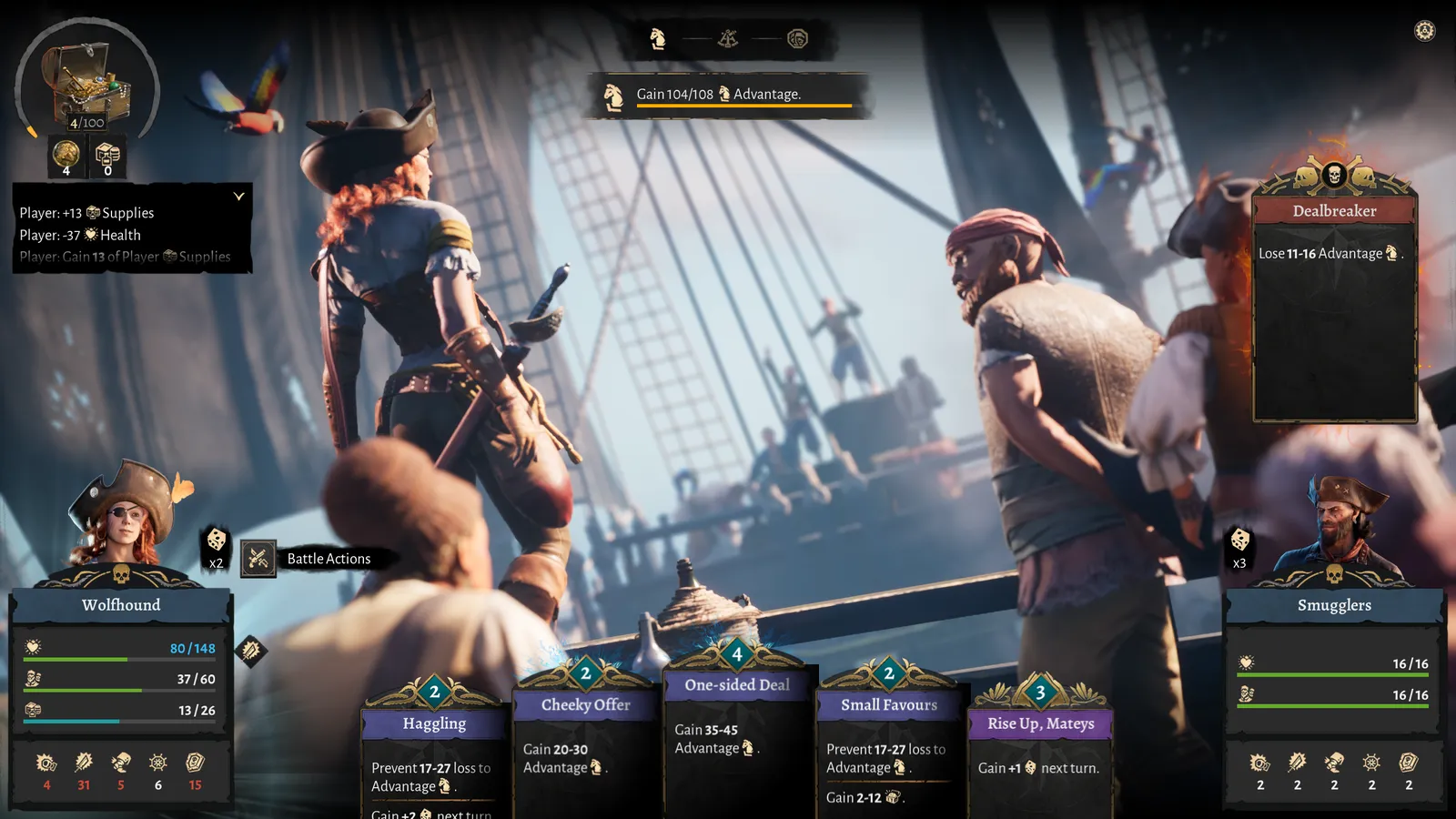
The action economy splits into two families (per IGN):
- Battle actions — offensive/defensive core moves: fire cannons, board, brace, repair. These are your main damage and mitigation tools.
- Support actions — crew-driven specials that modify the fight: focus fire, crew rally, tactical buffs. They often cost a support resource (like morale/command points) and are where captain and crew quality show.
The practical takeaway: battle actions win fights; support actions win the fights that matter. Wasting support resources on easy wins leaves you empty for the next Crown engagement.
The Stats That Drive Combat
Ship and crew stats determine your dice:
- Gun — cannon attack dice.
- Boarding — boarding action dice (and crew damage).
- Speed — initiative/order and escape.
- Hull/HP — how many hits you take.
- Crew — the sailors who make actions possible; crew loss weakens your dice pool.
See the ships guide for how these map onto hull choices (gun/board/speed roles).
How to Win Naval Battles
From the community first-week play:
- Bring the right hull — a Tier 2 ship with a role (gun or speed) beats the starter Landlubber far more than any single combat decision. Fleet quality > in-fight tactics.
- Focus fire one enemy at a time — spreading cannon across two ships lets both live longer than killing one first.
- Brace before big incoming turns — when the enemy lines up a heavy attack, spend your action on brace/repair instead of a third cannon shot.
- Keep crew topped up — crew loss weakens your dice pool every turn after; repair and crew-restore support actions between fights matter.
- Know when to retreat — speed hulls can escape fights you can't win. Losing a ship to a bad matchup is how early runs bleed.
Ships carry damage between fights unless repaired at a pier. A half-hull ship entering the next battle is a dead ship — port after every major fight.
The Balance Quirk: Dead Crews Keep Fighting
One of the most-reported combat complaints on Steam in launch week:
- Enemy ships keep attacking after their crew is killed, while your ship loses as soon as your crew dies — even at full HP ("my ship lost even at full HP" became the standard complaint).
- This makes crew-kill strategies feel unfair and makes losing feel cheap.
- Expect patch fixes here (balance tuning is typical for launch-week combat); check the update guide for patch notes.
With the crew-resolution quirk live, an enemy can outlast you on dead-crew technicality. Play for hull damage and full destruction rather than "kill their crew" strategies.
Is Combat Good? The Verdict So Far
- Pro: it's a tense, attrition-based system with real ship-building depth (hulls + captains + crew stats).
- Con: it's slow, it doesn't match the city-builder pacing for many players, and launch-week balance quirks (dead-crew fights, House of Fortune-style event bugs) undermine it.
- Reality: reviewers scored the game ~80 despite the mixed combat reaction — the settlement layer carries it. Treat combat as a system to learn, not the reason to buy (see the review).
FAQ
How does combat work in Corsair Cove?
Turn-based dice-and-actions: choose battle/support actions each turn; ship and crew stats set your dice pool; reduce the enemy hull to zero to win.
What are battle actions in Corsair Cove?
The core offensive/defensive moves — fire cannons, board, brace, repair — while support actions are crew-driven buffs and specials that modify the fight.
How do I win naval battles in Corsair Cove?
Bring a role-appropriate hull, focus fire one enemy at a time, brace on heavy incoming turns, keep crew topped up, and retreat when outmatched.
Is naval combat good in Corsair Cove?
Divisive — tense and deep for some, slow and mismatched for others. Reviewers scored the game ~80 despite it; the settlement layer is the main draw.
Why did I lose when the enemy crew was dead?
A launch-week balance quirk lets enemy ships keep fighting after their crew dies while you lose on crew death. Play for hull kills until patched.
Related Guides
- Corsair Cove How to Get More Pirates — Crew & Fighting Units
- Corsair Cove Wine Guide — Booze, Rum & Tavern Production
- Corsair Cove House of Fortune — Gambling, Dice & Known Bugs
- Corsair Cove Trading Post — Sell Resources & Make Coins
- Corsair Cove Mods Guide — Support, Fan Tools & What Works
Official resources: IGN — Combat Guide · Steam Community · Official wiki · Wikipedia
More Corsair Cove Guides
Corsair Cove PC system requirements: official minimum and recommended specs (CPU, GPU, RAM, storage), performance notes, and whether your PC can run it.
The Corsair Cove Trading Post explained: how to unlock it, build cost, how selling resources works, the most profitable goods, and the Wealth path to victory.
Every good Corsair Cove wiki and database: the official Hooded Horse wiki, IGN's guide, and fan databases for resources, buildings, deeds, and the community.
How wine works in Corsair Cove: the Booze → Rum → Wine production chain, what taverns consume, why pirate morale needs alcohol, and how raid loot fits in.