The Baldur's Gate trilogy explained: BG1, BG2 and BG3 release history, the Bhaalspawn saga, Enhanced Editions, the best play order, and what to buy in 2026.
Baldur's Gate Trilogy: Every Game in the Series, Explained
The "Baldur's Gate trilogy" means two slightly different things depending on who you ask. To classic CRPG fans it means the Bhaalspawn saga — Baldur's Gate (1998), Baldur's Gate II: Shadows of Amn (2000) and its expansion Throne of Bhaal (2001), one continuous story built on BioWare's Infinity Engine. To everyone who showed up in 2023, it means those two classics plus Baldur's Gate 3 — Larian Studios' record-breaking Dungeons & Dragons epic that became one of the best-selling RPGs ever made. Both definitions are correct, and this guide covers the whole picture: what each game is, how the saga connects, which order to play them in, and exactly what to buy if you're starting fresh in 2026.
The short answer for most people: play BG3 first if you want the modern experience, then decide whether the 2D-era originals are for you. The long answer — with the full history, the timeline, and the buying breakdown — is below.
Official resources: Steam store page — Baldur's Gate 3 · Steam — Baldur's Gate: Enhanced Edition · Steam — Baldur's Gate II: Enhanced Edition · bg3.wiki · Larian Studios
What Exactly Is the Baldur's Gate Trilogy?
Baldur's Gate is a series of computer RPGs set in the Forgotten Realms, the most popular campaign setting of Dungeons & Dragons. The games take place in and around the city of Baldur's Gate, a major trading port on the Sword Coast of Faerûn, but the story ranges across much of the continent.
The "trilogy" label comes from the original design. BioWare and publisher Interplay originally planned the first game as part of a trilogy following one protagonist — the Bhaalspawn, a mortal child of the dead god of murder, Bhaal. The first game (Baldur's Gate), its sequel (Shadows of Amn) and that sequel's expansion (Throne of Bhaal) form one complete, unbroken story arc, which is why the community shorthand "BG1 > BG2 > ToB" is called the trilogy run. The games let you import your character from one to the next, so a single hero's journey runs all the way through.
Baldur's Gate 3 complicates the label. It's a direct sequel in name and setting — set in the same world, more than 120 years later — but it stars a completely new protagonist and is built on a completely different ruleset (Dungeons & Dragons 5th Edition instead of AD&D 2nd Edition). Larian's game is the third numbered entry, so in the modern marketing sense the trilogy is BG1, BG2 and BG3. Purists will tell you the "real" trilogy ended in 2001, and there's something to that, but both readings are useful: the old trilogy is one story, and the franchise is three games.
If someone says "play the trilogy," check whether they mean the Bhaalspawn saga (BG1 → BG2 → Throne of Bhaal) or the numbered series (BG1 → BG2 → BG3). This guide covers both, because the buying decisions overlap.
Every Baldur's Gate Game in Release Order
| # | Game | Year | Developer | Ruleset | Notes |
|---|---|---|---|---|---|
| 1 | Baldur's Gate | 1998 | BioWare | AD&D 2e | The original; won the 1998 Origins Award for Best RPG |
| 2 | Baldur's Gate: Tales of the Sword Coast | 1999 | BioWare | AD&D 2e | First expansion; adds Durlag's Tower and Ulgoth's Beard |
| 3 | Baldur's Gate II: Shadows of Amn | 2000 | BioWare | AD&D 2e | Widely considered one of the greatest RPGs ever made (Metacritic 95) |
| 4 | Baldur's Gate II: Throne of Bhaal | 2001 | BioWare | AD&D 2e | Expansion; concludes the Bhaalspawn saga |
| 5 | Baldur's Gate: Dark Alliance (and II) | 2001–2004 | Snowblind / Black Isle | D&D 3e | Action-RPG spinoffs on consoles; not part of the main story |
| 6 | Baldur's Gate: Enhanced Edition | 2012 | Overhaul/Beamdog | AD&D 2e | Remaster of BG1 + TotSC, plus new content |
| 7 | Baldur's Gate II: Enhanced Edition | 2013 | Overhaul/Beamdog | AD&D 2e | Remaster of BG2 + ToB, plus new content |
| 8 | Baldur's Gate: Siege of Dragonspear | 2016 | Beamdog | AD&D 2e | New interquel expansion set between BG1 and BG2 |
| 9 | Baldur's Gate 3 | 2023 | Larian Studios | D&D 5e | Early Access 2020; full release August 3, 2023 |
There are also two cancelled or forgotten projects worth knowing about: Baldur's Gate III: The Black Hound, a Black Isle Studios sequel that was scrapped in the early 2000s, and a trilogy of tie-in novels that the community largely agrees are not good. Neither matters for actually playing the games.
Baldur's Gate (1998): Where the Legend Started
Released on December 21, 1998, the first Baldur's Gate shipped on five CD-ROMs and was, at the time, an absurdly ambitious project. BioWare built it on a brand-new engine — the Infinity Engine — that rendered an isometric 2D world with pre-rendered backgrounds, and it married the top-down tactical combat of the era with something most RPGs didn't have: a genuinely reactive, open world where you could go almost anywhere, talk to anyone, and kill anyone.
You play the ward of the wizard Gorion, raised in a fortress library in the Sword Coast wilderness, who is forced to flee when the fortress is attacked on the eve of your coming of age. From there the plot unfolds around a conspiracy to assassinate the iron-producing region of the Sword Coast and, eventually, the revelation that you are a Bhaalspawn — one of many mortal children of the murdered god Bhaal, and the target of a shadowy cabal. The main villain, Sarevok, remains one of the most memorable antagonists in CRPG history.
Mechanically, BG1 is a product of its time and proud of it. It runs on Advanced Dungeons & Dragons 2nd Edition rules: THAC0 (lower is better), negative armor classes, percentile strength, class kits, dual-classing and multiclassing for demihumans. The game does not hold your hand — the first hour consists of dying to wolves, bandits and the occasional gibberling, and the map is dotted with areas that will happily kill a level-1 party. That difficulty curve is part of the appeal, and it's also the reason the Enhanced Editions added a "story mode"-adjacent difficulty slider.
AD&D 2e armor class works backwards from what modern D&D players expect: lower AC is better, and hitting someone involves consulting THAC0 (To Hit Armor Class 0) tables. The Enhanced Editions keep this math. If you only know 5th Edition D&D, the originals will feel alien at first — that's normal, and it gets intuitive fast.
The reception was enormous. Baldur's Gate won the Origins Award for Best Role-Playing Game of 1998, took the Interactive Achievement Award for PC RPG of the Year, and effectively created the modern Western RPG market. Its 1999 expansion, Tales of the Sword Coast, added the infamous Durlag's Tower dungeon and is now bundled into every modern version.
Baldur's Gate II: Shadows of Amn (2000): The Masterpiece
Baldur's Gate II: Shadows of Amn, released in September 2000, took everything the first game did and made it bigger, deeper and more personal. The story opens with you and your companions imprisoned by the sadistic mage Jon Irenicus, who wants to extract the divine essence of your Bhaalspawn heritage. The escape sequence — which involves being tortured in a dungeon while Irenicus monologues — is a legendary opening that immediately raises the stakes beyond the first game's relatively gentle start.
The game moves the action from the wilderness to the sprawling city of Athkatla in the nation of Amn, and from there into some of the most famous dungeons in RPG history: the sewers beneath the city, the planar prison of the Spellhold, and the Underdark. It also added what became the series' signature feature: companions with personality. Party members banter with each other, fall in and out of love, argue, and pursue their own agendas, and the game's romance system was groundbreaking for 2000. Jaheira, Minsc, Aerie, Keldorn, Edwin, Viconia — the cast is the reason the game is still discussed today.
Shadows of Amn holds a Metacritic score of 95 and sold more than two million copies. IGN, GameSpot and GameSpy all named it RPG of the Year 2000, and it routinely appears on "greatest games of all time" lists — often in the top ten. Its June 2001 expansion, Throne of Bhaal, concluded the Bhaalspawn saga with a 10th-level-plus campaign, the huge Watcher's Keep dungeon, and a finale in which you decide the fate of Bhaal's divine essence — including, famously, the option to become a god yourself.
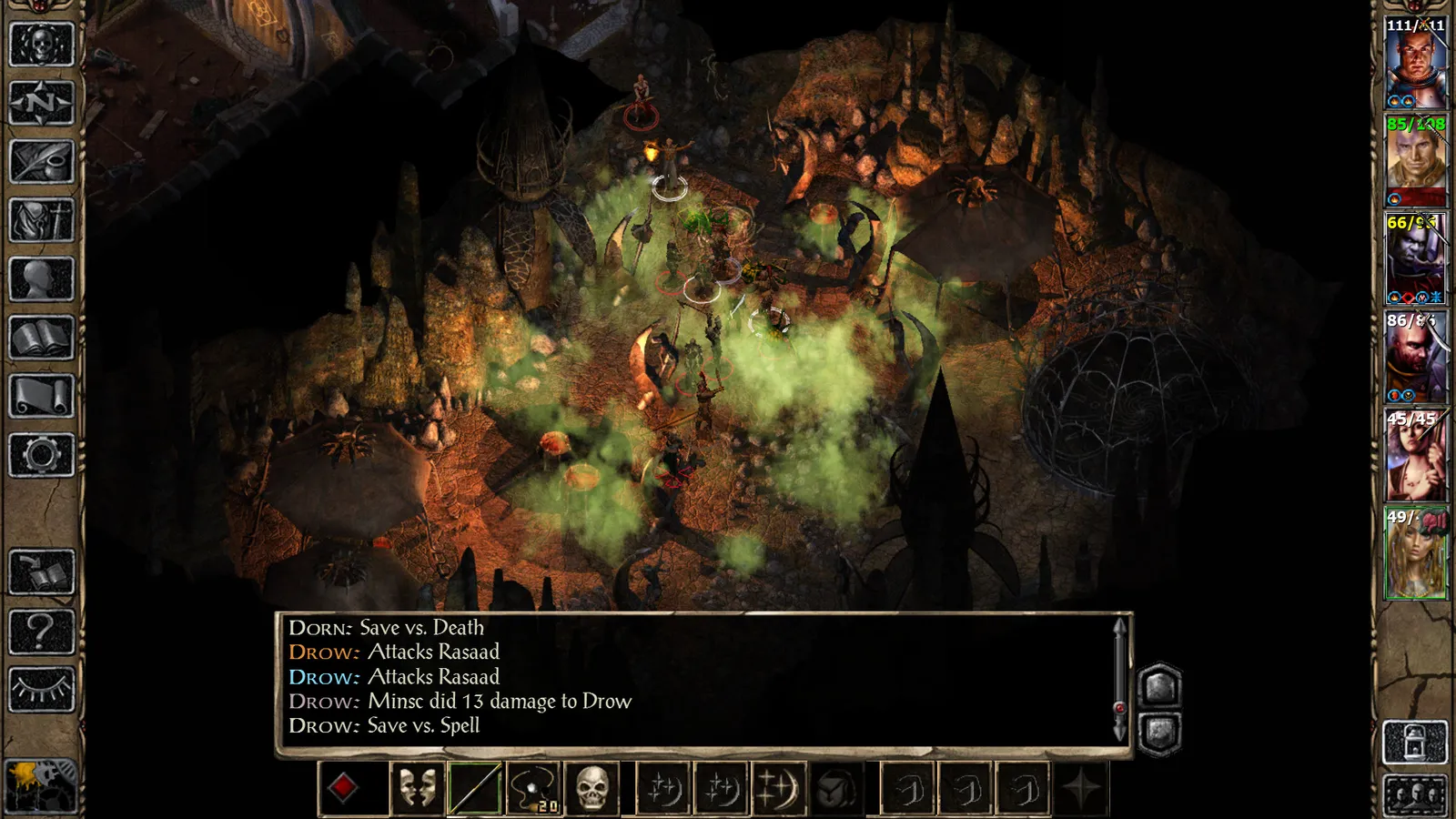
Per the official Beamdog page for Baldur's Gate II: Enhanced Edition, the enhanced edition bundles Shadows of Amn and Throne of Bhaal together "in this thrilling conclusion to the Bhaalspawn saga, and delve into the treasure-filled halls of Watcher's Keep."
Baldur's Gate 3 (2023): The Modern Revolution
For 23 years, the series sat dormant as a mainline franchise. Then Larian Studios — the Belgian studio behind the Divinity: Original Sin series — announced in 2019 that it had secured the license from Wizards of the Coast and was making Baldur's Gate 3. The game entered Early Access on Steam on October 6, 2020 with only the first act playable and a deliberately limited roster of races and classes; Early Access itself sold 2.5 million copies before full release.
The full game launched on August 3, 2023 for PC, followed by PlayStation 5 on September 6, macOS in late September, and Xbox Series X|S on December 7, 2023. The launch was a phenomenon: it hit a Metacritic score of 96 on PC and PS5, became the highest-scoring game of 2023, and won Game of the Year at all five major award ceremonies — the Golden Joysticks, The Game Awards, the DICE Awards, the Game Developers Choice Awards and the BAFTAs — a feat no game had achieved before.
Commercially it dwarfed everything else Larian had made. By February 2024 Larian's publishing director confirmed the game had "way over" 10 million players; by the end of 2024 it had sold roughly 15 million copies, and by the end of 2025 that figure passed 20 million. Larian posted €249 million in pre-tax profit in 2023 alone.
Gameplay-wise, BG3 is a completely different beast from its predecessors: fully 3D, turn-based, built on D&D 5th Edition, with a party of four, 12 classes and 46 subclasses, full voice acting for every line of dialogue, and a level cap of 12. It's set more than 120 years after Shadows of Amn and shares only the setting and a few familiar names with the classic games. For the full onboarding — character creation, combat, party building and the Act 1 roadmap — see our complete Baldur's Gate 3 guide.
The Enhanced Editions: How to Play the Originals Today
If you want to play BG1 and BG2 in 2026, you're almost certainly playing the Enhanced Editions, and that's the right call. Beamdog's Overhaul Games remastered the two classics to run on modern systems:
- Baldur's Gate: Enhanced Edition (November 28, 2012) bundles the original game and Tales of the Sword Coast, adds widescreen support, quality-of-life improvements imported from the BG2 engine, three new companions (the sorceress Neera, the blackguard Dorn and the monk Rasaad) with their own quests, and a separate arena campaign called The Black Pits.
- Baldur's Gate II: Enhanced Edition (November 15, 2013) bundles Shadows of Amn and Throne of Bhaal, adds new companions (including the duergar rogue Hexxat and the ranger Wilson — yes, a bear), The Black Pits II, and the same widescreen and UI modernizations.
Both EE versions were ported to PlayStation 4, Xbox One and Nintendo Switch in October 2019, so the entire classic saga is playable on modern consoles too. On PC they're $19.99 each on Steam; BG3 is $59.99.
In 2016, Beamdog also produced the first new content in the saga in over a decade: Baldur's Gate: Siege of Dragonspear, an expansion for BG1's Enhanced Edition set between the end of the first game and the beginning of Shadows of Amn. It's a full 25–30 hour campaign across about 70 new areas, introduces the Shaman class, and bridges the narrative gap that used to be handled by a text summary. It received mixed reviews on release (a controversy over a dropped line of dialogue did it no favors), but most players agree it's a solid interquel — the main consideration is that it's best played immediately after BG1, which means committing to the full saga run.
Always the Enhanced Editions. They're the same price as nothing, they run on any modern PC without mods, and they include everything the originals had plus the extras. The only reason to seek out the 1998/2000 originals is nostalgia or modding archaeology.
The Story So Far: Bhaalspawn Saga and BG3's Timeline
Here's how the narrative actually fits together, because it's the most common source of confusion for new players.
The Bhaalspawn saga (BG1 → BG2 → ToB) takes place in the late 1360s DR, in the aftermath of the Time of Troubles — a period in Forgotten Realms history when the gods walked the mortal world, and the god of murder, Bhaal, died. Before his death he sowed his essence across many mortal children, the Bhaalspawn. The saga follows one of them: from the death of your foster father Gorion in the wilderness, through the conspiracy of Sarevok (who turns out to be another Bhaalspawn), into the captivity of Jon Irenicus in Amn, and finally into the divine politics of the Bhaalspawn crisis that ends with the fate of Bhaal's essence decided — mortally or divinely.
Baldur's Gate 3 takes place in 1492 DR, more than 120 years later (the exact gap is roughly 124 years). It features a brand-new protagonist infected with a mind flayer tadpole, and its plot — involving a cult of the "Absolute" and three Chosen — is its own story. It connects to the old games in three ways:
- The city: Baldur's Gate itself is the setting of Act 3, and you'll see how it's grown since the 1360s.
- Familiar faces: a small number of characters from the saga survive into BG3 — most notably the druid Jaheira and the ranger Minsc, both of whom are recruitable companions.
- Thematic continuity: the Bhaalspawn crisis left a mark on Faerûn's religion and politics, and several BG3 characters reference it.
Per the bg3.wiki timeline, the events of Baldur's Gate 3 take place in the year 1492 DR — over a century after the Bhaalspawn saga's 1368–1369 DR events.
You do not need to play the old games to understand BG3 — Larian wrote it so new players could jump in blind, and the sales numbers make it obvious most of BG3's 20-million-plus audience arrived with no prior Baldur's Gate experience (the classics sold about five million copies across all releases as of 2006). But the old games do enrich it: when Jaheira talks about her late husband, when Minsc shouts about "boo," when you walk the streets of the city you saved decades ago in-universe, it lands harder if you were there.
What Order Should You Play the Trilogy?
There are three sensible routes, depending on your appetite for old-school CRPGs.
Route 1 — Classic saga run (for purists): BG1:EE → Siege of Dragonspear (optional) → BG2:EE (which includes Throne of Bhaal). This is the complete Bhaalspawn saga, one character imported through the whole arc, and it's what veterans mean by "the trilogy." Expect ~40 hours for BG1, ~15 for SoD, and 80+ for BG2+ToB if you do everything. The catch: you're committing to AD&D 2e mechanics and 1998-era interface conventions.
Route 2 — Straight to BG3 (for most people): Play Baldur's Gate 3 first. It's the modern, accessible, fully-voiced entry, it's the one that won every GOTY award, and it needs zero knowledge of the older games. If you fall in love with the world and want the historical deep dive, then go back to the Enhanced Editions — they're cheap and hold up surprisingly well. This is the route I recommend to anyone who isn't already a CRPG veteran.
Route 3 — BG2 alone (for the time-poor): Many long-time players will tell you that if you only play one of the classics, make it Shadows of Amn. It's the best-written, best-paced game in the saga, and it includes a brief recap of BG1. You'll miss the continuity of your own imported character, but the game stands alone well enough.
The biggest mistake new players make is buying BG1:EE or BG2:EE expecting Baldur's Gate 3 with old graphics. They're real-time-with-pause, 2D, text-heavy, ruleset-arcane games from a different era. The Enhanced Editions smooth the edges but they can't change the genre. If that sounds like a dealbreaker, start with BG3 — it is, by any measure, the most beginner-friendly entry in the franchise.
Save transfer note: within the Bhaalspawn saga, character import is fully supported (BG1 → BG2 → ToB), and it's one of the great payoffs of the old games — you keep your stats, your reputation, and your party relationships. Nothing transfers between the saga and BG3; the 120-year gap makes that impossible, and Larian didn't try.
How Long Is the Whole Trilogy?
This is the question everyone actually wants answered, so here are the real numbers:
| Game | Main story | With side content | 100% completionist |
|---|---|---|---|
| Baldur's Gate (+TotSC) | 30–40 hours | 50–60 hours | 70+ hours |
| Siege of Dragonspear | 15–20 hours | 25–30 hours | 35 hours |
| Baldur's Gate II (+ToB) | 50–60 hours | 80–100 hours | 120+ hours |
| Baldur's Gate 3 | 60–80 hours | 100–150 hours | 200+ hours |
Add it all up and a full saga run is realistically 150–250 hours, while a BG3-only playthrough is 100+ hours. BG3's Act 1 alone is commonly reported at 40–60 hours for thorough players. These are estimates from player reports and guide sites rather than official figures — Larian has never published completion-time data — but they're consistent across the community.
Buying Guide: What to Buy in 2026
Here's the practical shopping list (Steam US pricing, verified via the Steam store for the three main games):
- Baldur's Gate: Enhanced Edition — $19.99. Includes BG1 + Tales of the Sword Coast + Black Pits + new companions.
- Baldur's Gate II: Enhanced Edition — $19.99. Includes Shadows of Amn + Throne of Bhaal + Black Pits II + new companions.
- Baldur's Gate: Siege of Dragonspear — sold separately, frequently discounted. Only worth it if you're doing the full saga run; it requires BG1:EE.
- Baldur's Gate 3 — $59.99. The Digital Deluxe edition (extra cosmetics, digital artbook, soundtrack, and the Divinity: Original Sin 2 armor set) runs higher and occasionally bundles with a Deluxe soundtrack upgrade.
All three main games go on sale regularly — the EE games frequently drop to $5–10 during Steam sales, and BG3 has been discounted to ~$47 during major events. If you're budget-conscious, wait for a sale and buy the EEs first; they're older and their discount is deeper. If you're buying one thing, buy BG3.
Platforms: the EE games run on PC, Mac, Linux, PS4, Xbox One and Switch; BG3 runs on PC, Mac, PS5 and Xbox Series X|S (with split-screen co-op on all platforms except Xbox Series S, and full crossplay added in the 2025 Patch 8 update).
Is the Baldur's Gate Trilogy Worth It in 2026?
Unambiguously, yes — with one caveat about expectations. Baldur's Gate 3 is one of the most critically and commercially successful RPGs ever made, a 20-million-copy, every-major-GOTY-winning milestone that the CRPG genre had never seen before, and it's fully playable right now with all its content patches shipped. The Enhanced Editions are two of the most historically important games in the genre, available for the price of a sandwich, and they remain the reference point for what "player freedom in an RPG" means — over 25 years on, almost nothing has matched BG2's combination of companion writing, dungeon design and mechanical depth.
The caveat is honest: the classics are old, and they play old. If you try BG1 and bounce off the real-time-with-pause combat or the THAC0 math, that's not a personal failing — it's a 1998 game. Play BG3, enjoy it, and treat the saga as optional archaeology. But if the idea of a single character's journey from an orphaned ward to a demigod deciding the fate of a dead god's essence appeals to you, there is nothing else quite like the original trilogy, then or now.
If party-based, freeform RPGs are your thing, our Kenshi beginner's guide covers another take on squad-driven open worlds, and the RimWorld beginner's guide is worth a look if the "reactive world generates your story" side of BG3 is what hooked you.
Frequently Asked Questions
Is Baldur's Gate 3 connected to BG1 and BG2?
Yes, but loosely. It's set in the same world (the Forgotten Realms), in the same city, more than 120 years after Shadows of Amn, and it features two returning companions from the classic saga (Jaheira and Minsc). But it has a brand-new protagonist, a new story, and a new ruleset, and it was designed to be played with zero knowledge of the earlier games.
Do I need to play BG1 and BG2 before Baldur's Gate 3?
No. BG3 is deliberately newcomer-friendly and was the first Baldur's Gate game for most of its 20-million-plus players. The old games enrich the experience but are entirely optional — see our Baldur's Gate 3 guide to get started.
What is the best order to play the Baldur's Gate trilogy?
For most players: Baldur's Gate 3 first, then the Enhanced Editions if you want the saga. For purists doing the full Bhaalspawn run: BG1:EE → Siege of Dragonspear → BG2:EE (which contains Throne of Bhaal), importing your character through all three.
How long does it take to finish the whole trilogy?
A complete saga run (BG1 through Throne of Bhaal) is roughly 150–250 hours. A single BG3 playthrough is 100+ hours, with thorough runs stretching well past that. These are community estimates; Larian publishes no official figures.
Are the Enhanced Editions worth it in 2026?
Yes — they're the definitive way to play the classics: widescreen, bug fixes, restored content, new companions and new campaigns for $19.99 each, and they're on modern consoles too. Just know they're 1998/2000-era games under the polish.
Related Guides
- Baldur's Gate 3 Guide — how to play, build a party, and survive the first act
- Kenshi Beginner's Guide — party-based open-world survival RPG
- RimWorld Beginner's Guide — a different take on emergent storytelling
Last updated: August 13, 2026.
More Baldur's Gate 3 Guides
The best official Baldur's Gate 3 merch: Larian's store, the Deluxe Edition, official books (including the Astarion novel) and the collectibles worth buying.
Complete Baldur's Gate 3 mod guide: the official in-game mod manager, the Toolkit, how to install mods on PC and console, and the best community mods.
How to start a new Baldur's Gate 3 campaign: game modes, Honour Mode rules, Custom Mode, modded runs, Dark Urge, and Act 3 secrets worth a second playthrough.
Every major Baldur's Gate 3 patch explained: Patch 1 through Patch 8, Honour Mode, the mod manager, crossplay, photo mode, and where to read official notes.
Baldur's Gate 3 PC requirements: official minimum and recommended specs, storage and SSD warnings, Steam Deck support, and real 1080p performance.
How to buy a Baldur's Gate 3 physical copy: the Deluxe Edition box for PS5, Xbox and PC, discs, contents, price, and where to find one in 2026.
Baldur's Gate 3 price history: the $59.99 base price, standard $44.99 sale discounts, Deluxe upgrade pricing, CD key safety and when to buy on each platform.
The Baldur's Gate 3 review, three years on: critic scores, what makes it great, the honest criticisms, sales, and whether it's worth buying in 2026.